

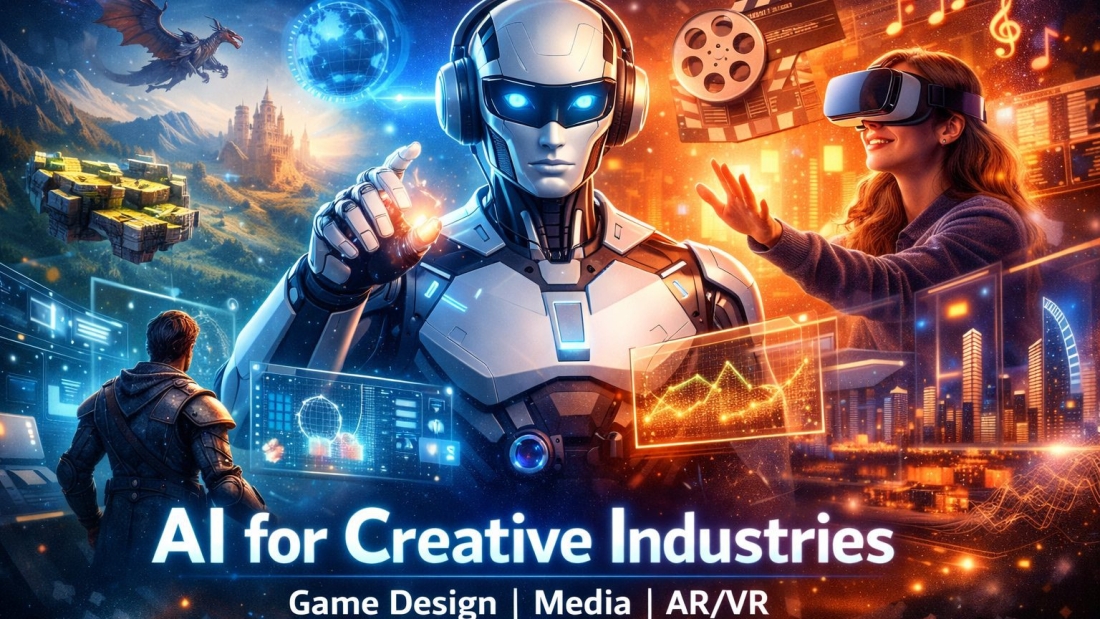
Introduction to AI in Creative Industries
Creative industries have always been powered by imagination, emotion, and storytelling. From video games and films to immersive AR/VR experiences, creativity sits at the core. Now, artificial intelligence is stepping into this space—not as a threat, but as a powerful collaborator.
AI for creative industries is no longer a futuristic idea. It’s already shaping how games are built, how movies are edited, and how virtual worlds feel alive. Think of AI as a supercharged creative assistant that never sleeps and keeps learning.
What Makes Creative Industries Unique
Unlike traditional industries, creative fields rely heavily on originality, aesthetics, and emotional impact. Every project is different. Every audience reaction matters. That’s why AI’s ability to learn patterns, styles, and preferences is incredibly valuable here.
Why AI Is a Game-Changer for Creativity
AI removes repetitive grunt work and opens space for imagination. Instead of spending weeks on technical tasks, creators can focus on ideas, storytelling, and innovation. It’s like having an extra brain that handles the heavy lifting.
Understanding AI as a Creative Partner
AI vs Human Creativity
Let’s clear one thing up: AI doesn’t “feel” creativity. Humans do. What AI does brilliantly is analyze, predict, and generate variations at lightning speed. The magic happens when human intuition meets machine intelligence.
Augmentation, Not Replacement
AI enhances creative workflows instead of replacing artists, designers, or writers. It’s similar to how Photoshop didn’t kill graphic design—it revolutionized it.
AI in Game Design
Gaming is one of the biggest winners when it comes to AI adoption. From smarter characters to endless worlds, AI is changing how games are built and played.
Procedural Content Generation
AI can generate levels, maps, environments, and even quests automatically. This means:
- Larger game worlds
- Faster development cycles
- Endless replayability
It’s like planting a seed and watching an entire universe grow on its own.
AI-Powered NPC Behavior
Gone are the days of robotic non-playable characters.
Smarter Game Worlds
AI-driven NPCs can:
- React to player behavior
- Learn from interactions
- Adapt strategies in real time
This makes gameplay feel more natural and immersive.
AI for Game Testing and QA
Faster Bug Detection
AI bots can play games thousands of times, identifying bugs, crashes, and balance issues faster than human testers. This results in:
- Higher-quality releases
- Reduced development costs
AI in Media and Entertainment
Media production is another area where AI is making waves—from pre-production to post-production.
AI in Film and Video Production
Scriptwriting and Storyboarding
AI tools can analyze scripts, suggest plot improvements, generate storyboards, and even predict audience engagement. While humans still lead storytelling, AI speeds up brainstorming.
AI in Music Composition
Personalized Soundtracks
AI can compose music based on mood, genre, or user preferences. This is especially powerful for games, films, and streaming platforms where personalization matters.
AI in Journalism and Content Creation
AI assists in:
- Drafting articles
- Generating summaries
- Editing videos
Creators can focus on voice, storytelling, and authenticity while AI handles structure and speed.
AI in AR and VR Experiences
AR and VR are all about immersion—and AI takes that immersion to the next level.
AI-Driven Immersive Worlds
AI can dynamically build virtual environments that respond to user actions. No two experiences need to be the same.
Real-Time Interaction and Adaptation
AI enables:
- Natural voice interactions
- Gesture recognition
- Real-time environment changes
Personalized AR/VR Experiences
From training simulations to virtual shopping, AI tailors experiences based on user behavior and preferences.
Benefits of AI for Creative Professionals
Speed and Efficiency
What used to take weeks can now take days—or hours. AI accelerates workflows without compromising quality.
Cost Reduction
Smaller teams can now create big-budget experiences. AI lowers production costs while maintaining professional standards.
Creative Freedom
By automating repetitive tasks, AI gives creators more time to experiment, iterate, and innovate.
Challenges and Ethical Considerations
AI isn’t perfect, and creative industries must use it responsibly.
Originality and Ownership
Who owns AI-generated content? The creator? The tool? This is an ongoing debate that industries are still navigating.
Bias in AI Models
AI learns from data, and biased data leads to biased outputs.
Human Oversight Matters
Human review is essential to ensure fairness, originality, and ethical standards.
AI Tools Transforming Creative Industries
Popular AI Tools for Game Designers
- AI level generators
- Behavior modeling engines
- Automated testing bots
Media and Content Creation Tools
- AI video editors
- Music generation platforms
- Script analysis tools
AI Platforms for AR/VR
- Real-time environment generators
- AI avatars and virtual assistants
The Future of AI in Creative Industries
AI-Generated Worlds at Scale
Future games and virtual spaces may evolve continuously, shaped by millions of user interactions.
Collaboration Between Humans and Machines
The future isn’t human vs AI—it’s human + AI. Creativity will become more collaborative, experimental, and inclusive.
How Businesses Can Adopt AI Creatively
Building AI-Ready Creative Teams
Creative teams must learn how to:
- Use AI tools effectively
- Interpret AI outputs
- Maintain creative direction
Skills Creatives Need in the AI Era
- Prompt engineering
- Data literacy
- Creative strategy
Conclusion
AI for creative industries is reshaping game design, media production, and AR/VR experiences in powerful ways. It enhances creativity, speeds up workflows, and unlocks possibilities that once felt impossible. The key lies in balance—using AI as a tool, not a crutch. When human imagination leads and AI supports, the result is pure creative magic.