

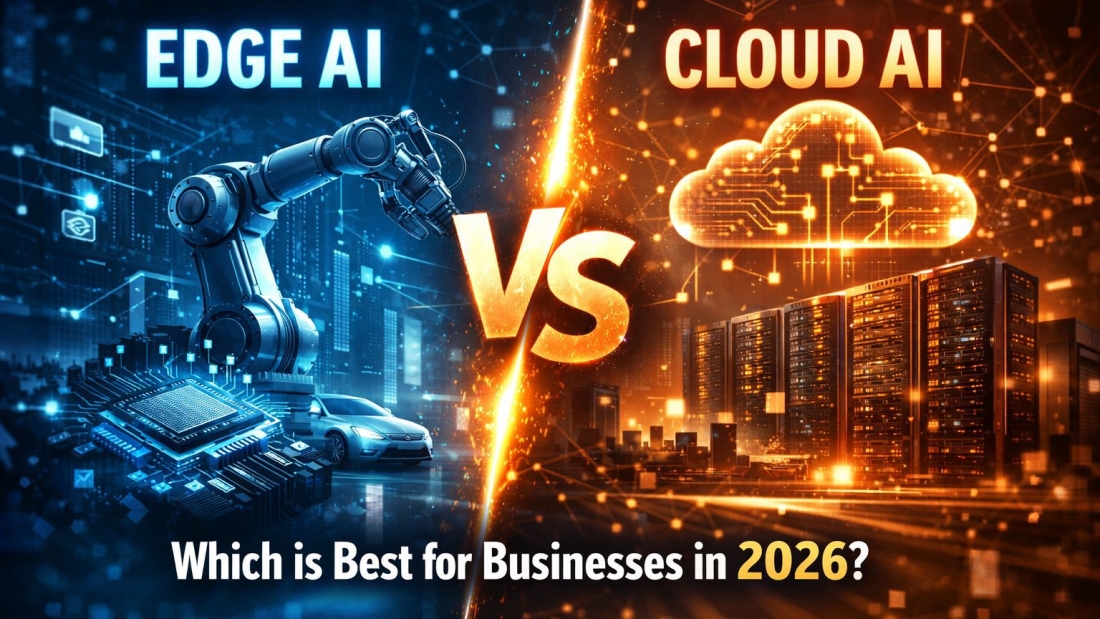
Introduction to AI Deployment Models
Artificial Intelligence isn’t just a buzzword anymore — it’s the engine quietly running behind modern businesses. From smart recommendations to predictive maintenance, AI is everywhere. But here’s the big question companies are wrestling with in 2026: Where should that AI actually run?
That’s where the debate between Edge AI vs Cloud AI kicks in.
Think of it like choosing between cooking at home or ordering from a massive central kitchen. Both get the job done, but the experience, speed, and cost? Totally different.
What Is Edge AI?
Edge AI processes data directly on devices — like smartphones, sensors, cameras, or machines — instead of sending it to a distant server. The “edge” simply means closer to where the data is created.
Imagine a security camera that can detect suspicious movement instantly without needing to “ask” a cloud server. That’s Edge AI in action.
What Is Cloud AI?
Cloud AI, on the other hand, runs on remote data centers powered by tech giants. Devices collect data and send it to the cloud, where powerful servers process it and send results back.
It’s like having a supercomputer on demand — but it lives far away.
How AI Infrastructure Has Evolved by 2026
AI in 2026 is faster, smarter, and more deeply integrated into daily business operations than ever before.
The Rise of Smart Devices
We now have AI chips inside cameras, cars, factory machines, and even refrigerators. Devices are no longer “dumb collectors” of data — they’re becoming decision-makers.
Growth of Hyperscale Cloud Platforms
At the same time, cloud providers have built mind-blowing infrastructure. We’re talking about data centers that can train trillion-parameter AI models. The cloud isn’t slowing down either.
So businesses now stand at a crossroads: local intelligence or centralized power?
Core Differences Between Edge AI and Cloud AI
Data Processing Location
- Edge AI: Processes data on-site
- Cloud AI: Sends data to remote servers
Simple difference. Huge impact.
Latency and Speed
Need instant decisions? Edge AI wins. No internet round-trip means near-zero delay.
Cloud AI can be fast, but there’s always some delay in sending and receiving data.
Connectivity Requirements
Edge AI can work even with poor or no internet. Cloud AI? It depends heavily on stable connectivity.
Scalability
Cloud AI scales like magic. Need more power? Just upgrade your cloud plan. Edge AI scaling means deploying more hardware.
Advantages of Edge AI for Modern Businesses
Real-Time Decision Making
In industries like manufacturing or autonomous vehicles, milliseconds matter. Edge AI reacts instantly, preventing accidents and downtime.
Enhanced Privacy and Data Security
Sensitive data (like medical or personal data) can stay on the device. Less data traveling = fewer chances of interception.
Reduced Bandwidth Costs
Sending every bit of data to the cloud is expensive. Edge AI filters and processes locally, reducing cloud traffic.
Advantages of Cloud AI for Modern Businesses
Massive Computational Power
Training large AI models requires insane computing power. Cloud platforms handle this effortlessly.
Centralized Data Management
All data in one place makes analytics, backups, and monitoring easier.
Easy Model Training and Updates
Cloud AI allows companies to update AI models globally without touching every single device.
Cost Comparison: Edge AI vs Cloud AI
Hardware Investment
Edge AI needs smarter devices, which increases upfront hardware costs. Cloud AI shifts that cost into subscription fees.
Operational Expenses
Cloud AI comes with ongoing data transfer and storage costs. Edge AI reduces these but may increase maintenance costs.
Long-Term ROI
Edge AI often wins in environments with constant data generation, while Cloud AI is cost-effective for large-scale analytics.
Security Considerations
Edge AI Security Challenges
More devices mean more potential entry points for hackers. Managing device-level security can be complex.
Cloud AI Security Risks
Cloud systems are huge targets. A single breach can expose massive datasets.
Compliance and Regulations
Data protection laws are stricter in 2026. Edge AI helps with compliance by keeping data local.
Industry Use Cases for Edge AI
Manufacturing and Smart Factories
Machines detect defects in real time, reducing waste instantly.
Retail and Smart Stores
Smart cameras track inventory and customer behavior without sending video to the cloud.
Healthcare and Wearable Devices
Wearables monitor health metrics and alert users immediately — no delay.
Industry Use Cases for Cloud AI
Big Data Analytics
When businesses need to analyze millions of records, cloud AI shines.
Customer Personalization
Cloud systems analyze user behavior across platforms to deliver personalized experiences.
Financial Forecasting
Complex predictive models for markets and risks rely on cloud-scale processing.
The Role of 5G and IoT in AI Decisions
5G has reduced latency, making cloud communication faster. Meanwhile, IoT growth means billions of connected devices generating data.
This combination pushes companies toward Edge AI for speed and Cloud AI for deep analysis.
Hybrid AI: The Best of Both Worlds?
How Hybrid AI Works
Edge devices handle real-time tasks. The cloud handles heavy analysis and long-term learning. They work as a team.
When Hybrid AI Makes Sense
If your business needs both instant responses and deep insights, hybrid AI is often the smartest path.
Challenges Businesses Face When Choosing
- Integration complexity
- Skill shortages
- Budget limitations
- Legacy systems
Choosing AI infrastructure isn’t just technical — it’s strategic.
Key Decision Factors for 2026
Business Size
Large enterprises may afford hybrid systems. Smaller businesses may start cloud-first.
Data Sensitivity
Handling medical or financial data? Edge AI offers more control.
Speed Requirements
If delays cost money or safety, Edge AI is critical.
Budget Constraints
Cloud AI spreads costs over time. Edge AI demands upfront investment.
Future Trends in Edge and Cloud AI
AI chips are getting smaller and more powerful. Cloud platforms are becoming more energy-efficient. The future isn’t about one replacing the other — it’s about smarter collaboration.
Final Verdict: Which One Should You Choose?
There’s no one-size-fits-all answer.
- Need real-time performance and privacy? Go Edge.
- Need massive processing and scalability? Go Cloud.
- Need both? Hybrid AI is your winner.
The smartest businesses in 2026 aren’t picking sides — they’re building systems where edge and cloud work together like brain and memory.
Conclusion
The Edge AI vs Cloud AI debate isn’t about which technology is better. It’s about which one fits your business goals, budget, and operational needs. Edge AI brings speed and privacy. Cloud AI brings power and scale. Together, they form the backbone of modern intelligent systems. The real advantage lies in understanding your needs and designing an AI strategy that blends performance, cost-efficiency, and future readiness.