
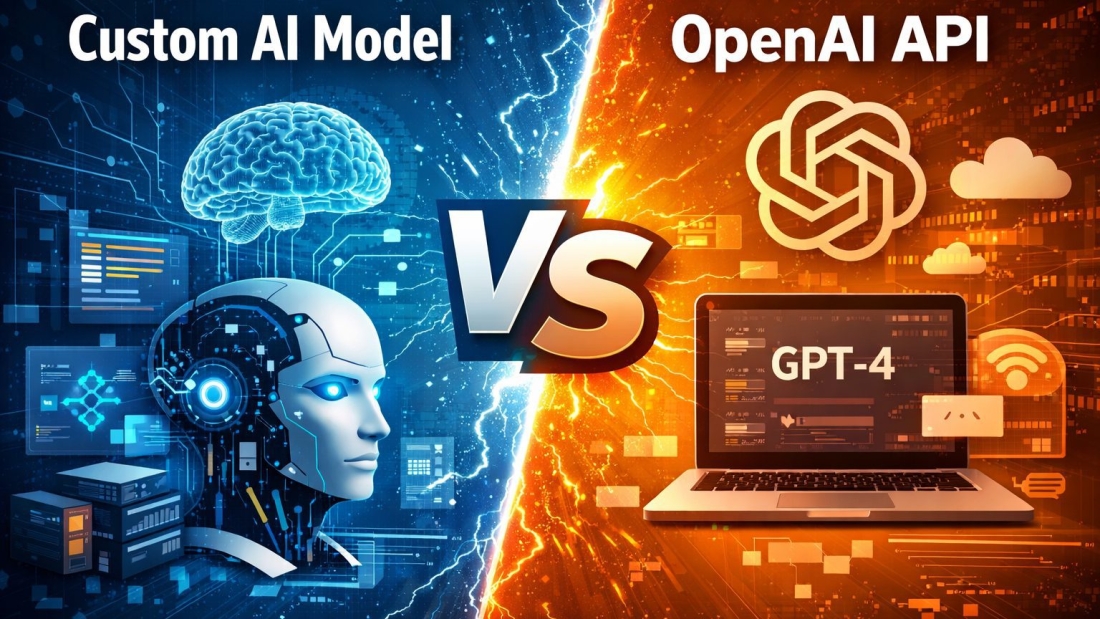
Custom AI Model vs OpenAI API

Custom AI Model vs OpenAI API – Which Is Better?

Introduction to AI Models

Artificial Intelligence (AI) is no longer just a futuristic concept. From chatbots to recommendation systems, AI models have become the backbone of modern technology. But if you’re looking to implement AI in your business or project, you might wonder: should you build a custom AI model or rely on the OpenAI API? Let’s break it down and see which option fits your needs best.


What is a Custom AI Model?

Definition and Purpose

A custom AI model is an AI system built specifically for your organization’s requirements. Unlike general-purpose AI tools, it’s trained on your unique data to solve particular problems.

How It Works

Custom models usually involve collecting a dataset, cleaning it, training the model using machine learning or deep learning techniques, and continuously refining it to improve accuracy.

Pros of Custom AI Models

  • Highly tailored to your business needs.
  • Can achieve superior accuracy for niche applications.
  • Full control over data privacy and model behavior.

Cons of Custom AI Models

  • Requires significant time and resources to develop.
  • High costs for infrastructure, training, and maintenance.
  • Needs skilled AI engineers to manage and improve.

What is OpenAI API?

Definition and Overview

OpenAI API is a ready-to-use AI service that provides access to pre-trained models like GPT-4. It allows developers to integrate AI capabilities into applications without building a model from scratch.

How OpenAI API Works

You send input (prompts) to the API, and the model returns output based on its pre-trained knowledge. No heavy training or complex infrastructure is required.

Pros of Using OpenAI API

  • Quick integration and fast deployment.
  • Cost-effective for small to medium-scale projects.
  • Continuously updated and maintained by OpenAI.

Cons of OpenAI API

  • Less control over model behavior and outputs.
  • Dependent on external service; limited customization.
  • Data privacy concerns if sensitive information is sent to the API.

Key Differences Between Custom AI Models and OpenAI API

Development Time

Custom AI models can take months to develop, while OpenAI API can be integrated in days or even hours.

Cost Considerations

Custom AI requires upfront investment in data collection, computing, and human resources. OpenAI API follows a pay-as-you-go pricing, which can be cheaper initially but may add up over high usage.

Flexibility and Customization

Custom models offer complete customization. OpenAI API is general-purpose, so you might need workarounds for specific tasks.

Maintenance Requirements

Custom models need continuous monitoring and retraining. OpenAI API is maintained by OpenAI, so you get automatic improvements without extra work.


Performance Comparison

Accuracy and Reliability

Custom AI models excel in specialized tasks with specific datasets. OpenAI API is versatile but may not match the precision of a well-trained custom model in niche scenarios.

Speed and Scalability

OpenAI API is optimized for performance and can handle high traffic efficiently. Custom models might require additional infrastructure to scale.

Handling Complex Tasks

Custom AI can outperform in complex tasks if trained properly. OpenAI API handles a wide range of general tasks but may struggle with very specialized needs.


Use Cases for Custom AI Models

Enterprise-Specific Applications

Companies with unique business processes benefit from models tailored to their workflow.

Industry-Specific Data

Healthcare, finance, or legal industries often need models trained on proprietary datasets for compliance and accuracy.

High Security Requirements

Custom AI keeps sensitive data on-premises, reducing the risk of breaches.


Use Cases for OpenAI API

Rapid Prototyping

Startups and developers can test ideas quickly without heavy upfront costs.

General Purpose AI Tasks

From chatbots to content generation, OpenAI API works well for most standard applications.

Cost-Effective Solutions

Pay only for what you use; ideal for small businesses and projects with limited budgets.


Integration and Ease of Use

Technical Requirements

Custom AI needs strong technical expertise and computing infrastructure. OpenAI API only requires API calls and basic coding knowledge.

Developer Skills Needed

Custom models demand experienced data scientists and AI engineers. OpenAI API can be used by general developers or even non-technical staff with minimal guidance.


Security and Data Privacy

Custom AI Model Security

Data stays within the organization, giving full control over privacy and compliance.

OpenAI API Security

Sensitive data is sent to OpenAI servers, which may be a concern for industries like healthcare and finance.


Custom AI Models in 2026 and Beyond

As AI technology evolves, custom models will become more accessible with improved tools and automation, enabling businesses to deploy highly specialized AI faster.

OpenAI API Updates and Improvements

OpenAI continues to improve its models, offering better performance, safety, and expanded features, making it a powerful choice for general-purpose AI needs.


Conclusion

Choosing between a custom AI model and OpenAI API depends on your business goals, budget, timeline, and data sensitivity. If you need a highly specialized solution with complete control, a custom AI model is the way to go. However, if you’re looking for speed, versatility, and cost-effectiveness, OpenAI API is a solid choice. Ultimately, the “better” option is the one that aligns perfectly with your project’s unique requirements.

Antigravity vs Cursor IDE – Which is Better?

Antigravity vs Cursor IDE – Which is Better?

Introduction to Modern AI-Powered Development Tools

The way we write code has changed dramatically. Gone are the days when developers had to Google every error or manually refactor massive codebases. Today, AI-powered IDEs are stepping in like smart co-pilots, helping developers write cleaner, faster, and better code. Two names that are making serious noise in this space are Antigravity and Cursor IDE.

But here’s the real question: Antigravity vs Cursor IDE – which is better? Let’s break it down in a simple, honest, and developer-friendly way.

Why Developers Are Moving Toward AI IDEs

Think of AI IDEs as GPS for coding. You can still reach your destination without them, but why struggle when you can get guided help? These tools reduce mental load, speed up development, and help catch mistakes early.

The Rise of Intelligent Coding Assistants

AI-powered tools are no longer just autocomplete engines. They understand context, refactor code, explain logic, and even help design systems. That’s where Antigravity and Cursor IDE shine.


What Is Antigravity?

Overview of Antigravity

Antigravity is an AI-driven development environment designed to help developers think less about syntax and more about logic. It focuses on high-level reasoning, automation, and intelligent code assistance.

Core Philosophy Behind Antigravity

Antigravity aims to “lift” developers above repetitive tasks. The idea is simple: let AI handle boilerplate, repetitive fixes, and common patterns while you focus on problem-solving.

Target Users of Antigravity

Antigravity is ideal for:

  • Developers working on complex systems
  • Teams that value automation
  • Engineers who want deep AI reasoning over code

What Is Cursor IDE?

Overview of Cursor IDE

Cursor IDE is a modern, AI-first code editor built on top of familiar IDE experiences. It feels like a smarter version of VS Code, but with AI deeply embedded into the workflow.

Cursor IDE’s Core Vision

Cursor IDE wants to be your daily coding companion. It’s designed to understand your entire codebase and respond to natural language instructions like a real teammate.

Who Should Use Cursor IDE?

Cursor IDE is perfect for:

  • Beginners and intermediate developers
  • Fast-moving startups
  • Developers who want minimal setup and instant productivity

Antigravity vs Cursor IDE – Feature Comparison

User Interface and Ease of Use

Cursor IDE wins in familiarity. If you’ve used VS Code, Cursor feels like home. Antigravity, on the other hand, has a more experimental interface that may take time to get used to.

AI Capabilities and Intelligence

Antigravity focuses on deeper reasoning and system-level understanding. Cursor IDE shines at contextual code edits, explanations, and inline suggestions.

Code Generation and Refactoring

Cursor IDE excels at generating clean, readable code quickly. Antigravity is better at large-scale refactoring and architectural suggestions.

Debugging and Error Handling

Cursor IDE explains errors in plain English, which is a blessing for beginners. Antigravity goes deeper, offering logical explanations and long-term fixes.

Performance and Speed

Cursor IDE feels snappy and lightweight. Antigravity can feel heavier due to its advanced processing but compensates with smarter outputs.


Developer Experience and Workflow

Learning Curve

Cursor IDE has a shallow learning curve. You can start using it effectively within minutes. Antigravity requires more exploration but rewards patience.

Productivity Boost

Cursor IDE boosts short-term productivity. Antigravity improves long-term efficiency, especially in large projects.

Real-World Coding Scenarios

For quick feature builds, Cursor IDE feels faster. For deep refactoring or complex logic, Antigravity feels more powerful.


Integrations and Ecosystem

Language Support

Both tools support major languages like JavaScript, Python, Java, and more. Cursor IDE currently has broader community-driven support.

Framework and Tool Compatibility

Cursor IDE integrates smoothly with popular frameworks and tools. Antigravity is catching up but focuses more on core coding intelligence.


Security and Privacy Considerations

Data Handling in Antigravity

Antigravity emphasizes controlled data processing, making it appealing for enterprise-level projects.

Privacy Approach of Cursor IDE

Cursor IDE is transparent about data usage and provides options to limit data sharing.


Pricing and Value for Money

Cost Structure of Antigravity

Antigravity is generally priced for professional and enterprise users, offering advanced features at a premium.

Cursor IDE Pricing Model

Cursor IDE offers flexible pricing, making it accessible for solo developers and small teams.


Pros and Cons of Antigravity

Key Advantages

  • Deep AI reasoning
  • Strong architectural insights
  • Ideal for complex projects

Limitations

  • Steeper learning curve
  • Heavier interface

Pros and Cons of Cursor IDE

Key Advantages

  • Easy to use
  • Fast and lightweight
  • Excellent for daily coding

Limitations

  • Less advanced system-level reasoning
  • Limited customization compared to Antigravity

Antigravity vs Cursor IDE – Head-to-Head Verdict

Which One Is Better for Beginners?

Cursor IDE, hands down. It’s intuitive, friendly, and gets out of your way.

Which Tool Suits Professional Developers?

Antigravity is better for experienced developers working on complex systems and long-term projects.


Conclusion

So, Antigravity vs Cursor IDE – which is better?
The answer depends on you.

If you want speed, simplicity, and instant productivity, Cursor IDE is your best bet. If you crave deep intelligence, architectural insights, and powerful AI reasoning, Antigravity is worth the investment.

Think of Cursor IDE as a smart assistant and Antigravity as a strategic partner. Choose the one that matches your workflow and goals.

How AI Is Redefining Customer Experience in E-Commerce Trends, Tools & Strategies for 2026

How AI Is Redefining Customer Experience in E-Commerce: Trends, Tools & Strategies for 2026

Introduction to AI in E-Commerce

Online shopping isn’t what it used to be. Gone are the days when customers were happy just clicking “Buy Now.” Today, they want experiences that feel personal, fast, and effortless. This is where artificial intelligence steps in like a smart store assistant who knows exactly what you want—even before you ask.

What Is Artificial Intelligence?

Artificial intelligence, or AI, refers to machines that can think, learn, and make decisions like humans. In e-commerce, AI analyzes massive amounts of data to understand customer behavior, preferences, and patterns.

Why Customer Experience Matters More Than Ever

Let’s be honest—customers have options. Tons of them. If your online store doesn’t deliver a smooth and personalized experience, they’ll leave in seconds. Customer experience (CX) is now the biggest competitive advantage, and AI is the engine driving it.


The Evolution of Customer Experience in Online Shopping

From Traditional E-Commerce to AI-Driven Experiences

Traditional e-commerce focused on listings and discounts. AI-driven e-commerce focuses on people. Instead of guessing what customers want, AI knows—based on data, behavior, and intent.

Key Shifts in Consumer Expectations

Customers now expect:

  • Personalized recommendations
  • Instant support
  • Seamless shopping across devices
  • Relevant offers at the right time

AI makes all of this possible without burning out your team.


Role of AI in Modern E-Commerce

Data-Driven Decision Making

AI turns raw data into insights. It helps businesses understand what customers like, when they buy, and why they leave. Decisions become smarter, faster, and more accurate.

Automation and Intelligence Combined

Automation saves time. Intelligence adds value. AI combines both—automating tasks while continuously learning and improving outcomes.


Hyper-Personalization at Scale

In 2026, personalization won’t be optional. AI will customize homepages, emails, ads, and product recommendations for each individual user—at scale.

AI-Powered Chatbots and Virtual Assistants

Chatbots are no longer robotic. They understand context, emotions, and intent. Think of them as digital sales reps working 24/7.

Voice Commerce and Conversational AI

“Hey, order my favorite sneakers.” Voice-enabled shopping is growing fast, and AI is making it more accurate and conversational.

Visual Search and Image Recognition

Customers can upload an image and find similar products instantly. AI-powered visual search shortens the path from inspiration to purchase.

Predictive Analytics and Customer Behavior Forecasting

AI predicts what customers will buy next, when they’ll return, and even when they might churn—so businesses can act before it’s too late.


AI Tools Transforming E-Commerce Customer Experience

Recommendation Engines

Netflix-style recommendations aren’t just for movies anymore. AI suggests products based on browsing history, preferences, and past purchases.

AI Chatbots and Live Support Tools

From order tracking to product advice, AI chatbots handle repetitive queries while human agents focus on complex issues.

Customer Data Platforms (CDPs)

AI-powered CDPs unify customer data across channels, creating a single, accurate customer profile.

AI-Powered CRM Systems

Modern CRMs use AI to predict customer needs, automate follow-ups, and improve relationships.


Personalization: The Heart of AI-Driven CX

Real-Time Personalization

AI adapts content and offers in real time. Every click, scroll, and pause tells a story—and AI listens.

Personalized Product Recommendations

Customers see what they actually want, not random products. This boosts conversions and satisfaction.

Dynamic Pricing and Offers

AI adjusts pricing and discounts based on demand, behavior, and market trends—fair and profitable.


AI in Customer Support and Engagement

24/7 Support with AI Chatbots

No waiting. No frustration. AI ensures customers get instant help anytime, anywhere.

Sentiment Analysis for Better Engagement

AI analyzes tone and emotion in messages to respond more empathetically and effectively.


AI-Powered Marketing Strategies for E-Commerce

Personalized Email Marketing

AI crafts emails based on customer behavior, increasing open rates and conversions.

AI in Social Commerce

From product tagging to automated replies, AI makes social shopping smoother and more engaging.

Smarter Ad Targeting with Machine Learning

AI finds the right audience, at the right time, with the right message—maximizing ad ROI.


AI and Omnichannel Customer Experience

Seamless Shopping Across Platforms

AI ensures customers enjoy a consistent experience across websites, apps, social media, and marketplaces.

Consistent Brand Experience Using AI

Whether online or mobile, AI maintains brand tone, messaging, and personalization.


Ethical AI and Customer Trust

Data Privacy and Security

Customers care about their data. Ethical AI practices build trust and long-term loyalty.

Transparency in AI Usage

Being honest about how AI is used creates confidence and credibility.


Challenges of Implementing AI in E-Commerce

Cost and Technical Complexity

AI requires investment, expertise, and planning—but the payoff is worth it.

Data Quality and Integration Issues

AI is only as good as the data it receives. Clean, integrated data is essential.


Strategies to Successfully Implement AI in 2026

Choosing the Right AI Tools

Focus on tools that align with your goals—not just trends.

Training Teams for AI Adoption

Human + AI is the winning formula. Train teams to work alongside intelligent systems.

Measuring AI Performance and ROI

Track KPIs, customer satisfaction, and revenue impact to measure success.


Future of AI-Driven Customer Experience

What to Expect Beyond 2026

AI will become more human, more predictive, and more immersive.

AI as a Competitive Advantage

Businesses that embrace AI early will lead the market. Those who don’t will struggle to keep up.


Conclusion

AI is no longer the future—it’s the present. In 2026, e-commerce brands that prioritize AI-driven customer experience will win hearts, loyalty, and revenue. From personalization to predictive insights, AI transforms online shopping into a journey customers actually enjoy. The question isn’t whether to adopt AI—it’s how fast you can do it.

Building AI-Powered SaaS Architecture & Best Practices

Building AI-Powered SaaS: Architecture & Best Practices

What Is an AI-Powered SaaS?

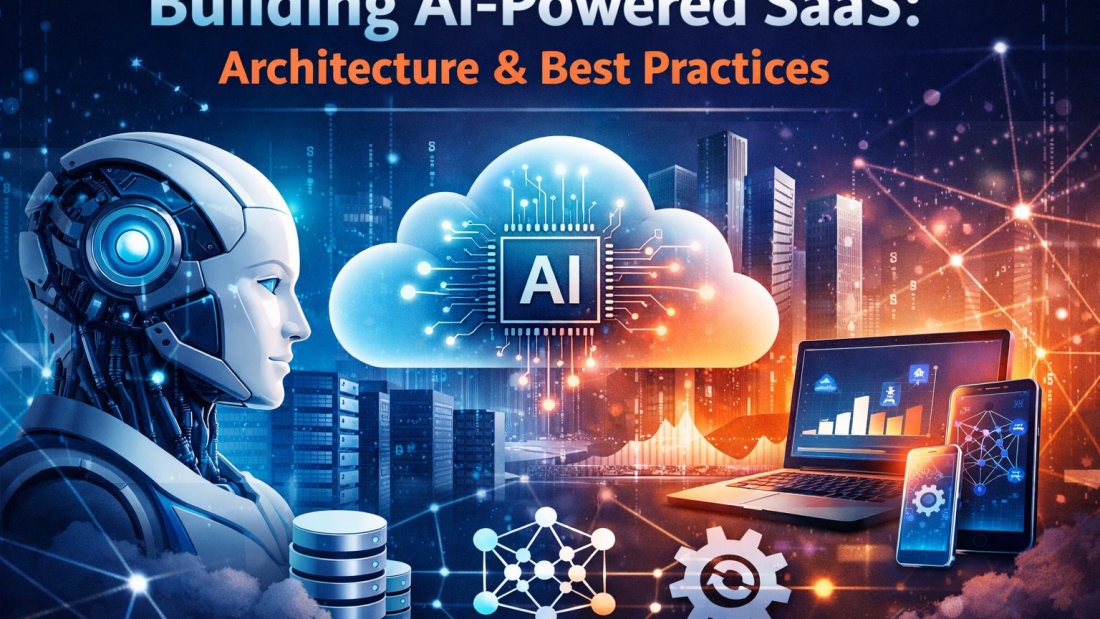
An AI-powered SaaS is a cloud-based software application that uses artificial intelligence or machine learning to deliver smarter, adaptive, and automated experiences.

Instead of fixed logic, AI SaaS products learn from data. They improve over time, adapt to users, and make predictions or decisions automatically.

Think of it like this:
Traditional SaaS follows rules.
AI-powered SaaS writes better rules as it goes.


Why AI Is Transforming SaaS Products

AI has changed user expectations. People now expect software to be:

  • Personalized
  • Predictive
  • Fast
  • Intelligent

AI helps SaaS companies:

  • Automate repetitive tasks
  • Improve customer experience
  • Reduce operational costs
  • Unlock data-driven insights
  • Create new revenue streams

In short, AI turns SaaS from a tool into a smart assistant.


Types of AI-Powered SaaS Applications

Examples of AI Use Cases

  • AI chatbots and virtual assistants
  • Recommendation engines
  • Fraud detection systems
  • Predictive analytics platforms
  • Marketing automation tools
  • AI-powered CRMs
  • Content generation platforms

If your SaaS solves a problem involving decisions, patterns, or predictions—AI can help.


Core Components of AI-Powered SaaS Architecture

A solid AI SaaS architecture usually includes:

  • Frontend (Web or Mobile App)
  • Backend APIs
  • Data pipelines
  • AI/ML models
  • Model serving layer
  • Cloud infrastructure
  • Monitoring and logging systems

Each part plays a role. Ignore one, and the whole system suffers.


Choosing the Right AI Model Strategy

Build vs Buy AI Models

You have two main options:

Build Your Own Models

  • Full control
  • Highly customizable
  • Requires ML expertise
  • Higher development time

Use Pre-trained or API-Based Models

  • Faster to launch
  • Lower upfront cost
  • Limited customization
  • Dependency on third parties

👉 Best practice?
Start with pre-trained models, then build custom ones as you scale.


Data as the Backbone of AI SaaS

AI is only as good as its data.

Data Collection and Preprocessing

You need:

  • Clean data
  • Relevant features
  • Consistent formats
  • Bias-free datasets

Bad data = bad predictions. Simple as that.

Automate data pipelines to:

  • Collect user interactions
  • Clean and normalize data
  • Store it securely
  • Feed it into models continuously

Designing Scalable System Architecture

Scalability is non-negotiable.

Cloud Infrastructure Choices

Most AI SaaS products rely on:

  • AWS
  • Google Cloud
  • Azure

Use:

  • Microservices architecture
  • Containerization (Docker)
  • Orchestration (Kubernetes)

This allows you to scale AI workloads independently from your core app.


Model Deployment and Serving Layer

Real-Time vs Batch Inference

Real-Time Inference

  • Instant predictions
  • Used for chatbots, recommendations
  • Higher infrastructure cost

Batch Inference

  • Scheduled predictions
  • Used for analytics and reports
  • More cost-efficient

Choose based on your use case—not hype.


MLOps: Managing AI in Production

MLOps is DevOps for machine learning.

Tools for MLOps

  • MLflow
  • Kubeflow
  • Airflow
  • DVC

MLOps helps with:

  • Version control
  • Model deployment
  • Rollbacks
  • Experiment tracking

Without MLOps, AI systems become messy fast.


Security and Privacy in AI SaaS

AI systems handle sensitive data—so security matters.

Compliance and Regulations

Follow:

  • GDPR
  • HIPAA
  • SOC 2
  • ISO standards

Encrypt data at rest and in transit.
Limit access using role-based permissions.
Audit everything.

Trust is currency in SaaS.


Performance Optimization and Cost Control

AI can be expensive if unmanaged.

Scaling AI with User Growth

Optimize by:

  • Using smaller models where possible
  • Auto-scaling inference servers
  • Caching predictions
  • Monitoring GPU/CPU usage

Smart optimization = higher margins.


UX Design for AI-Powered Features

AI should feel helpful, not confusing.

Design principles:

  • Explain AI outputs clearly
  • Show confidence levels when needed
  • Allow user feedback
  • Avoid “black box” experiences

Great AI UX builds trust and adoption.


Monitoring, Logging, and Continuous Improvement

Key Metrics to Track AI Performance

  • Accuracy
  • Latency
  • Drift detection
  • User satisfaction
  • Error rates

AI models degrade over time. Monitoring keeps them sharp.


Ethical AI and Responsible Development

Ethical AI isn’t optional anymore.

Focus on:

  • Bias reduction
  • Transparency
  • Explainability
  • Fair decision-making

Responsible AI protects users—and your brand.


Common Challenges in AI SaaS Development

Let’s be honest. It’s not easy.

Common issues:

  • Data quality problems
  • High infrastructure costs
  • Model drift
  • Skill gaps
  • Security risks

The good news? Every challenge has a solution if planned early.


Best Practices for Building AI-Powered SaaS

Here’s a quick checklist:

  • Start simple, then scale
  • Focus on real user problems
  • Invest in data quality
  • Use MLOps from day one
  • Monitor models continuously
  • Design transparent UX
  • Prioritize security and ethics

AI success is not magic—it’s discipline.


Conclusion

Building an AI-powered SaaS is like constructing a smart city. You need strong foundations, reliable infrastructure, intelligent systems, and constant monitoring.

When done right, AI transforms your SaaS into a living product—one that learns, adapts, and delivers real value at scale.

The future of SaaS is intelligent. The question is: are you building for it today?

Future of Quantum Computing in Business and Science

Future of Quantum Computing in Business and Science

Introduction to Quantum Computing

Quantum computing sounds like something straight out of a sci-fi movie, right? But here’s the thing—it’s real, it’s happening now, and it’s set to completely change how businesses operate and how science solves the world’s toughest problems.

Unlike traditional computers that think in straight lines, quantum computers think in probabilities. Imagine solving a maze not by trying one path at a time, but by exploring all paths at once. That’s the power we’re talking about.

What Is Quantum Computing?

Quantum computing is a new computing paradigm that uses the principles of quantum mechanics—like superposition and entanglement—to process information. Instead of bits (0s and 1s), it uses qubits, which can exist in multiple states at the same time.

In simple words? Quantum computers don’t just calculate faster—they calculate smarter.

How Quantum Computing Differs from Classical Computing

Classical computers are like calculators following step-by-step instructions. Quantum computers are more like intuition-driven problem solvers. They evaluate countless possibilities simultaneously, making them ideal for complex problems involving massive data and variables.


The Evolution of Quantum Computing

Early Research and Breakthroughs

Quantum computing isn’t new. The theory dates back to the 1980s. But only recently has technology caught up with the math. Companies like IBM, Google, and Microsoft have made huge breakthroughs, pushing quantum computers out of labs and into real-world testing.

Current State of Quantum Technology

Right now, we’re in the “early adopter” phase. Quantum computers exist, but they’re still fragile, expensive, and complex to operate. Think of them as the first airplanes—promising, but not yet ready for mass travel.

Quantum Hardware vs Quantum Software

Hardware focuses on building stable qubits, while software focuses on algorithms that can actually use quantum power. Both are evolving side by side, and progress in one accelerates the other.


Why Quantum Computing Matters

Speed Beyond Imagination

Quantum computers can solve problems in seconds that would take classical computers thousands of years. That’s not an exaggeration—it’s a paradigm shift.

Solving Problems Classical Computers Cannot

From simulating molecules to optimizing global logistics, quantum computing opens doors that were previously locked.


Future of Quantum Computing in Business

Quantum Computing in Finance

Finance is all about predictions, probabilities, and risk—and that’s exactly where quantum computing shines.

Risk Analysis and Portfolio Optimization

Quantum algorithms can analyze millions of market scenarios at once, helping banks and investors minimize risk and maximize returns.

Quantum Computing in Supply Chain Management

Logistics and Route Optimization

Imagine optimizing global shipping routes in real time, accounting for weather, fuel costs, and demand. Quantum computing can make that possible.

Quantum Computing in Healthcare and Pharma

Drug Discovery and Personalized Medicine

Quantum computers can simulate molecular interactions with extreme accuracy, speeding up drug discovery and enabling treatments tailored to individual patients.

Marketing and Customer Analytics

Quantum computing can analyze customer behavior patterns on a whole new level, enabling hyper-personalized marketing strategies that actually feel human.


Future of Quantum Computing in Science

Quantum Computing in Physics

Quantum computers help scientists simulate quantum systems—something classical computers struggle with. It’s like finally having a mirror that reflects reality accurately.

Quantum Computing in Chemistry

From designing new materials to understanding chemical reactions, quantum computing accelerates discovery.

Quantum Computing in Climate and Environmental Science

Climate Modeling and Sustainability

More accurate climate models mean better predictions, smarter policies, and more effective sustainability strategies.


Quantum Computing and Artificial Intelligence

Machine Learning

Quantum AI could train models faster, find patterns humans can’t see, and revolutionize decision-making.

Faster Data Processing and Pattern Recognition

When AI meets quantum speed, data becomes insight almost instantly.


Challenges Facing Quantum Computing

Technical Limitations

Qubits are sensitive. A tiny disturbance can ruin calculations. Error correction remains a major hurdle.

Cost and Infrastructure Issues

Quantum computers require extreme conditions, like near-absolute-zero temperatures. That doesn’t come cheap.

Lack of Skilled Professionals

The Talent Gap in Quantum Science

There’s a shortage of people who understand both quantum physics and real-world applications.


Security Implications of Quantum Computing

Quantum Threats to Cybersecurity

Quantum computers could break current encryption methods, putting global data at risk.

Post-Quantum Cryptography

New encryption techniques are being developed to stay ahead of quantum threats.


How Businesses Can Prepare for the Quantum Future

Investing in Quantum Research

Early investment means long-term advantage.

Building Quantum-Ready Strategies

Businesses don’t need quantum computers today—but they do need a plan.

Upskilling Teams for the Quantum Era

Training employees now ensures readiness later.


Timeline: When Will Quantum Computing Go Mainstream?

Most experts predict meaningful business adoption within the next 10–15 years. Some industries may benefit even sooner.


Ethical and Regulatory Considerations

Responsible Use of Quantum Technology

With great power comes great responsibility.

Global Regulations and Policies

Governments are already working on frameworks to manage quantum risks.


The Long-Term Vision of Quantum Computing

Quantum as a Service (QaaS)

Cloud-based quantum computing will make access easier for businesses.

Collaboration Between Business and Science

The future belongs to those who collaborate, not compete.


Conclusion

The future of quantum computing in business and science is not a question of if, but when. While challenges remain, the potential benefits are too powerful to ignore. From smarter businesses to breakthrough scientific discoveries, quantum computing is set to redefine what’s possible. The organizations that prepare today will lead tomorrow.

AI-Driven Public Service Delivery and Citizen Experience

AI-Driven Public Service Delivery and Citizen Experience

Introduction to AI in Public Services

Public services are the backbone of any society. From healthcare and education to transportation and social welfare, citizens rely on governments to deliver these services efficiently. But let’s be honest—traditional public service systems are often slow, paper-heavy, and frustrating. This is where artificial intelligence steps in like a breath of fresh air.

What Is AI-Driven Public Service Delivery?

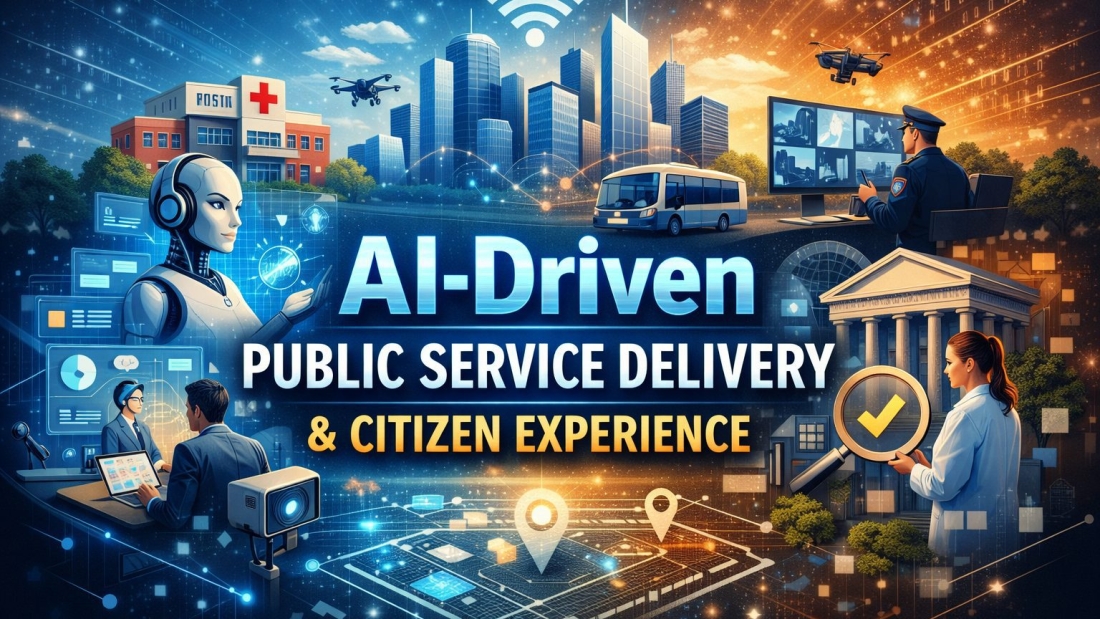
AI-driven public service delivery means using artificial intelligence technologies—like machine learning, natural language processing, and predictive analytics—to improve how government services are designed, delivered, and managed. Instead of manual processes and one-size-fits-all solutions, AI enables smarter, faster, and more personalized services.

Why Governments Are Turning to AI

Governments worldwide are facing increasing pressure. Growing populations, limited budgets, and rising citizen expectations demand better solutions. AI helps governments do more with less. Think of it as a smart assistant that never sleeps, never gets tired, and keeps learning from data.


The Evolution of Public Service Delivery

Traditional Public Services vs Digital Government

In the past, public services depended heavily on paperwork, physical offices, and long waiting lines. Need a license renewed? Take a day off work. Want to file a complaint? Fill out endless forms. Digital government initiatives changed some of this, but AI takes it several steps further.

The Rise of Smart Governance

Smart governance uses technology and data to make better decisions. AI helps governments anticipate problems instead of reacting to them. It’s like switching from a rear-view mirror to a GPS that predicts traffic ahead.


Role of Artificial Intelligence in Government Operations

Automation in Administrative Processes

AI automates repetitive tasks such as data entry, document verification, and application processing. This reduces human error and frees government employees to focus on complex and meaningful work.

Predictive Analytics for Better Decision-Making

AI analyzes historical and real-time data to predict future trends. Whether it’s forecasting unemployment rates or predicting disease outbreaks, predictive analytics empowers policymakers with actionable insights.

Data-Driven Policy Formulation

Policies based on gut feelings are risky. AI-driven insights ensure policies are grounded in real data, making them more effective and impactful.


Enhancing Citizen Experience Through AI

Personalized Citizen Services

Citizens expect the same level of personalization from governments that they get from private companies. AI enables tailored recommendations, reminders, and services based on individual needs.

Faster Response Times and 24/7 Availability

Nobody likes waiting. AI-powered systems respond instantly, whether it’s checking application status or answering common questions.

Chatbots and Virtual Assistants

Chatbots act as digital front desks. They guide citizens, answer questions, and resolve issues at any hour. It’s like having a helpful government representative in your pocket.


AI in Healthcare Public Services

Smart Health Systems

AI improves hospital management, patient scheduling, and medical record analysis. This leads to reduced waiting times and better patient care.

Predictive Healthcare and Early Diagnosis

By analyzing medical data, AI can identify health risks early. Early detection saves lives and reduces healthcare costs—a win-win situation.


AI-Driven Education Services

Personalized Learning Platforms

AI adapts learning materials to individual student needs. Students learn at their own pace, improving outcomes and engagement.

Improving Access to Education

AI-powered tools bridge gaps for remote and underserved communities, ensuring inclusive and equitable education.


Smart Cities and AI Integration

Traffic Management and Urban Planning

AI analyzes traffic patterns to reduce congestion and optimize public transport. Cities become more livable and less stressful.

Public Safety and Surveillance

AI helps detect unusual activities and respond to emergencies faster, enhancing public safety while optimizing resource use.


AI in Social Welfare and Benefits Distribution

Fraud Detection and Prevention

AI identifies unusual patterns that may indicate fraud. This ensures benefits reach the right people without misuse.

Efficient Resource Allocation

Governments can allocate resources where they’re needed most, maximizing social impact.


Improving Transparency and Trust in Government

Reducing Human Bias

AI systems, when designed responsibly, reduce subjective decision-making and ensure fairness.

Open Data and Accountability

AI-powered dashboards make government data accessible and understandable, fostering transparency and trust.


Challenges of AI in Public Service Delivery

Data Privacy and Security Concerns

Handling sensitive citizen data requires strong security measures. Privacy must never be compromised.

Ethical and Bias Issues

AI can inherit biases from data. Ethical frameworks are essential to ensure fair outcomes.

Digital Divide and Accessibility

Not everyone has access to digital tools. Governments must ensure AI benefits everyone, not just the tech-savvy.


AI Governance and Policy Frameworks

Regulations for Responsible AI

Clear laws and guidelines ensure AI is used ethically and responsibly.

Human-in-the-Loop Approach

AI should support, not replace, human judgment. Human oversight keeps systems accountable.


Real-World Examples of AI in Public Services

AI Use Cases from Around the World

From AI-powered tax systems to smart policing and digital identity platforms, countries worldwide are already reaping the benefits of AI in governance.


The Future of AI-Driven Public Services

Expect more conversational AI, real-time analytics, and predictive public services in the coming years.

Long-Term Impact on Citizen Experience

AI will redefine how citizens interact with governments—making services proactive, seamless, and citizen-centric.


Conclusion

AI-driven public service delivery is no longer a futuristic idea—it’s happening now. By improving efficiency, transparency, and personalization, AI enhances citizen experience and builds trust in government. While challenges exist, thoughtful implementation and ethical governance can unlock AI’s full potential. The future of public services is smart, responsive, and powered by AI.

The Rise of AI-Optimized Data Centers What’s Different From Traditional Ones

The Rise of AI-Optimized Data Centers: What’s Different From Traditional Ones?

Introduction to AI-Optimized Data Centers

Data centers are like the beating heart of the internet. Every click, stream, and cloud backup flows through them. But here’s the problem—traditional data centers were never designed for today’s AI-heavy, always-on digital world. They’re under pressure like never before.

That’s why AI-optimized data centers are rising fast. They’re smarter, greener, and far more efficient than their traditional counterparts.

Why Data Centers Are the Backbone of the Digital World

From social media and e-commerce to AI tools and streaming platforms, everything depends on data centers. If they slow down, the digital world feels it instantly.

The Growing Pressure on Traditional Data Centers

Traditional data centers struggle with rising energy costs, complex workloads, and sustainability demands. It’s like asking an old engine to power a modern electric car—it just wasn’t built for that.


Understanding Traditional Data Centers

How Traditional Data Centers Work

Traditional data centers rely heavily on fixed infrastructure and manual configuration. Servers, cooling systems, and also power supplies are managed based on predefined rules.

Key Components of Legacy Data Centers

  • Physical servers
  • Network switches
  • Cooling systems
  • Backup power units

Cooling, Power, and Manual Management

Most decisions—like cooling levels or workload distribution—are handled manually or through basic automation. This often leads to wasted energy and higher costs.


What Are AI-Optimized Data Centers?

Simple Definition

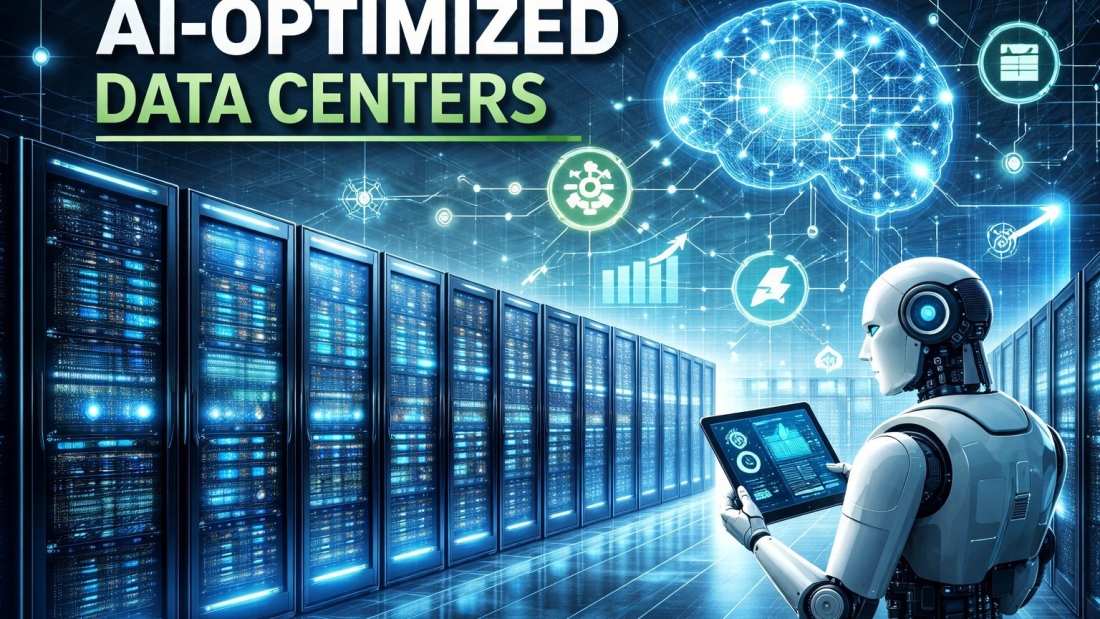
AI-optimized data centers use artificial intelligence to monitor, manage, and also optimize operations in real time. Think of them as self-learning facilities that constantly improve performance.

Core Technologies Behind AI Optimization

  • Machine Learning
  • Predictive Analytics
  • Computer Vision
  • Real-Time Monitoring

Machine Learning and Real-Time Analytics

These systems learn from historical and live data to make smarter decisions—without human intervention.


Why AI-Optimized Data Centers Are Rising

Explosion of AI and Big Data Workloads

AI models, big data analytics, and cloud services require massive computing power. Traditional setups simply can’t keep up.

Energy Efficiency and Cost Pressures

Electricity bills are one of the biggest data center expenses. AI helps reduce waste while optimizing power usage.

Sustainability and Carbon Reduction Goals

With stricter environmental regulations, companies are turning to AI to cut emissions and then meet sustainability targets.


Key Differences Between AI-Optimized and Traditional Data Centers

Infrastructure Design

AI-optimized data centers are built for flexibility, using modular and scalable designs.

Energy and Cooling Systems

AI dynamically adjusts cooling and power based on real-time demand—traditional systems don’t.

Automation vs Manual Operations

AI-optimized centers rely on automation, while traditional ones depend on human oversight.


AI-Driven Cooling and Power Management

Smart Cooling Systems

AI predicts heat patterns and adjusts cooling before temperatures spike—like a thermostat that thinks ahead.

Predictive Power Optimization

Power usage is continuously optimized to avoid overloads and also energy waste.

Reducing Energy Waste

This approach can cut energy consumption by up to 30–40%.


Performance and Scalability Advantages

Handling High-Performance AI Workloads

AI-optimized data centers are designed to support GPUs, TPUs, and also AI accelerators.

Dynamic Resource Allocation

Resources are assigned where needed, when needed—no guesswork.

Faster Scaling Without Downtime

Scaling up doesn’t require major downtime, making operations smoother.


AI for Data Center Monitoring and Maintenance

Predictive Maintenance

AI detects equipment issues before failures happen—saving time and money.

Anomaly Detection

Unusual behavior is flagged instantly, preventing major outages.

Preventing Costly Downtime

Less downtime means happier users and higher revenue.


Sustainability Benefits of AI-Optimized Data Centers

Lower Carbon Footprint

Optimized energy use directly reduces emissions.

Renewable Energy Integration

AI balances workloads based on renewable energy availability.

Water and Resource Conservation

Smart cooling systems significantly reduce water consumption.


Security Improvements with AI

AI-Based Threat Detection

AI spots cyber threats faster than traditional security tools.

Automated Incident Response

Threats are neutralized automatically while minimizing damage.

Protecting Critical Infrastructure

This is crucial for industries like finance, healthcare, and also government.


Real-World Examples of AI-Optimized Data Centers

Tech Giants Leading the Way

Companies for example Google and Microsoft already use AI to optimize their data centers.

Hyperscale and Edge Data Centers

AI makes both massive and small-scale data centers more efficient.

Lessons From Early Adopters

Early adopters report lower costs, better uptime, and also improved sustainability.


Challenges of AI-Optimized Data Centers

High Initial Investment

AI infrastructure isn’t cheap upfront—but it pays off long-term.

Skill Gaps and Complexity

Skilled professionals are needed to manage AI systems.

Data Privacy and Ethics

Responsible AI use is essential to avoid misuse.


The Future of Data Centers

Autonomous Data Centers

The future points toward fully self-managing facilities.

AI + Green Energy Synergy

AI will play a key role in carbon-neutral data centers.

What Businesses Should Prepare For

Companies must rethink infrastructure strategies to stay competitive.


Conclusion

AI-optimized data centers represent a major leap forward from traditional designs. They’re smarter, more efficient, and also far better suited for today’s digital and AI-driven world. As demand for computing power grows, these intelligent facilities won’t just be an option; in fact, they’ll be the standard.

AI for Sales Forecasting and Customer Insights

AI for Sales Forecasting and Customer Insights

Introduction to AI in Modern Sales

Sales today isn’t just about gut feelings and last year’s numbers. It’s more like playing chess with data. And AI? That’s your grandmaster. Businesses are increasingly turning to AI for sales forecasting and customer insights to stay competitive, reduce uncertainty, and make smarter decisions faster.

Why Traditional Sales Forecasting Falls Short

Traditional sales forecasting relies heavily on historical data, spreadsheets, and human assumptions. While experience matters, it often brings bias, errors, and slow updates. Market shifts, customer behavior changes, and unexpected trends can easily throw off manual forecasts.

The Rise of Data-Driven Decision Making

AI changes the game by analyzing massive datasets in real time. Instead of guessing, sales teams now rely on predictive insights backed by data. Think of it as switching from a paper map to GPS—faster, smarter, and more accurate.


What Is AI Sales Forecasting?

Definition and Core Concepts

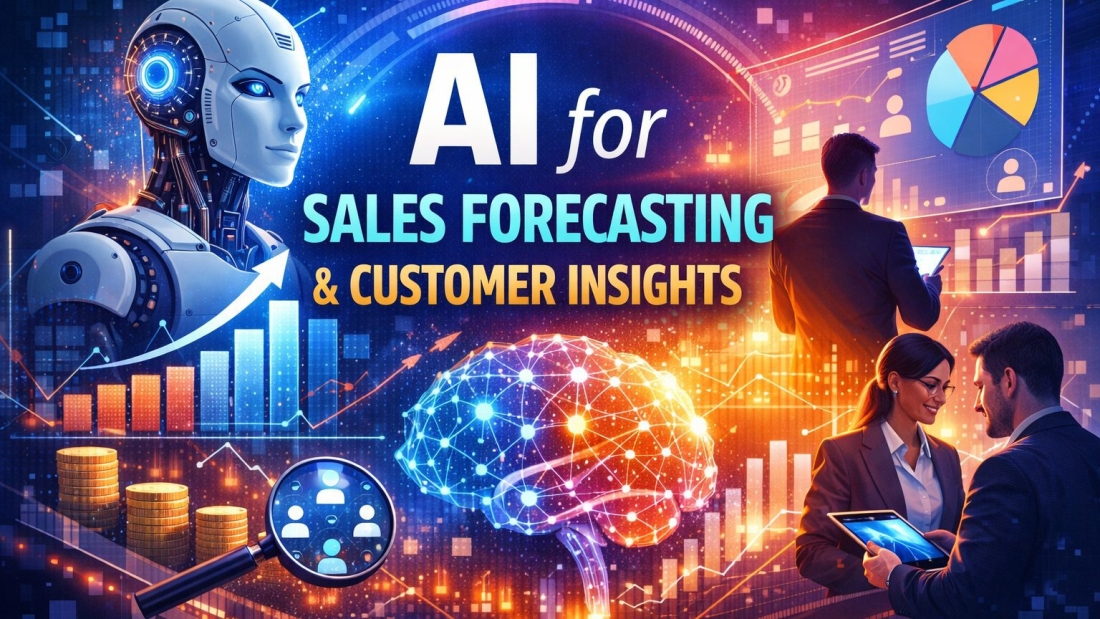
AI sales forecasting uses machine learning and predictive analytics to estimate future sales outcomes. It analyzes patterns in historical data, customer behavior, seasonality, and external factors to predict revenue and demand.

How AI Differs from Manual Forecasting

Manual forecasting is reactive. AI forecasting is proactive. AI learns continuously, adapts to new data, and improves accuracy over time—something static spreadsheets simply can’t do.

Rule-Based Models vs Machine Learning Models

Rule-based models follow fixed logic. Machine learning models, on the other hand, learn from data. They adjust predictions automatically as conditions change, making them far more powerful.


Understanding Customer Insights Through AI

What Are Customer Insights?

Customer insights are deep understandings of customer behavior, preferences, needs, and motivations. They answer questions like: Why do customers buy? When do they leave? What do they want next?

How AI Extracts Insights from Data

AI scans thousands of data points—from clicks and purchases to reviews and chats—and turns them into actionable insights. It’s like having a superpower that sees patterns invisible to the human eye.

Structured vs Unstructured Customer Data

Structured data includes CRM records and transactions. Unstructured data includes emails, reviews, and social posts. AI excels at analyzing both, especially unstructured data that humans struggle with.


Key Technologies Powering AI Sales Forecasting

Machine Learning Algorithms

Machine learning models identify trends, correlations, and anomalies in sales data. Over time, they refine predictions without manual intervention.

Predictive Analytics

Predictive analytics forecasts future outcomes based on historical and real-time data. It helps sales teams anticipate demand, revenue, and customer actions.

Natural Language Processing (NLP)

NLP allows AI to understand human language. It’s used to analyze customer feedback, emails, and conversations.

Sentiment Analysis in Sales

Sentiment analysis detects emotions in customer interactions. Happy, frustrated, or confused—AI reads between the lines and informs sales strategies.


Benefits of AI for Sales Forecasting

Improved Accuracy and Precision

AI reduces guesswork. Forecasts become more reliable, helping businesses plan confidently.

Faster Forecasting Cycles

What once took weeks now takes minutes. AI processes data instantly, enabling real-time forecasting.

Reduced Human Bias

AI relies on data, not emotions or assumptions. This leads to more objective predictions.

Better Inventory and Resource Planning

Accurate forecasts prevent overstocking or shortages, saving costs and improving efficiency.


Benefits of AI-Driven Customer Insights

Personalization at Scale

AI enables personalized offers, messages, and recommendations for thousands of customers simultaneously.

Better Customer Segmentation

AI groups customers based on behavior, value, and preferences, not just demographics.

Improved Customer Retention

By predicting churn, businesses can act before customers leave.

Predicting Customer Lifetime Value

AI estimates how much revenue a customer will generate over time, helping prioritize high-value customers.


AI Use Cases in Sales Forecasting

Demand Forecasting

AI predicts future product demand, helping businesses prepare ahead of time.

Revenue Prediction

Sales leaders can forecast revenue with higher confidence and accuracy.

Sales Pipeline Optimization

AI identifies bottlenecks and suggests actions to close deals faster.

Deal Win Probability Scoring

AI assigns probability scores to deals, helping sales teams focus on high-potential opportunities.


AI Use Cases in Customer Insights

Customer Behavior Prediction

AI predicts what customers are likely to do next—buy, upgrade, or leave.

Churn Prediction

AI flags customers at risk of leaving, enabling timely intervention.

Cross-Selling and Upselling

AI recommends relevant products based on customer behavior.

Purchase Intent Analysis

AI detects buying signals, helping sales teams strike at the right moment.


Data Sources Used for AI Sales Intelligence

CRM and ERP Systems

These systems provide structured data like sales history and customer profiles.

Website and App Analytics

User behavior data reveals interests and intent.

Social Media and Reviews

AI analyzes public sentiment and brand perception.

Customer Support Interactions

Support tickets and chats offer valuable insight into customer pain points.


Implementing AI in Sales Forecasting

Data Collection and Preparation

Clean, accurate data is the foundation of effective AI.

Choosing the Right AI Tools

Select tools that align with business goals and integrate easily.

Training and Testing Models

AI models must be trained, tested, and refined for accuracy.

Continuous Model Optimization

AI improves over time, but only with continuous monitoring.


Challenges of AI in Sales Forecasting

Data Quality Issues

Poor data leads to poor predictions.

High Implementation Costs

Initial setup can be expensive for small businesses.

Resistance from Sales Teams

Change can be uncomfortable. Training is essential.

Ethical and Privacy Concerns

Data privacy and compliance must be prioritized.


Best Practices for Using AI in Sales

Aligning AI with Business Goals

AI should solve real problems, not just look impressive.

Combining Human Expertise with AI

AI supports decision-making, it doesn’t replace humans.

Ensuring Data Security

Protect customer data with strong security measures.

Measuring AI Performance Metrics

Track accuracy, ROI, and impact regularly.


AI Tools for Sales Forecasting and Customer Insights

CRM-Based AI Tools

CRMs like Salesforce and HubSpot offer built-in AI features.

Standalone AI Analytics Platforms

These provide advanced forecasting and insights.

Cloud-Based AI Solutions

Cloud platforms offer scalability and flexibility.


Future of AI in Sales Forecasting

Real-Time Predictive Sales

Forecasts will update instantly as data changes.

Autonomous Sales Intelligence

AI will recommend actions, not just insights.

AI-Powered Decision Automation

Sales decisions will become faster and smarter.


Conclusion

AI for sales forecasting and customer insights is no longer optional—it’s essential. Businesses that embrace AI gain clarity, speed, and a competitive edge. By combining data, technology, and human expertise, AI turns uncertainty into opportunity and insights into growth.

AI for Sustainability — Using AI to Address Climate, Energy, and Environmental Challenges

AI for Sustainability — Using AI to Address Climate, Energy, and Environmental Challenges

Introduction to AI for Sustainability

Let’s be honest—climate change, energy shortages, and environmental damage can feel overwhelming. It’s like trying to fix a leaking dam with a roll of tape. But what if we had a smarter assistant, one that could analyze massive amounts of data, spot patterns humans might miss, and help us make better decisions faster? That’s where AI for sustainability comes in.

Artificial Intelligence isn’t just about chatbots or self-driving cars anymore. It’s becoming a powerful ally in the fight against climate change and environmental degradation.

What Sustainability Really Means in the AI Era

Sustainability is about meeting today’s needs without stealing from tomorrow. In the AI era, it means using intelligent systems to balance economic growth, environmental protection, and social well-being—all at once.

Why Technology Alone Is Not Enough

AI isn’t a magic wand. Think of it like a compass—it shows direction, but humans still have to walk the path. When combined with smart policies and responsible behavior, AI becomes a real game-changer.


The Growing Climate and Environmental Crisis

Climate Change at a Glance

Rising temperatures, melting glaciers, extreme weather—these aren’t future predictions anymore. They’re happening now. The challenge? Climate systems are incredibly complex, and traditional methods struggle to keep up.

Energy Scarcity and Environmental Degradation

As populations grow, so does energy demand. Fossil fuels still dominate, leading to pollution, deforestation, and biodiversity loss.

The Role of Data in Understanding the Crisis

Here’s the catch: we already have tons of data. Satellites, sensors, weather stations—you name it. AI helps turn this data chaos into clear, actionable insights.


What Is Artificial Intelligence?

A Simple Explanation of AI

AI is basically teaching machines to think—well, sort of. It allows computers to learn from data, recognize patterns, and make decisions with minimal human input.

Key AI Technologies Powering Sustainability

  • Machine Learning
  • Deep Learning
  • Computer Vision
  • Natural Language Processing

Machine Learning, Deep Learning, and Predictive Analytics

These technologies help predict weather patterns, optimize energy usage, and even detect illegal deforestation—sometimes in real time.


How AI Supports Climate Change Mitigation

AI in Climate Modeling and Prediction

Climate models used to take weeks. AI-powered models can process scenarios faster and more accurately, helping scientists predict floods, heatwaves, and storms.

Reducing Greenhouse Gas Emissions with AI

AI optimizes industrial processes, transportation routes, and energy consumption—cutting emissions without sacrificing productivity.

Carbon Tracking and Monitoring Systems

AI-powered platforms can now track carbon footprints across entire supply chains. Transparency is the first step toward accountability.


AI for Renewable Energy Optimization

Smart Solar and Wind Energy Forecasting

Renewable energy depends on weather, which is unpredictable. AI improves forecasting, making clean energy more reliable.

AI-Driven Energy Storage Solutions

AI helps decide when to store energy and when to release it—like a smart battery manager.

Grid Balancing and Demand Forecasting

Smart grids use AI to balance supply and demand, reducing energy waste and blackouts.


AI in Energy Efficiency and Smart Cities

Smart Buildings and Energy Management

AI-powered buildings adjust lighting, heating, and cooling automatically—saving energy without compromising comfort.

AI-Powered Urban Planning

From reducing traffic congestion to optimizing public transport, AI helps cities breathe a little easier.

Traffic, Lighting, and Waste Optimization

Ever seen streetlights turn on only when someone walks by? That’s AI quietly saving energy.


AI in Environmental Protection

Wildlife Conservation and Biodiversity

AI analyzes camera traps and drones to track endangered species and stop poaching.

Deforestation and Land Monitoring

Satellite images + AI = real-time deforestation alerts. Forests finally get a digital guardian.

Ocean Health and Marine Life Protection

AI monitors ocean temperatures, coral reefs, and illegal fishing—protecting life beneath the waves.


AI for Sustainable Agriculture

Precision Farming with AI

AI helps farmers decide when to plant, water, and harvest—using fewer resources and boosting yields.

Water Management and Soil Health

Smart irrigation systems reduce water waste while keeping crops healthy.

Reducing Food Waste Using AI

From supply chains to supermarkets, AI predicts demand and cuts food waste dramatically.


AI and Circular Economy

Waste Sorting and Recycling Automation

AI-powered robots can sort waste faster and more accurately than humans.

Designing Sustainable Products

AI helps design products that are easier to recycle and last longer.

AI in Supply Chain Optimization

Less waste, fewer emissions, smoother logistics—it’s efficiency at its best.


AI for Disaster Prediction and Management

Early Warning Systems

AI detects earthquakes, floods, and wildfires earlier—saving lives.

Disaster Response and Recovery

AI helps coordinate rescue efforts and allocate resources efficiently.

Climate Resilience Planning

Governments use AI to plan infrastructure that can survive future climate risks.


Ethical and Environmental Challenges of AI

Energy Consumption of AI Models

Big AI models consume a lot of power. Green AI focuses on efficiency and renewable energy usage.

Data Bias and Environmental Justice

If data is biased, AI decisions can be unfair. Responsible data practices are essential.

Responsible and Green AI Practices

Sustainable AI means transparent, efficient, and ethical systems.


Real-World Examples of AI for Sustainability

AI Projects Tackling Climate Change

From Google’s AI reducing data center energy use to AI-driven climate platforms, real impact is already visible.

Corporate and Government Initiatives

Governments and companies worldwide are investing in AI-driven sustainability programs.

Startups Driving Sustainable Innovation

Small startups are often the biggest innovators, using AI to solve niche environmental problems.


The Future of AI for Sustainability

Expect more AI-powered climate tools, smarter energy systems, and greener technologies.

Collaboration Between Humans and AI

AI won’t replace humans—it will empower them to make smarter decisions.

Policy, Regulation, and Global Impact

Strong policies will ensure AI benefits the planet, not harms it.


Conclusion

AI for sustainability isn’t science fiction—it’s happening right now. Like a skilled co-pilot, AI helps humanity navigate the complex challenges of climate change, energy efficiency, and environmental protection. When used responsibly, AI can turn data into hope and innovation into action. The future isn’t just intelligent—it’s sustainable.

AI-Native Programming Coding in a Post-LLM World

AI-Native Programming: Coding in a Post-LLM World

Introduction to AI-Native Programming

Let’s be honest—coding doesn’t look the same anymore. If you’ve written software in the last few years, you’ve probably felt it too. AI isn’t just helping developers write code faster; it’s changing how we think about programming altogether. Welcome to AI-native programming, where software is built with AI at its core, not as an afterthought.

This isn’t just another trend. It’s a shift as big as moving from assembly language to high-level programming. And yes, we’re already living in it.


What Does “Post-LLM World” Really Mean?

A post-LLM world doesn’t mean Large Language Models (LLMs) are gone. Quite the opposite. It means they’re everywhere—quietly embedded into workflows, tools, and decision-making processes.

In this world:

  • Writing every line of code manually feels outdated
  • Developers focus more on intent than syntax
  • AI becomes a collaborator, not just a tool

Think of it like GPS for coding. You still drive the car, but you’re no longer memorizing every road.


How Programming Looked Before LLMs

Before LLMs, programming was mostly:

  • Manual coding line by line
  • Heavy reliance on documentation and Stack Overflow
  • Slow debugging cycles
  • Steep learning curves for beginners

Developers spent more time writing code than thinking about systems. Creativity was often limited by time, syntax, and repetitive tasks.


The Rise of AI-Native Developers

AI-native developers are not just coders who “use AI.” They design software assuming AI will:

  • Generate boilerplate
  • Suggest architectures
  • Refactor and optimize code
  • Explain and document logic

They don’t ask “Can AI help here?”
They ask “Why wouldn’t AI handle this?”


Core Principles of AI-Native Programming

Human-in-the-Loop Development

AI writes fast. Humans think deep. AI-native programming blends both. Developers guide, review, and validate while AI handles execution-heavy tasks.

It’s like flying a plane with autopilot—you’re still the pilot.


Prompt-Driven Engineering

Prompts become the new instructions. Clear, structured prompts define:

  • What the system should do
  • Constraints and edge cases
  • Performance and security expectations

Bad prompt? Bad output. Simple as that.


Model-Aware Code Design

AI-native systems are built knowing:

  • Which models are used
  • Their strengths and limits
  • How they evolve over time

This awareness shapes architecture decisions from day one.


Automation-First Mindset

If a task is repetitive, AI should own it. Testing, documentation, refactoring—automation isn’t optional anymore. It’s expected.


How LLMs Are Changing the Coding Workflow

From Writing Code to Directing Code

Developers are shifting from typing code to directing outcomes. Instead of asking “How do I write this loop?” you ask “What’s the best way to solve this problem?”

AI handles the “how.” You focus on the “why.”


AI as a Pair Programmer

LLMs don’t get tired. They don’t judge. In fact, they explain things calmly, again and again.

They:

  • Suggest improvements
  • Catch bugs early
  • Offer alternative approaches

It’s like having a senior developer on call 24/7.


Faster Prototyping and Iteration

Ideas move from concept to code in hours, not weeks. Startups love this. So do enterprises racing against time.

Speed is no longer a luxury—it’s the default.


AI-Native Tools and Frameworks

AI-Assisted IDEs

Modern IDEs now:

  • Autocomplete entire functions
  • Explain unfamiliar code
  • Refactor with context awareness

Coding feels more like a conversation than a chore.


Agent-Based Development Platforms

AI agents can:

  • Build features autonomously
  • Run tests
  • Fix errors
  • Deploy updates

Developers become orchestrators of intelligent agents.


Code Generation and Refactoring Tools

Legacy code? No problem. AI can:

  • Understand old systems
  • Rewrite them cleanly
  • Add missing documentation

It’s like renovating a house without tearing it down.


AI-Native Programming Languages: Are They Coming?

Natural Language as Code

Why shouldn’t English—or any human language—be executable? We’re already halfway there.

“Build an API with authentication and logging” is becoming a valid instruction.


Hybrid Human-AI Syntax

Future languages may blend:

  • Structured code
  • Natural language descriptions
  • AI-interpreted intent

Less syntax. More meaning.


Examples and Early Experiments

Tools and DSLs already hint at this future, where code reads more like a conversation than a puzzle.


Impact on Software Architecture

Modular and Intent-Based Design

Systems are designed around what they do, not just how they’re implemented. AI fills in the gaps.


Self-Documenting Systems

AI-generated documentation stays updated automatically. No more outdated README files.


Adaptive and Learning Architectures

AI-native systems evolve. They learn from usage, optimize performance, and adapt to new requirements.


New Skills Developers Must Learn

Prompt Engineering as a Core Skill

Writing good prompts is the new clean code. Precision matters.


System Thinking Over Syntax

Understanding architecture, workflows, and user needs matters more than memorizing syntax.


AI Evaluation and Debugging

Developers must verify outputs, detect hallucinations, and ensure correctness. AI isn’t magic—it needs supervision.


Ethical and Security Challenges

Code Reliability and Hallucinations

AI can be confidently wrong. Human validation is non-negotiable.


Data Privacy and IP Risks

Feeding sensitive data into models requires strict controls and awareness.


Over-Reliance on AI

AI should assist, not replace thinking. The moment we stop questioning outputs, problems begin.


AI-Native Programming in Real-World Use Cases

Startups and Rapid MVPs

AI-native development lets startups test ideas fast and cheap.


Enterprise Software Modernization

Old systems get new life with AI-assisted refactoring and documentation.


Education and Learning to Code

Beginners learn concepts faster when AI explains mistakes in real time.


The Future of Developers in a Post-LLM World

Developers won’t disappear. They’ll evolve into:

  • Problem solvers
  • System designers
  • AI supervisors

The keyboard stays. The mindset changes.


Is Traditional Coding Becoming Obsolete?

Not obsolete—augmented. Manual coding still matters, but it’s no longer the bottleneck.


How to Start Your AI-Native Programming Journey

  • Use AI daily, not occasionally
  • Learn to write better prompts
  • Focus on architecture and logic
  • Treat AI as a teammate, not a shortcut

Conclusion

AI-native programming isn’t about replacing developers. It’s about freeing them. In a post-LLM world, coding becomes more creative, more strategic, and surprisingly more human. Those who adapt won’t just survive—they’ll build the future faster than ever.