

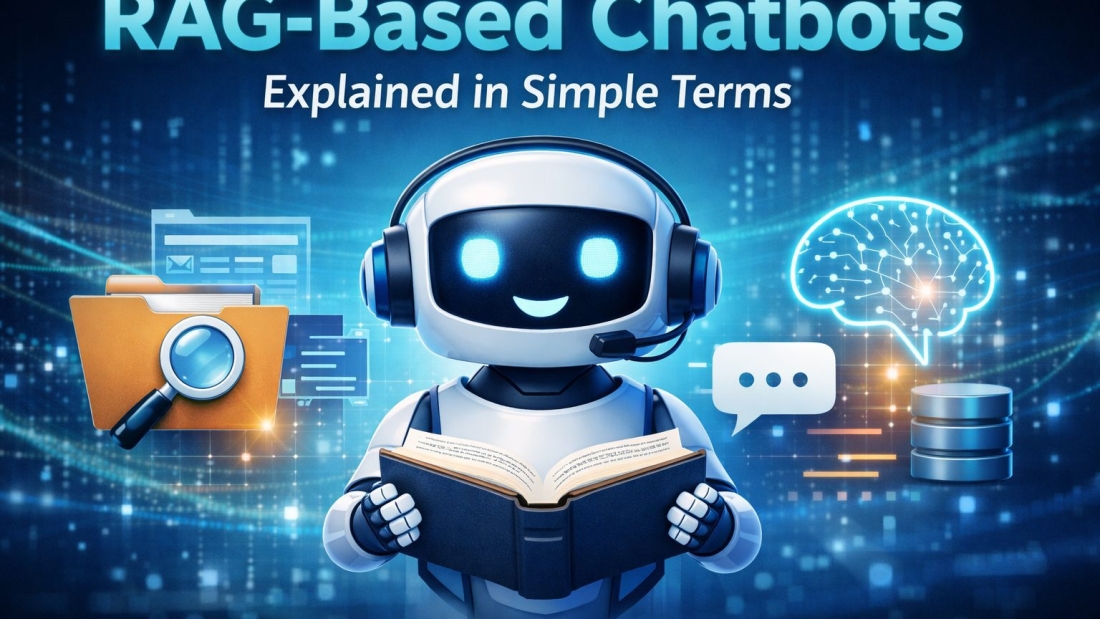
Introduction to RAG-Based Chatbots
Chatbots are everywhere. From customer support windows popping up on websites to AI assistants helping you write emails, they’ve become part of daily digital life. But here’s the thing—many chatbots still struggle with accuracy, outdated information, or just plain guessing. That’s where RAG-based chatbots come in, and they’re kind of a game-changer.
RAG-based chatbots are designed to be smarter, more reliable, and far less “confidently wrong.” Sounds good already, right? Let’s break it all down in the simplest way possible.
What Does RAG Stand For?
RAG stands for Retrieval-Augmented Generation.
Big words, simple idea.
- Retrieval: Find the right information.
- Augmented: Add that information to context.
- Generation: Create a human-like response.
In short, RAG helps chatbots look things up before answering, instead of relying only on what they remember.
Why Everyone Is Talking About RAG
Because RAG solves one of the biggest problems in AI chatbots: hallucinations. That’s when a chatbot confidently gives you an answer that sounds right but is totally wrong. With RAG, the chatbot grounds its answers in real data. Think less guessing, more knowing.
Understanding Chatbots Before RAG
Before RAG, chatbots had two main styles. Neither was perfect.
Traditional Rule-Based Chatbots
These are the old-school bots. They follow strict rules like:
“If user says X, reply with Y.”
They’re predictable and safe but also painfully limited. Ask something unexpected, and they break faster than a cheap toy.
AI-Powered Chatbots Without RAG
These chatbots use large language models trained on massive datasets. They’re great at conversation but rely only on what they learned during training.
Limitations of Pre-Trained Models
- They can’t access new or private data.
- They may give outdated answers.
- They sometimes make things up.
Basically, they’re like a smart friend who hasn’t checked the internet in years.
What Is Retrieval-Augmented Generation (RAG)?
The Simple Definition
RAG is a method where a chatbot retrieves relevant information from a data source first, then uses that information to generate an answer.
Instead of guessing, it checks its notes.
RAG Explained With a Real-Life Example
Imagine a student in an exam.
- Without RAG: The student answers purely from memory.
- With RAG: The student is allowed to open the book, find the right page, then answer.
Which one would you trust more?
Why Retrieval Matters
Because no AI model can remember everything. Retrieval lets the chatbot stay accurate, updated, and specific—especially when dealing with company data or technical documentation.
How RAG-Based Chatbots Work (Step by Step)
Let’s walk through it like a simple flow.
Step 1 – User Asks a Question
You ask something like:
“What’s our company’s refund policy?”
Step 2 – Information Retrieval
The system searches a knowledge base, documents, or database to find relevant content.
Step 3 – Context Injection
The retrieved information is added to the chatbot’s prompt as context.
Step 4 – Answer Generation
The AI generates a response using both its language skills and the retrieved data.
The result? A clear, accurate, and relevant answer.
Key Components of a RAG System
The Knowledge Source
This could be:
- PDFs
- Databases
- Websites
- Internal company documents
The Retriever
This component finds the most relevant pieces of information. Often powered by vector databases and embeddings.
The Language Model
This is the “talker.” It turns raw information into a natural response.
How These Components Work Together
Think of it as a team:
- One member searches.
- One member understands.
- One member explains.
RAG vs Traditional Chatbots
Accuracy Comparison
RAG chatbots win. Hands down. They rely on real data, not assumptions.
Knowledge Freshness
Traditional models are stuck in the past. RAG models can use up-to-date information instantly.
Flexibility and Scalability
Add new documents, and the chatbot instantly becomes smarter—no retraining required.
Benefits of RAG-Based Chatbots
More Accurate Answers
Because answers are grounded in retrieved data, not just probability.
Reduced Hallucinations
RAG significantly lowers the chances of made-up responses.
Real-Time Knowledge Access
Perfect for fast-changing industries.
Better User Trust
When users get consistent and correct answers, trust follows naturally.
Common Use Cases of RAG-Based Chatbots
Customer Support
Answer FAQs using live company policies.
Internal Company Knowledge Bases
Employees get instant answers without digging through documents.
Education and Learning
Students can ask questions based on specific textbooks or notes.
Healthcare and Legal Assistance
Access structured, verified information with reduced risk.
RAG-Based Chatbots in Businesses
Why Companies Are Adopting RAG
Because it:
- Saves time
- Reduces support costs
- Improves accuracy
Cost vs Value Perspective
While setup may cost more initially, the long-term ROI is strong.
Competitive Advantage
Faster, smarter support equals happier customers.
Challenges and Limitations of RAG
Data Quality Issues
Bad data = bad answers. RAG is only as good as its sources.
Retrieval Errors
If the retriever fetches the wrong info, the answer suffers.
Performance and Latency
More steps mean slightly slower responses if not optimized.
RAG vs Fine-Tuning
Key Differences Explained Simply
- Fine-tuning teaches the model new behavior.
- RAG gives the model new information.
When to Use RAG
The point data changes often or is private.
When Fine-Tuning Makes Sense
When you want consistent tone or behavior changes.
Tools and Technologies Used in RAG
Vector Databases
Used to store and search embeddings efficiently.
Embeddings
Numerical representations of text that make retrieval possible.
APIs and Frameworks
These glue everything together.
Future of RAG-Based Chatbots
Smarter Retrieval Systems
Better ranking, filtering, and context selection.
Multimodal RAG
Text + images + videos all working together.
RAG Combined With Agents
Autonomous systems that can plan, retrieve, and act.
Is RAG the Right Choice for You?
Questions to Ask Before Building
- Do you have a lot of documents?
- Does your data change often?
- Is accuracy critical?
RAG for Small vs Large Teams
RAG scales well for both—just adjust complexity.
Best Practices for Building RAG Chatbots
Clean and Structured Data
Garbage in, garbage out.
Continuous Evaluation
Test answers regularly.
User Feedback Loops
Let users help improve accuracy.
Final Thoughts on RAG-Based Chatbots
RAG-based chatbots are like giving AI a reliable reference book. They combine the best of both worlds—human-like conversation and fact-based accuracy. If you care about trust, precision, and scalability, RAG isn’t just a trend. It’s the future.