

Introduction to Energy Consumption Forecasting
Why Energy Forecasting Matters Today
Imagine running a city without knowing how much electricity people will need tomorrow. Sounds chaotic, right? That’s exactly why energy consumption forecasting matters. Power plants, grid operators, and businesses rely on accurate predictions to keep the lights on—literally.
Energy forecasting helps utilities balance supply and demand. Too much power? Waste. Too little? Blackouts. In a world moving toward renewable energy and smart grids, precision is no longer optional—it’s essential.
The Growing Complexity of Energy Demand
Energy demand isn’t what it used to be. We now have electric vehicles, smart homes, rooftop solar panels, and data centers consuming massive amounts of power. Weather patterns are shifting. Human behavior changes rapidly.
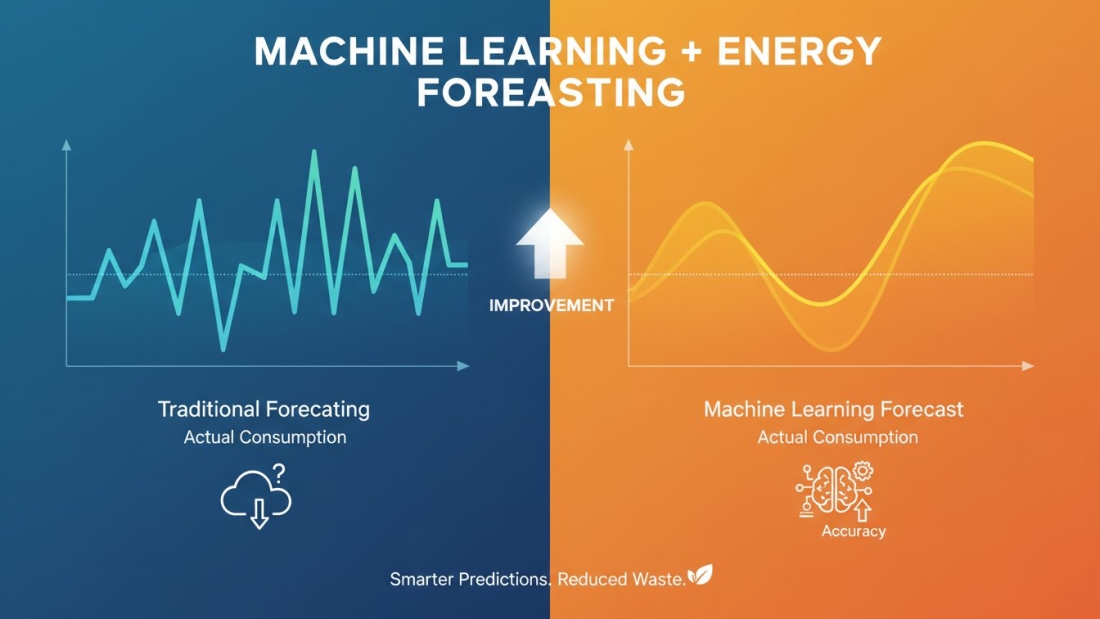
Traditional models struggle to keep up. This is where machine learning steps in like a supercharged brain.
Traditional Energy Forecasting Methods
Statistical Models and Their Limitations
For decades, forecasting relied on linear regression and time-series models like ARIMA. These methods worked well when patterns were stable and predictable.
Traditional models assume relationships are simple. Reality says otherwise.
Why Legacy Models Struggle with Modern Data
Legacy systems can’t process massive streams of smart meter data efficiently. They don’t adapt quickly to sudden changes like heatwaves or economic disruptions.
Think of them as calculators in a world that now requires supercomputers.
What is Machine Learning?
Core Concepts of Machine Learning
Machine learning (ML) is a subset of artificial intelligence where systems learn from data instead of being explicitly programmed.
Instead of telling a model, “Energy increases when temperature rises,” you feed it data. The model discovers patterns on its own.
Supervised vs. Unsupervised Learning
In supervised learning, models are trained using labeled data—like historical energy usage and known outcomes.
Unsupervised learning, on the other hand, finds hidden patterns without predefined labels. It’s like uncovering secrets buried in data.
The Role of Machine Learning in Energy Forecasting
Pattern Recognition at Scale
Machine learning thrives on patterns. It can detect subtle correlations between temperature, humidity, holidays, and electricity demand—patterns humans might miss.
And it does this across millions of data points.
Learning from Historical and Real-Time Data
ML models continuously learn. They adapt as new data flows in from smart meters, IoT sensors, and weather systems.
The result? Forecasts that improve over time instead of becoming outdated.
Types of Machine Learning Models Used
Regression Models
Advanced regression models like Support Vector Regression capture nonlinear relationships better than traditional linear regression.
They’re like upgraded tools—more flexible and precise.
Decision Trees and Random Forest
Decision trees break problems into smaller decisions. Random forests combine multiple trees for stronger predictions.
Think of it as consulting multiple experts instead of relying on one opinion.
Neural Networks and Deep Learning
Neural networks mimic the human brain. They process layers of data to detect complex relationships.
Recurrent Neural Networks (RNN)
RNNs are designed for sequential data, making them ideal for time-series forecasting.
Long Short-Term Memory (LSTM) Models
LSTM models remember long-term dependencies. They understand how last winter’s energy usage might influence this year’s patterns.
That memory is powerful.
Key Data Sources for Energy Forecasting
Smart Meter Data
Smart meters provide real-time consumption data at granular levels. This data fuels ML models with detailed insights.
Weather and Environmental Data
Temperature, wind speed, humidity, and solar radiation heavily impact energy demand.
ML integrates this seamlessly.
Economic and Behavioral Data
Economic growth, population trends, and even major events affect consumption. ML models can incorporate all of it.
Benefits of Machine Learning in Energy Forecasting
Higher Accuracy
Studies consistently show ML-based models outperform traditional methods in prediction accuracy.
Less guesswork. More precision.
Real-Time Adaptability
Sudden heatwave? Unexpected event? ML adapts quickly without manual recalibration.
Scalability
From a single building to an entire national grid, ML scales effortlessly.
Short-Term vs. Long-Term Energy Forecasting
Day-Ahead Forecasting
Day-ahead predictions help utilities plan power generation and pricing.
Accuracy here directly impacts costs.
Seasonal and Annual Predictions
Long-term forecasting supports infrastructure planning and investment decisions.
It shapes the future of energy systems.
Machine Learning and Renewable Energy Integration
Managing Solar and Wind Variability
Solar and wind are unpredictable. Cloud cover changes. Wind speeds fluctuate.
ML predicts generation patterns, reducing uncertainty.
Grid Stability Improvements
Better forecasting means fewer imbalances, fewer outages, and a more resilient grid.
Challenges in Implementing Machine Learning Models
Data Quality Issues
Poor data equals poor predictions. Cleaning and preprocessing are critical.
Model Interpretability
Some deep learning models act like “black boxes.” Understanding how they make decisions can be challenging.
Computational Costs
Training large models requires computing power. However, cloud solutions are reducing barriers.
Real-World Applications and Case Studies
Utility Companies
Utilities use ML to optimize load distribution and reduce operational costs.
Smart Cities
Smart cities leverage ML forecasting to manage street lighting, EV charging, and building efficiency.
Industrial Energy Management
Factories use ML to predict peak loads and avoid penalty charges.
The Future of AI in Energy Forecasting
Edge Computing and IoT Integration
IoT devices combined with edge computing enable real-time predictions at the source.
Faster. Smarter. More efficient.
Autonomous Energy Grids
Self-healing grids powered by AI may soon adjust automatically without human intervention.
Science fiction? Not anymore.
Best Practices for Building Effective Models
Data Preprocessing
Clean data is non-negotiable.
Feature Engineering
Selecting the right variables dramatically improves performance.
Continuous Model Training
Models must evolve with changing consumption patterns.
Why Businesses Should Care About ML-Based Forecasting
Energy costs directly impact profits. Better forecasting means better budgeting, reduced waste, and smarter investments.
Would you rather guess your expenses—or predict them accurately?
Machine learning turns uncertainty into strategic advantage.
Conclusion
Energy consumption forecasting has entered a new era. Traditional methods served their purpose, but the complexity of modern energy systems demands something smarter.
Machine learning brings adaptability, precision, and scalability to forecasting models. It learns from massive datasets, adapts to real-time changes, and improves over time. From integrating renewable energy to stabilizing smart grids, ML is reshaping how we predict and manage energy demand.
In a world racing toward sustainability and digital transformation, machine learning isn’t just improving forecasting—it’s redefining it.