

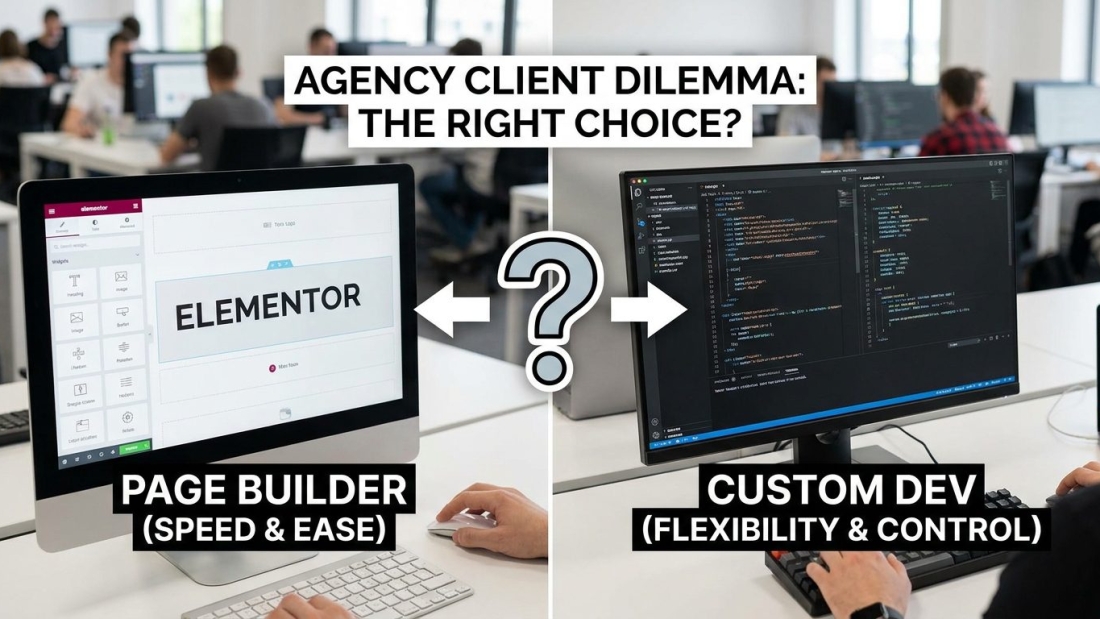
Elementor vs Custom Development — A Clear Breakdown
Core Difference
Elementor operates like a visual workshop where pages are assembled through drag-and-drop mechanics. It removes the friction of coding, letting teams craft websites quickly with pre-built elements. This makes it highly appealing for agencies handling multiple lightweight projects where speed matters more than precision.
Custom development, by contrast, is a ground-up creation. Every function, structure, and interaction is coded intentionally. Nothing is inherited unless deliberately added. This results in a product shaped exactly around the client’s requirements, not confined by any predefined system.
Speed vs Control
Elementor thrives on rapid execution. Websites can go live within days, making it ideal for tight timelines and quick turnarounds. It’s like assembling a ready-made structure—fast, efficient, and predictable.
Custom development moves slower but offers absolute control. Each feature is engineered with care, allowing agencies to build complex systems without compromise. The timeline stretches, but so does the level of precision.
Cost Perspective
Elementor is generally lighter on the wallet. Reduced development time means lower upfront costs, which suits startups and small businesses. However, recurring expenses from plugins and maintenance can accumulate over time.
Custom development requires a larger initial investment. You’re funding expertise, planning, and execution. While expensive at the start, it often prevents costly rebuilds later.
Performance and Growth
Elementor can perform well, but excess plugins and layered code may weigh it down as the site grows. Optimization becomes necessary to maintain speed.
Custom-built websites are leaner. They include only what’s needed, resulting in faster performance and stronger scalability. This makes them better suited for high-traffic or evolving platforms.
Design Flexibility
Elementor offers flexibility within its framework, but patterns can repeat. It’s creative, yet not limitless.
Custom development removes boundaries entirely. Every detail can be shaped uniquely, making it the better choice for brands that want a distinct identity.
Maintenance and SEO
Elementor simplifies updates and allows non-technical users to manage content easily. Still, plugin conflicts can arise if not handled carefully.
Custom development demands technical upkeep but tends to be more stable. It also provides deeper SEO control through cleaner code and faster load times.
Security
Elementor relies on multiple plugins, each adding a potential risk if not maintained properly.
Custom development reduces dependency on third-party tools, allowing tighter, more controlled security measures.
When to Choose What
- Choose Elementor for speed, affordability, and simple projects.
- Choose Custom Development for scalability, performance, and complex functionality.
Final Thought
There’s no universal winner. Elementor excels in convenience, while custom development dominates in precision. The smartest choice depends entirely on the project’s scope, budget, and long-term vision.