

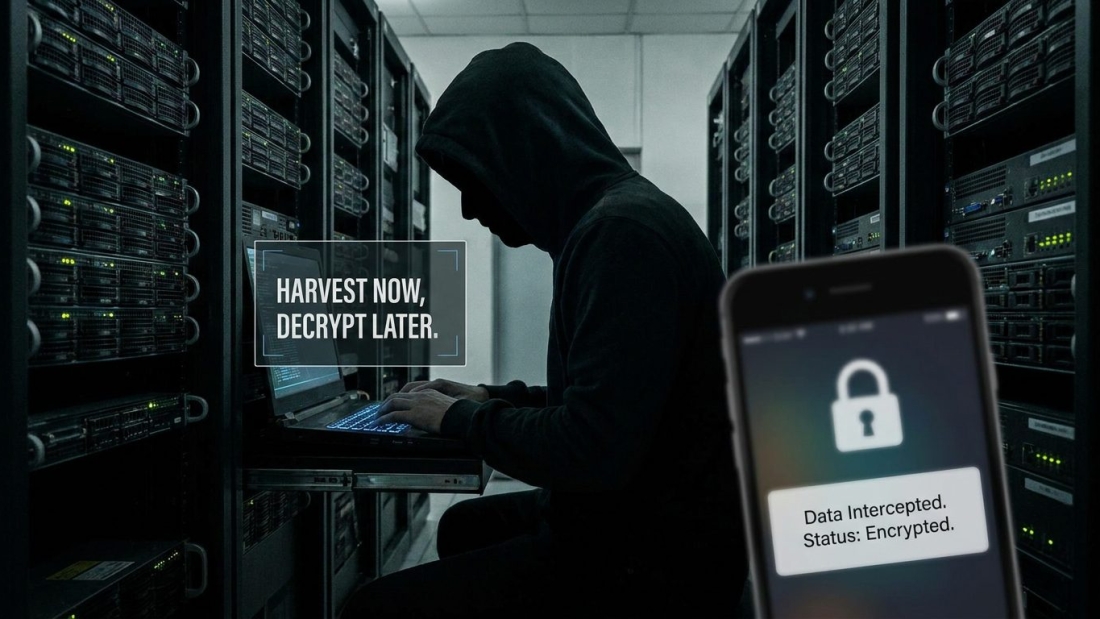
Most businesses believe encryption keeps their data safe. Lock it up, and no one gets in. But what if attackers aren’t trying to break in today — they’re simply waiting?
Welcome to one of the most dangerous and least-discussed cybersecurity threats of 2026: Harvest Now, Decrypt Later (HNDL).
What Is Harvest Now, Decrypt Later?
HNDL is a strategy used by nation-state actors and sophisticated cybercriminals. The idea is simple but devastating — attackers intercept and steal your encrypted data today, store it, and wait until quantum computers are powerful enough to break the encryption and read everything inside.
No immediate breach. No ransom demand. No alarm goes off. Just silent, patient collection.
The data you send today — contracts, financial records, client information, intellectual property — could be fully readable to an adversary within the next decade.
Why This Is a Present-Day Problem
Many businesses think quantum computing is a distant threat. It isn’t.
Cybersecurity agencies including the US Department of Homeland Security, the UK’s National Cyber Security Centre, and the EU Agency for Cybersecurity have all confirmed that adversaries are already harvesting encrypted data right now, banking on future quantum capabilities to unlock it.
In 2024, NIST finalized the world’s first post-quantum cryptography standards — a clear signal that the threat is real and the transition needs to begin immediately.
More alarming: recent research published between 2025 and 2026 has significantly reduced the estimated computing power needed to break RSA-2048 encryption. Timelines are compressing faster than most security teams anticipated.
Who Is Most at Risk?
Any organization that stores sensitive, long-lived data faces exposure. That includes:
- Financial institutions — transaction records, trading data, client communications
- Healthcare providers — patient records that must stay confidential for decades
- Government and defence — classified communications and national security data
- Enterprises with valuable IP — product designs, research, competitive intelligence
- Any business handling long-term customer data
If your data needs to remain confidential for ten or more years, it is already a target.
What Can You Do Right Now?
Quantum readiness is not a one-day fix. Cryptographic migrations historically take five to ten years. The window to act is open — but it won’t stay open.
Here’s where to start:
- Map your sensitive data — know what you have, where it lives, and how long it needs to stay protected
- Audit your encryption — identify systems running on RSA or elliptic curve cryptography, which quantum computers can break
- Segment your networks — limit how much data an attacker can harvest from a single access point
- Begin post-quantum migration planning — start with the most vulnerable, highest-value systems first
The Bottom Line
The breach you face in 2032 may have already started today. Organisations that act now will control their transition. Those that wait will be reacting to a breach they never saw coming.
At LogIQ Curve, we help enterprises across the GCC, UK, and beyond build cybersecurity strategies built for the threats of today — and tomorrow.