

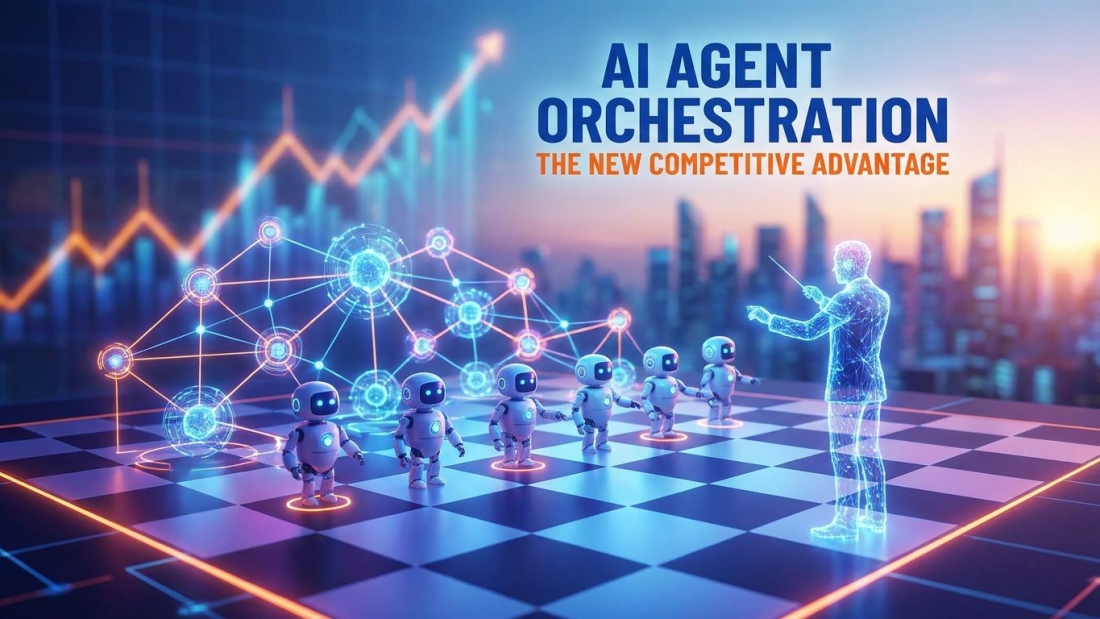
Artificial intelligence is no longer limited to simple chat replies or automated emails. Businesses are now building connected AI ecosystems where multiple intelligent agents work together like a coordinated digital workforce. This shift is known as AI agent orchestration, and it is quickly becoming a major competitive advantage.
Instead of relying on isolated AI tools, companies are linking systems together so they can exchange information, complete tasks collectively, and react faster. One AI agent may analyze customer behavior, another may manage operations, while another handles reporting or support. Together, they create a smoother and far more efficient workflow.
Think of it like an orchestra. A single musician can perform well, but a full orchestra creates something richer and more powerful. AI orchestration follows the same idea, different AI agents perform specialized roles while one orchestration layer keeps everything synchronized.
What AI Agent Orchestration Really Means
AI agent orchestration is the process of managing multiple AI systems so they operate toward a shared objective. Every agent has a unique responsibility. Some focus on analytics, others manage customer interactions, while some handle internal processes.
Without orchestration, AI tools often remain disconnected. Marketing software, customer support systems, and analytics platforms may all work separately without sharing insights. Orchestration connects them into one intelligent network where information flows instantly between systems.
This reduces manual work significantly. Employees no longer need to move data between platforms or repeat the same processes. AI agents automatically exchange information in real time, improving speed, accuracy, and operational efficiency.
How AI Agents Work Together
AI agents collaborate through constant communication and automation triggers. An orchestration layer acts like a digital manager, ensuring each system understands its role and timing.
For example, an online store may use one AI agent to track customer demand, another to monitor inventory, and another to manage customer service. If a product suddenly becomes popular, the system can automatically update stock alerts, launch promotions, and adjust delivery timelines without human intervention.
This goes beyond traditional automation. Instead of handling isolated tasks, orchestrated AI creates intelligent workflows capable of managing complex operations simultaneously.
Why Businesses Are Adopting It
The biggest advantage is speed. Companies can process information and react much faster than before. In competitive industries, even minor delays can lead to lost customers and missed revenue.
Customer experience also improves dramatically. AI orchestration allows businesses to deliver quicker support, personalized recommendations, and seamless service by connecting multiple systems together.
Cost reduction is another driving factor. Repetitive tasks that once required large teams can now be automated. Employees can focus more on strategy and creative work instead of repetitive operations.
| Benefit | Business Impact |
|---|---|
| Faster workflows | Higher efficiency |
| Smarter automation | Lower labor costs |
| Connected systems | Better decision-making |
| Real-time insights | Faster growth |
Industries Already Using AI Orchestration
Healthcare organizations use orchestrated AI to manage appointments, patient records, and diagnostics more efficiently. Financial companies rely on connected AI systems to monitor fraud, process transactions, and analyze risk in real time.
E-commerce brands also use orchestration heavily. AI agents personalize shopping experiences, optimize pricing, manage recommendations, and monitor deliveries simultaneously. Marketing teams use connected AI systems to automate campaigns and analyze audience behavior more effectively.
Challenges Businesses Face
Despite its benefits, AI orchestration comes with challenges. Security is a major concern because multiple systems constantly exchange sensitive data. Weak protection can lead to cyber threats and data breaches.
Data quality also matters. AI systems depend on accurate information. If the data is outdated or incorrect, the entire orchestration process becomes unreliable.
Another obstacle is integration. Older business systems often struggle to connect with modern AI platforms, forcing companies to upgrade infrastructure before orchestration can work properly.
The Future of AI Agent Ecosystems
The future of AI orchestration looks incredibly advanced. Businesses are moving toward fully connected ecosystems where AI agents handle large portions of operations automatically.
Human employees will focus more on creativity, strategy, and relationship-building while AI manages repetitive workflows. Instead of replacing people completely, orchestrated AI will act as a highly capable digital co-worker.
Companies adopting these systems early are positioning themselves for long-term growth and stronger competitive power.
Conclusion
AI agent orchestration is transforming how modern businesses operate. Instead of using disconnected AI tools, companies are creating intelligent ecosystems where multiple AI agents collaborate smoothly.
This creates faster workflows, sharper decision-making, lower operational costs, and better customer experiences. As AI technology continues evolving, orchestration will likely become a core business strategy rather than an optional innovation.
Businesses that embrace AI orchestration today are preparing for a future driven by speed, automation, and intelligent collaboration.