
Introduction to Open-Source LLMs
What Are Large Language Models (LLMs)?
Large Language Models, or LLMs, are AI systems trained on massive amounts of text to understand, generate, and reason with human language. Think of them as ultra-smart autocomplete engines that don’t just finish your sentences—but understand context, intent, and meaning.
Why Open-Source LLMs Matter for Businesses
Open-source LLMs give businesses freedom. Freedom from vendor lock-in, and to customize and control data. Unlike closed models, open-source LLMs let companies adapt AI exactly to their workflows, tone, and industry needs.
Why Businesses Are Moving Toward Fine-Tuned LLMs
Generic AI vs Business-Specific AI
Generic AI is like hiring a smart intern who knows a little about everything. Fine-tuned AI? That’s like training a senior employee who knows your business inside out. Businesses don’t want “almost right” answers anymore—they want precision.
Competitive Advantage Through Customization
When your AI understands your products, policies, customers, and language, it becomes a strategic weapon. Faster responses, fewer mistakes, and happier customers—all from one tailored system.
Understanding Fine-Tuning
What Fine-Tuning Really Means
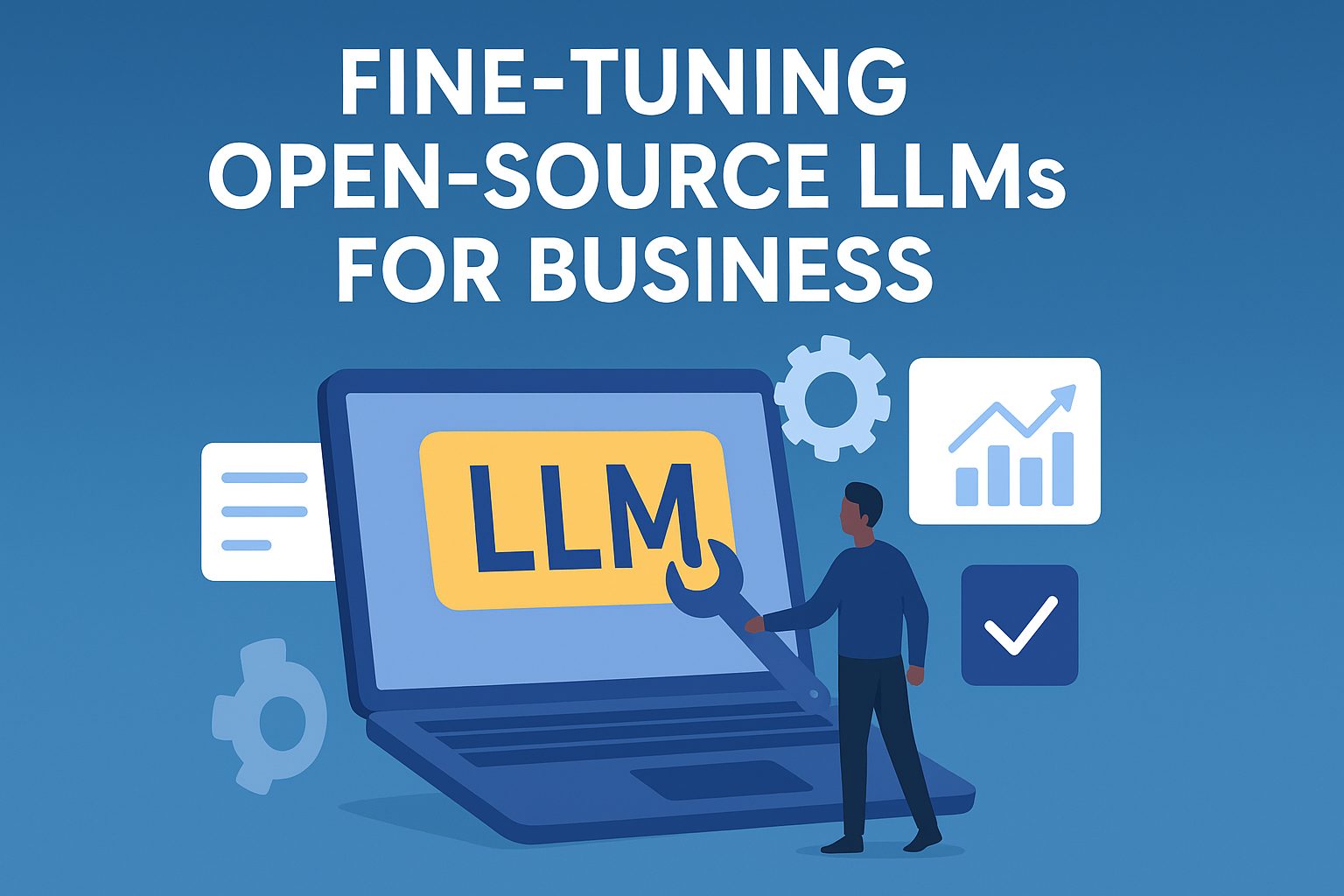
Fine-tuning is the process of taking a pre-trained LLM and training it further on your own data. Instead of starting from scratch, you’re refining an already smart brain to specialize in your domain.
Fine-Tuning vs Prompt Engineering
Prompt engineering tells the model how to behave. Fine-tuning teaches the model what to know. Prompts are instructions; fine-tuning is education.
Fine-Tuning vs RAG (Retrieval-Augmented Generation)
RAG pulls information from external sources at runtime. Fine-tuning embeds knowledge directly into the model. The smartest setups often combine both.
Key Benefits of Fine-Tuning Open-Source LLMs
Cost Control and Ownership
Once fine-tuned, your model runs on your infrastructure. No per-request fees. No surprise bills. Long-term, this can save serious money.
Data Privacy and Security
Your data stays yours. Sensitive customer info never leaves your environment, making compliance and security much easier.
Better Accuracy and Domain Knowledge
A fine-tuned model speaks your industry’s language. Whether it’s legal terms, medical jargon, or internal acronyms—it just gets it.
Brand Voice and Consistency
Want your AI to sound professional, friendly, or bold? Fine-tuning ensures every response aligns with your brand voice.
Popular Open-Source LLMs for Business Fine-Tuning
LLaMA and LLaMA-Based Models
Highly efficient and widely adopted. Great balance of performance and resource usage.
Mistral and Mixtral
Known for speed and reasoning capabilities. Ideal for real-time business applications.
Falcon
Enterprise-friendly and powerful, especially for large-scale deployments.
BLOOM
Strong multilingual support, making it great for global businesses.
Business Use Cases for Fine-Tuned LLMs
Customer Support Automation
AI agents trained on FAQs, tickets, and policies can resolve issues instantly—24/7.
Sales and Lead Qualification
Fine-tuned models can analyze leads, personalize pitches, and even predict buying intent.
Marketing Content Generation
From ad copy to email campaigns, AI trained on your past content keeps messaging on-brand.
Internal Knowledge Assistants
Employees can query company docs like they’re chatting with a colleague.
Code Assistance and DevOps
Developers get AI helpers trained on internal codebases and best practices.
Preparing Your Data for Fine-Tuning
Choosing the Right Dataset
Quality beats quantity. Use real conversations, documents, and workflows relevant to your goals.
Data Cleaning and Formatting
Messy data leads to messy results. Clean, structured, and labeled data is non-negotiable.
Avoiding Bias and Hallucinations
Diverse datasets and validation checks reduce risks and improve reliability.
Infrastructure and Tools Needed
Hardware Requirements
GPUs are key. Depending on model size, even consumer-grade GPUs can work for small projects.
Cloud vs On-Premise Setup
Cloud offers flexibility. On-premise offers control. Choose based on budget and compliance needs.
Frameworks and Libraries
Popular tools include Hugging Face, PyTorch, and LoRA-based fine-tuning frameworks.
Step-by-Step Fine-Tuning Process
Model Selection
Choose a model aligned with your use case and resources.
Dataset Preparation
Format data into prompt-response pairs or instruction-based examples.
Training and Validation
Train gradually, monitor loss, and validate against real scenarios.
Testing and Deployment
Stress-test the model before rolling it into production.
Cost Considerations and ROI
Training Costs Explained
Costs depend on compute, time, and model size. Smaller fine-tuned models often outperform larger generic ones.
Long-Term Savings for Businesses
Reduced labor, faster workflows, and fewer errors mean strong ROI over time.
Common Challenges in Fine-Tuning LLMs
Overfitting Risks
Too much focus on narrow data can reduce flexibility.
Data Quality Issues
Bad input equals bad output—no exceptions.
Maintenance and Model Drift
Regular updates keep the model aligned with evolving business needs.
Best Practices for Business Success
Start Small and Scale Gradually
Pilot first. Expand once value is proven.
Combine Fine-Tuning with RAG
This hybrid approach delivers accuracy and flexibility.
Monitor Performance Continuously
Track responses, feedback, and KPIs to improve over time.
Future of Fine-Tuned LLMs in Business
Rise of Vertical-Specific AI
Industry-focused models will dominate the next wave of AI adoption.
AI as a Core Business Asset
Fine-tuned LLMs won’t be tools—they’ll be teammates.
Conclusion
Fine-tuning open-source LLMs is no longer a luxury—it’s a smart business move. It offers control, cost efficiency, and performance tailored exactly to your needs. In a world where generic AI is everywhere, customized intelligence is how businesses stand out.