
Introduction to AI Models
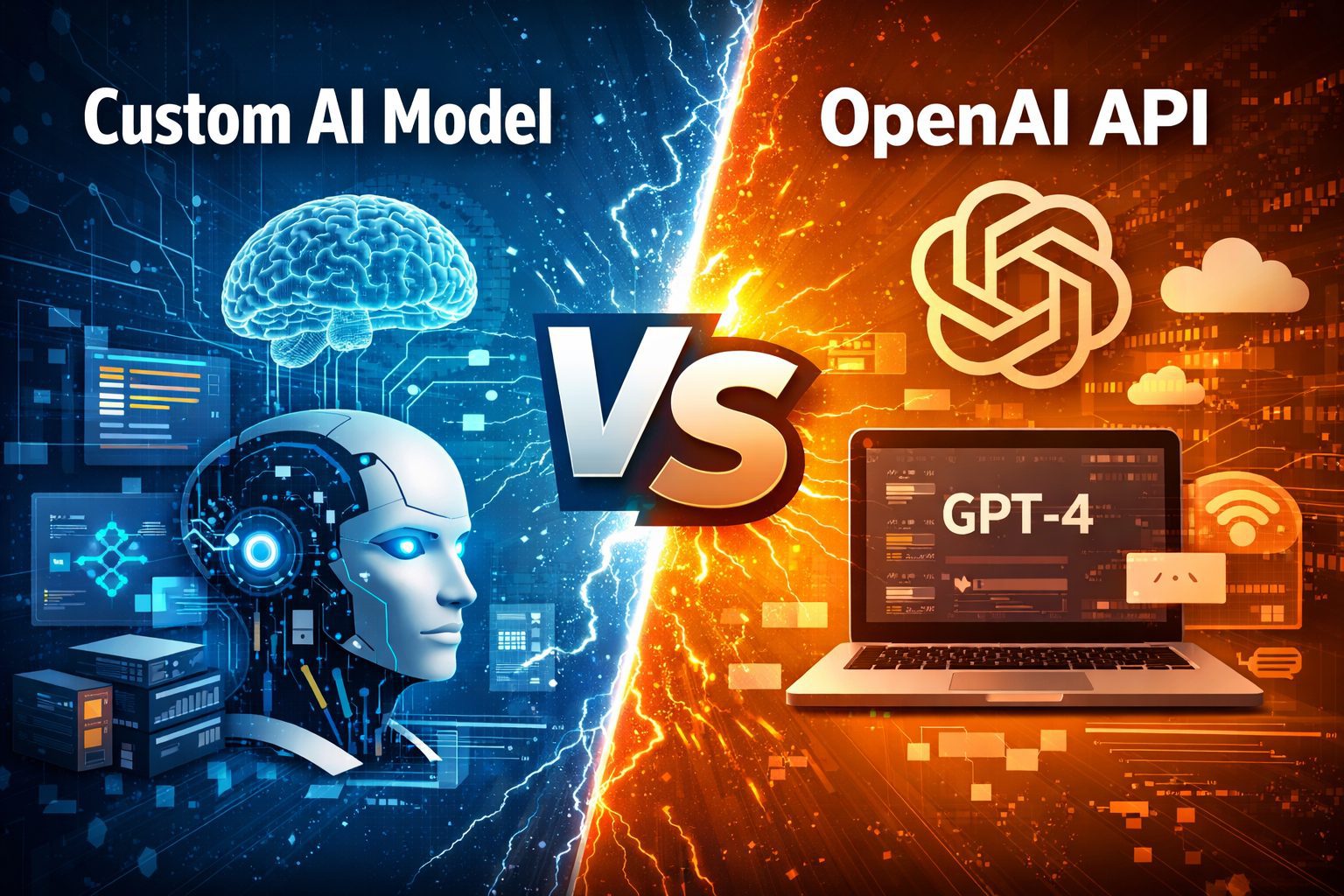
Artificial Intelligence (AI) is no longer just a futuristic concept. From chatbots to recommendation systems, AI models have become the backbone of modern technology. But if you’re looking to implement AI in your business or project, you might wonder: should you build a custom AI model or rely on the OpenAI API? Let’s break it down and see which option fits your needs best.
What is a Custom AI Model?
Definition and Purpose
A custom AI model is an AI system built specifically for your organization’s requirements. Unlike general-purpose AI tools, it’s trained on your unique data to solve particular problems.
How It Works
Custom models usually involve collecting a dataset, cleaning it, training the model using machine learning or deep learning techniques, and continuously refining it to improve accuracy.
Pros of Custom AI Models
- Highly tailored to your business needs.
- Can achieve superior accuracy for niche applications.
- Full control over data privacy and model behavior.
Cons of Custom AI Models
- Requires significant time and resources to develop.
- High costs for infrastructure, training, and maintenance.
- Needs skilled AI engineers to manage and improve.
What is OpenAI API?
Definition and Overview
OpenAI API is a ready-to-use AI service that provides access to pre-trained models like GPT-4. It allows developers to integrate AI capabilities into applications without building a model from scratch.
How OpenAI API Works
You send input (prompts) to the API, and the model returns output based on its pre-trained knowledge. No heavy training or complex infrastructure is required.
Pros of Using OpenAI API
- Quick integration and fast deployment.
- Cost-effective for small to medium-scale projects.
- Continuously updated and maintained by OpenAI.
Cons of OpenAI API
- Less control over model behavior and outputs.
- Dependent on external service; limited customization.
- Data privacy concerns if sensitive information is sent to the API.
Key Differences Between Custom AI Models and OpenAI API
Development Time
Custom AI models can take months to develop, while OpenAI API can be integrated in days or even hours.
Cost Considerations
Custom AI requires upfront investment in data collection, computing, and human resources. OpenAI API follows a pay-as-you-go pricing, which can be cheaper initially but may add up over high usage.
Flexibility and Customization
Custom models offer complete customization. OpenAI API is general-purpose, so you might need workarounds for specific tasks.
Maintenance Requirements
Custom models need continuous monitoring and retraining. OpenAI API is maintained by OpenAI, so you get automatic improvements without extra work.
Performance Comparison
Accuracy and Reliability
Custom AI models excel in specialized tasks with specific datasets. OpenAI API is versatile but may not match the precision of a well-trained custom model in niche scenarios.
Speed and Scalability
OpenAI API is optimized for performance and can handle high traffic efficiently. Custom models might require additional infrastructure to scale.
Handling Complex Tasks
Custom AI can outperform in complex tasks if trained properly. OpenAI API handles a wide range of general tasks but may struggle with very specialized needs.
Use Cases for Custom AI Models
Enterprise-Specific Applications
Companies with unique business processes benefit from models tailored to their workflow.
Industry-Specific Data
Healthcare, finance, or legal industries often need models trained on proprietary datasets for compliance and accuracy.
High Security Requirements
Custom AI keeps sensitive data on-premises, reducing the risk of breaches.
Use Cases for OpenAI API
Rapid Prototyping
Startups and developers can test ideas quickly without heavy upfront costs.
General Purpose AI Tasks
From chatbots to content generation, OpenAI API works well for most standard applications.
Cost-Effective Solutions
Pay only for what you use; ideal for small businesses and projects with limited budgets.
Integration and Ease of Use
Technical Requirements
Custom AI needs strong technical expertise and computing infrastructure. OpenAI API only requires API calls and basic coding knowledge.
Developer Skills Needed
Custom models demand experienced data scientists and AI engineers. OpenAI API can be used by general developers or even non-technical staff with minimal guidance.
Security and Data Privacy
Custom AI Model Security
Data stays within the organization, giving full control over privacy and compliance.
OpenAI API Security
Sensitive data is sent to OpenAI servers, which may be a concern for industries like healthcare and finance.
Future Outlook and Trends
Custom AI Models in 2026 and Beyond
As AI technology evolves, custom models will become more accessible with improved tools and automation, enabling businesses to deploy highly specialized AI faster.
OpenAI API Updates and Improvements
OpenAI continues to improve its models, offering better performance, safety, and expanded features, making it a powerful choice for general-purpose AI needs.
Conclusion
Choosing between a custom AI model and OpenAI API depends on your business goals, budget, timeline, and data sensitivity. If you need a highly specialized solution with complete control, a custom AI model is the way to go. However, if you’re looking for speed, versatility, and cost-effectiveness, OpenAI API is a solid choice. Ultimately, the “better” option is the one that aligns perfectly with your project’s unique requirements.