
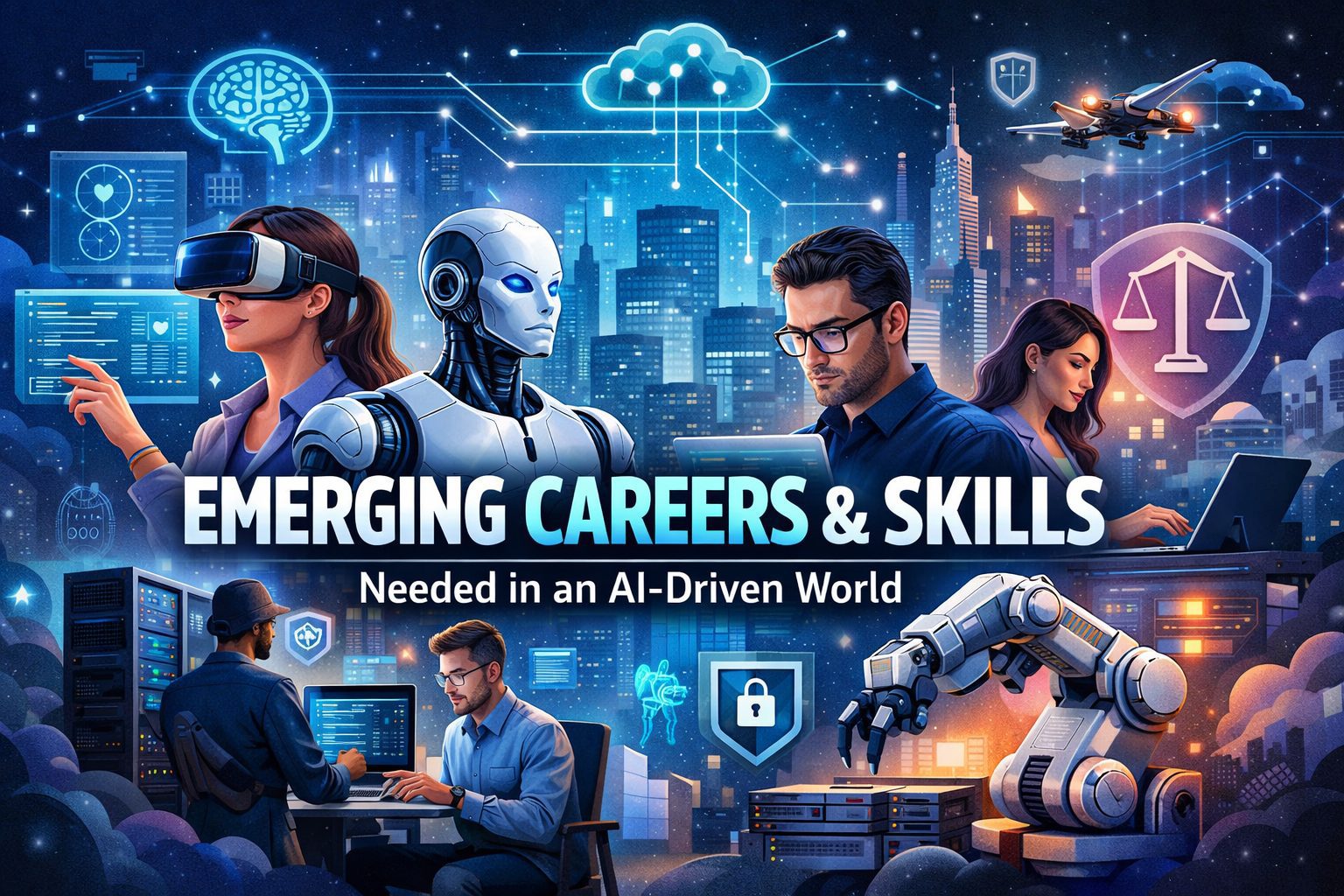
Introduction: Welcome to the Age of AI
Let’s be honest—artificial intelligence isn’t coming anymore. It’s already here, quietly (and sometimes loudly) reshaping how we work, learn, and earn. From chatbots handling customer service to algorithms predicting diseases before symptoms show up, AI has slipped into nearly every industry.
This shift brings a big question: What does this mean for your career?
The short answer—opportunity. The long answer—you’ll need new skills, new mindsets, and maybe even a brand-new job title.
In this article, we’ll break down emerging careers and skills needed in an AI-driven world, in plain English. No fluff. No fear-mongering. Just practical insight into where the future of work is heading—and how you can move with it instead of against it.
Why AI Is Reshaping the Global Job Market
AI works like a super-efficient assistant that never sleeps. It processes massive amounts of data, learns patterns, and makes decisions faster than humans ever could. Businesses love that.
But here’s the twist: AI doesn’t just replace jobs—it reshapes them.
Think of AI as electricity in the early 1900s. It didn’t eliminate work; it changed how work was done. The same thing is happening now, just at digital speed.
How Artificial Intelligence Is Changing Work
Automation vs Augmentation
Automation means AI takes over repetitive tasks. Augmentation means AI supports humans, making them better at what they do.
Most real-world jobs fall into augmentation, not replacement. AI handles the boring stuff, while humans focus on creativity, judgment, and strategy.
Jobs AI Will Replace vs Jobs AI Will Create
Roles at High Risk
- Data entry clerks
- Basic customer support roles
- Routine manufacturing jobs
- Simple bookkeeping tasks
These roles rely heavily on repetition—AI’s favorite playground.
Roles with Growing Demand
- AI specialists
- Data professionals
- Ethical AI experts
- Tech-savvy creatives
- Hybrid roles combining tech + human skills
And that’s where opportunity lives.
Top Emerging Careers in an AI-Driven World
AI and Machine Learning Engineer
These professionals design, build, and improve AI systems. They’re the architects behind recommendation engines, voice assistants, and predictive models.
Why it matters: AI doesn’t build itself—humans do.
Data Scientist and Data Analyst
Data scientists clean, analyze, and interpret massive datasets to help businesses make smarter decisions.
Think of them as: Translators between raw data and real-world insight.
Prompt Engineer
A new-age role born from generative AI. Prompt engineers know how to “talk” to AI tools to get accurate, useful, and creative outputs.
Surprising fact: You don’t always need coding skills—clarity of thought is king here.
AI Product Manager
They bridge the gap between business goals and AI capabilities. They decide what to build and why, not just how.
Perfect for: People who understand both tech and strategy.
Robotics Engineer
Robots aren’t just for factories anymore. They’re entering healthcare, logistics, and even hospitality.
Skill combo: Mechanical engineering + AI + problem-solving.
Cybersecurity Analyst
As AI grows, so do cyber threats. These professionals protect systems, data, and users from attacks—often using AI to fight AI.
High demand, high impact.
AI Ethics and Policy Specialist
AI decisions affect real lives. These specialists ensure fairness, transparency, and accountability in AI systems.
This role matters because: Technology without ethics is risky business.
Digital Transformation Consultant
They help organizations adopt AI and digital tools smoothly, without chaos.
Think: Change managers for the AI age.
Human-AI Interaction Designer
These designers focus on how humans interact with AI systems—making them intuitive, ethical, and user-friendly.
It’s UX design, leveled up.
Cloud and AI Infrastructure Architect
AI runs on powerful cloud systems. These experts design the backbone that keeps AI fast, scalable, and secure.
Essential Technical Skills for the AI Era
Programming and Coding Skills
Languages like Python, R, and JavaScript are especially valuable. Even basic coding literacy gives you a serious edge.
Data Literacy and Analytics
You don’t need to be a math genius—but understanding data, patterns, and dashboards is becoming a core workplace skill.
AI Tools and Platforms
Knowing tools like TensorFlow, PyTorch, ChatGPT, or enterprise AI platforms is increasingly important—even for non-technical roles.
Cloud Computing and DevOps
AI lives in the cloud. Skills in AWS, Azure, or Google Cloud help you stay relevant.
Must-Have Soft Skills in an AI-Driven World
Critical Thinking and Problem-Solving
AI gives answers. Humans ask the right questions.
Creativity and Innovation
AI can generate ideas—but humans decide which ones matter.
Emotional Intelligence
Empathy, leadership, and people skills can’t be automated easily. That’s your secret weapon.
Adaptability and Lifelong Learning
The most valuable skill? Learning how to learn.
Communication and Collaboration
Explaining complex ideas simply is gold in AI-heavy environments.
AI Skills Needed Across Different Industries
Healthcare
- AI-assisted diagnostics
- Health data analysis
- Medical robotics
Finance
- Fraud detection
- Algorithmic trading
- Risk modeling
Education
- Personalized learning systems
- AI-powered tutoring
- Curriculum analytics
Marketing and Sales
- Predictive analytics
- Personalized campaigns
- Customer behavior modeling
Manufacturing
- Smart automation
- Predictive maintenance
- Robotics integration
How to Prepare for Emerging AI Careers
Education and Certifications
Degrees help—but micro-credentials, bootcamps, and certifications are faster and more flexible.
Online Learning Platforms
Platforms like Coursera, Udemy, and edX offer AI-focused learning paths for all levels.
Building Real-World Projects
Nothing beats hands-on experience. Build, test, fail, improve—repeat.
Networking and Personal Branding
Share what you learn. Write, post, contribute. Visibility matters.
Challenges and Ethical Considerations
Job Displacement Concerns
Yes, some jobs will disappear. But many more will evolve.
Bias and Fairness in AI
AI reflects the data it’s trained on. That makes ethical oversight critical.
Privacy and Data Security
With great data comes great responsibility.
Future Outlook: What the Next 10 Years Look Like
Expect hybrid roles, constant reskilling, and deeper human-AI collaboration. The future isn’t humans vs AI—it’s humans with AI.
Those who adapt early won’t just survive—they’ll lead.
Conclusion: Thriving, Not Just Surviving, in an AI World
An AI-driven world isn’t something to fear—it’s something to prepare for. Emerging careers are opening doors we didn’t even know existed a decade ago. By combining technical know-how with human creativity, ethics, and adaptability, you position yourself right where opportunity lives.
The future of work belongs to the curious, the flexible, and the lifelong learners. So start now—your future self will thank you.