
Introduction to the AI-Driven Era
The Rise of Artificial Intelligence
AI is everywhere. From chatbots answering customer questions to algorithms deciding what we watch next, artificial intelligence has quietly slipped into our daily lives. It works fast, never gets tired, and can process more data in seconds than a human could in a lifetime. Sounds unbeatable, right?
But here’s the twist: the smarter AI gets, the more valuable human skills become.
The Big Question: Where Do Humans Fit In?
With machines writing content, analyzing data, and even creating art, people are starting to ask a scary question: Are humans still needed? The answer is a loud and confident yes. Not just needed—essential.
Understanding Human Skills
What Are Human Skills?
Human skills are the abilities that come naturally to people but are extremely hard for machines to copy.
Soft Skills vs Technical Skills
Technical skills help you use tools. Human skills help you use judgment. Things like empathy, communication, creativity, critical thinking, and leadership fall into this category. They’re often called “soft skills,” but honestly, there’s nothing soft about them.
Why These Skills Are Uniquely Human
AI can mimic patterns, but it doesn’t feel. It doesn’t understand context the way humans do. It doesn’t care. Human skills are powered by emotion, experience, and intuition—things machines simply don’t have.
What AI Does Best
Speed, Scale, and Automation
AI is amazing at repetitive tasks. It can sort data, automate workflows, and deliver results at lightning speed. Think of it like a super-fast calculator on steroids.
Data Processing and Pattern Recognition
Give AI a mountain of data, and it will find patterns no human could spot. That’s its sweet spot. But patterns alone don’t equal wisdom.
What AI Still Can’t Replace
Emotional Intelligence
AI can recognize emotions. Humans can understand them. Big difference. Emotional intelligence helps people read the room, sense tension, and respond with care.
Creativity and Original Thinking
AI creates by remixing existing ideas. Humans create by imagining what doesn’t exist yet. That spark of originality? That’s human.
Moral Judgment and Ethics
AI follows rules. Humans question them. When decisions involve ethics, values, or consequences, human judgment is irreplaceable.
Emotional Intelligence in an AI World
Empathy as a Competitive Advantage
In a world full of automation, empathy stands out. Customers remember how you made them feel, not how fast your system responded.
Human Connection in Workplaces
Teams thrive on trust, understanding, and motivation. AI can manage tasks, but humans manage people.
Creativity: The Human Superpower
Innovation Beyond Algorithms
AI can suggest ideas, but humans decide which ones matter. True innovation comes from curiosity, risk-taking, and imagination.
Storytelling, Art, and Imagination
Stories move people. Art inspires change. These aren’t just outputs—they’re expressions of human experience.
Critical Thinking and Decision-Making
Thinking Beyond Data
Data tells you what happened. Humans ask why. Critical thinking helps connect dots and challenge assumptions.
Context, Nuance, and Judgment
Life isn’t black and white. Humans understand gray areas. AI struggles there.
Communication Skills Matter More Than Ever
Clear Communication in a Tech-Heavy World
As systems get complex, explaining ideas simply becomes a superpower.
Persuasion, Negotiation, and Leadership
AI can inform, but humans influence. Leadership depends on trust and vision, not algorithms.
Adaptability and Lifelong Learning
Learning How to Learn
Jobs change fast. The ability to adapt matters more than memorizing skills.
Thriving in Constant Change
Humans who embrace change stay relevant. Those who resist it fall behind.
Leadership in the Age of AI
Human-Centered Leadership
Great leaders inspire, guide, and care. AI can support leaders—but it can’t be one.
Trust, Vision, and Purpose
People follow purpose, not code.
Human Skills in Different Industries
Business and Management
Strategy, negotiation, and relationship-building still need a human touch.
Healthcare and Education
Care and teaching are deeply human experiences. AI assists—but humans connect.
Creative and Service Industries
Creativity and service thrive on emotion, not automation.
The Future of Work
Humans + AI, Not Humans vs AI
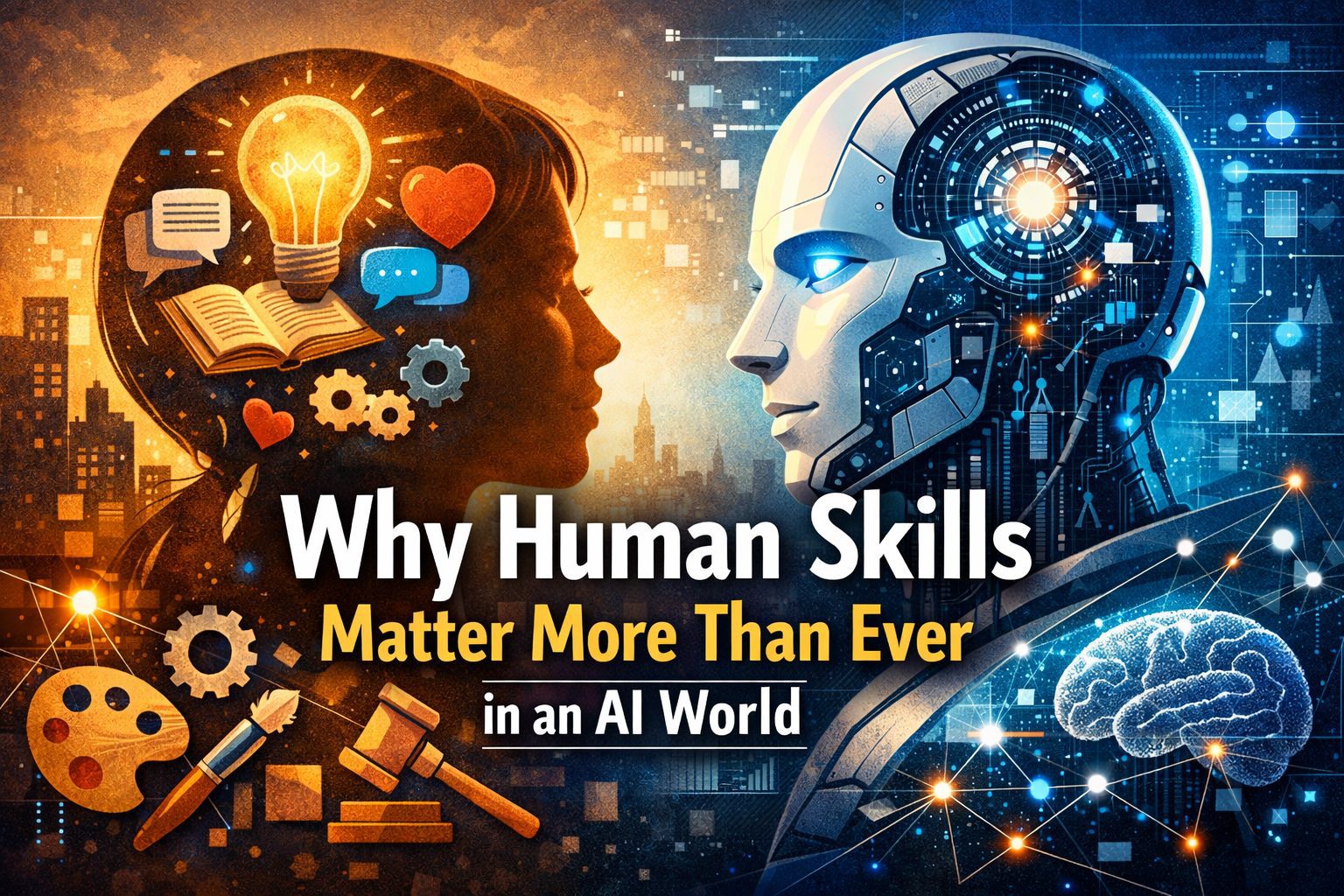
The future isn’t competition—it’s collaboration. AI handles the heavy lifting; humans handle meaning.
Jobs That Will Value Human Skills Most
Roles involving leadership, creativity, empathy, and judgment will only grow.
How to Develop Human Skills
Practical Ways to Improve Soft Skills
- Practice active listening
- Ask for feedback
- Reflect on experiences
Training, Feedback, and Self-Awareness
Growth starts with awareness. The more you understand yourself, the stronger your human skills become.
Why Companies Must Invest in Human Skills
Better Teams, Better Results
Teams with strong human skills perform better, innovate more, and stay longer.
Culture, Innovation, and Growth
A human-first culture beats a tech-first culture every time.
Common Myths About AI Replacing Humans
AI Will Take All Jobs
It won’t. It will change jobs—and create new ones.
Technical Skills Are All That Matter
Wrong. Technical skills open doors. Human skills keep you inside.
Conclusion: The Human Edge in an AI World
AI is powerful, but humans are meaningful. As machines take over tasks, human skills take center stage. Empathy, creativity, judgment, and communication aren’t optional anymore—they’re essential. The future belongs to people who know how to work with AI, not fear it. In an AI-powered world, being human is your biggest advantage.