
Understanding Zero Trust Security
What Zero Trust Really Means
Let’s cut through the buzzwords—Zero Trust security isn’t about trusting nothing; it’s about verifying everything.
In traditional security models, once someone gets inside your network, they’re often trusted by default. That’s like letting someone into your house and assuming they’ll behave perfectly just because they’re inside. Sounds risky, right?
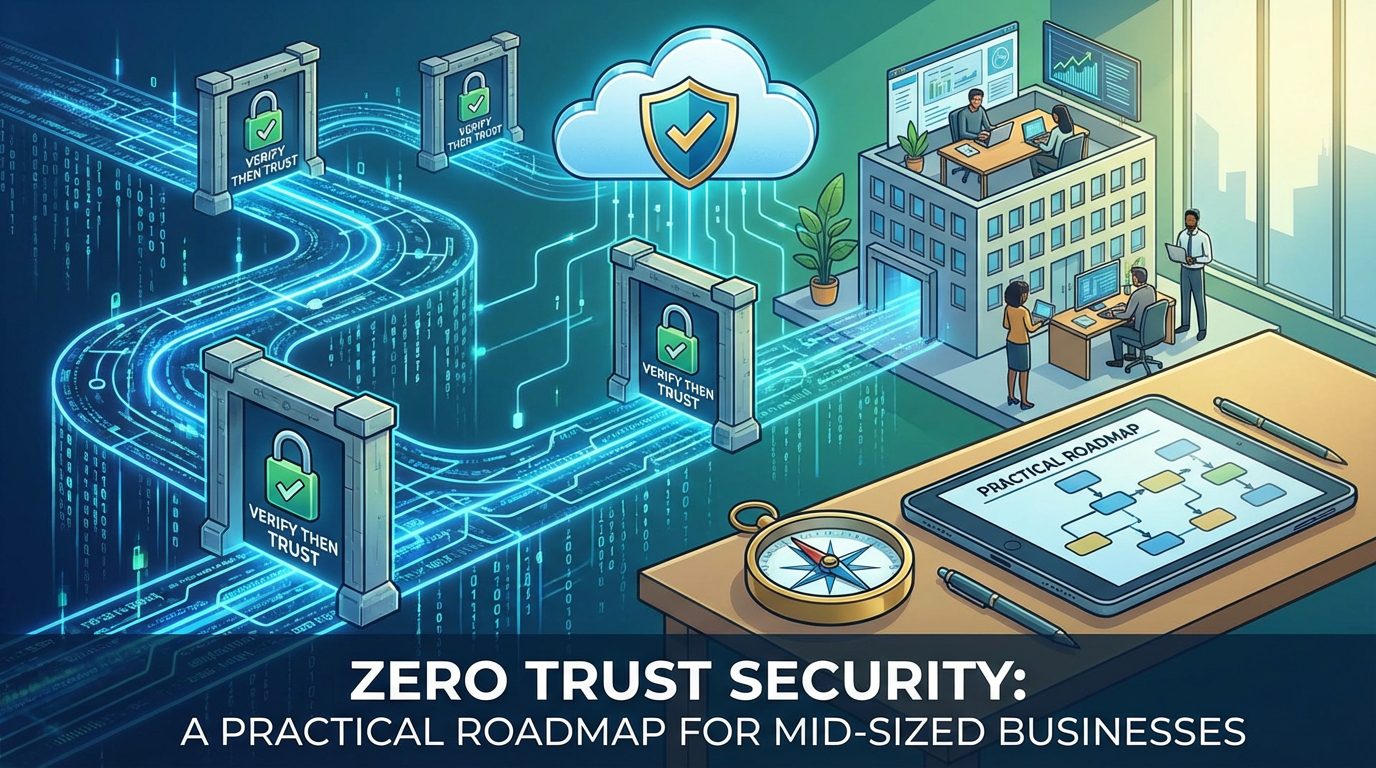
Zero Trust flips that idea completely. It works on a simple rule: never trust, always verify. Every user, device, and application must prove its legitimacy—every single time.
This approach doesn’t just secure the perimeter. It secures everything inside it too. And in today’s world, where threats can come from anywhere—even inside your organization—that mindset is critical.
Why Traditional Security Models Fail
Old-school security was built for a different era—when everything lived inside one office network. Firewalls and VPNs were enough back then.
But today? Businesses are spread across cloud platforms, remote teams, and mobile devices. The “perimeter” has basically disappeared.
Here’s the problem: once attackers breach the outer layer, they can move freely inside. That’s exactly what Zero Trust is designed to stop.
It’s not about building higher walls—it’s about locking every door inside the building.
Why Mid-Sized Businesses Need Zero Trust Now
Rising Cyber Threats
Cyberattacks are no longer targeting just big corporations. Mid-sized businesses are now prime targets because they often have valuable data but weaker defenses.
Hackers know this—and they exploit it.
From ransomware to phishing attacks, the threats are growing more sophisticated. And without a strong security model, even a single breach can cause serious damage—financially and reputationally.
Remote Work and Cloud Adoption
Let’s face it—work isn’t tied to an office anymore.
Employees are logging in from home, coffee shops, and different countries. At the same time, companies are moving data and applications to the cloud.
This creates a complex environment where traditional security simply can’t keep up.
Zero Trust is built for this new reality. It secures access no matter where users are or what device they’re using.
Core Principles of Zero Trust
Verify Explicitly
Every access request must be verified using multiple data points—identity, location, device health, and more.
It’s like a security checkpoint that checks your ID, your ticket, and even your behavior before letting you through.
Least Privilege Access
Users should only have access to what they absolutely need—nothing more.
This minimizes risk. Even if an account is compromised, the damage stays limited.
Assume Breach Mindset
Zero Trust assumes that breaches will happen. Instead of hoping for the best, it prepares for the worst.
This mindset ensures that systems are always monitored and threats are quickly contained.
Key Components of a Zero Trust Architecture
Identity and Access Management
Identity is the new perimeter.
Strong authentication methods like multi-factor authentication (MFA) ensure that only verified users gain access. This is the foundation of Zero Trust.
Device Security
Not all devices are safe. Some may be outdated or compromised.
Zero Trust checks device health before granting access. If something looks suspicious, access is denied.
Network Segmentation
Instead of one big open network, Zero Trust divides it into smaller segments.
This prevents attackers from moving freely if they gain access. It’s like having multiple locked rooms instead of one big hall.
Data Protection
Data is the most valuable asset—and it needs strong protection.
Encryption, access controls, and monitoring ensure that sensitive information stays secure at all times.
Step-by-Step Zero Trust Implementation Roadmap
Step 1: Assess Current Security Posture
Start by understanding where you stand.
Identify vulnerabilities, existing tools, and gaps in your current security setup. You can’t fix what you don’t see.
Step 2: Define Critical Assets
Not all data is equal.
Focus on protecting your most important assets—customer data, financial records, and intellectual property.
Step 3: Implement Strong Identity Controls
Introduce MFA and identity verification systems.
Make sure every user is authenticated before accessing any resource.
Step 4: Segment Networks and Limit Access
Break your network into smaller zones and control access between them.
This reduces the risk of lateral movement in case of a breach.
Step 5: Monitor and Continuously Improve
Security isn’t a one-time task.
Continuously monitor activity, detect anomalies, and update policies as needed. Zero Trust is an ongoing process.
Benefits of Zero Trust for Mid-Sized Businesses
Zero Trust offers several advantages that make it ideal for mid-sized organizations.
- Stronger Security: Reduced risk of breaches
- Better Visibility: Clear insights into user activity
- Flexibility: Supports remote and cloud environments
- Cost Efficiency: Prevents expensive security incidents
It’s not just about protection—it’s about control and confidence.
Challenges and Common Pitfalls
Adopting Zero Trust isn’t always easy.
One common challenge is complexity. Implementing new systems and processes can feel overwhelming.
There’s also resistance to change. Employees may find new security measures inconvenient at first.
And then there’s cost. While Zero Trust saves money in the long run, the initial investment can be a hurdle.
But here’s the thing—doing nothing is often more expensive.
Best Practices for Successful Adoption
To make Zero Trust work, businesses need a clear strategy.
Start small. Focus on critical areas first instead of trying to do everything at once.
Educate your team. Security is everyone’s responsibility, not just IT’s.
And most importantly, keep improving. Zero Trust isn’t a destination—it’s a journey.
Future of Zero Trust Security
Zero Trust is quickly becoming the standard for modern cybersecurity.
As threats evolve, businesses need smarter, more adaptive defenses. Zero Trust provides exactly that.
In the future, we’ll see more automation, AI-driven threat detection, and seamless security experiences.
The goal? Strong security without slowing down business operations.
Conclusion
Zero Trust security isn’t just a trend—it’s a necessity.
For mid-sized businesses, it offers a practical way to protect data, reduce risks, and adapt to modern work environments.
The journey may seem challenging, but the payoff is worth it. With the right approach, Zero Trust can transform your security from reactive to proactive.
And in today’s digital world, that’s exactly what you need.