
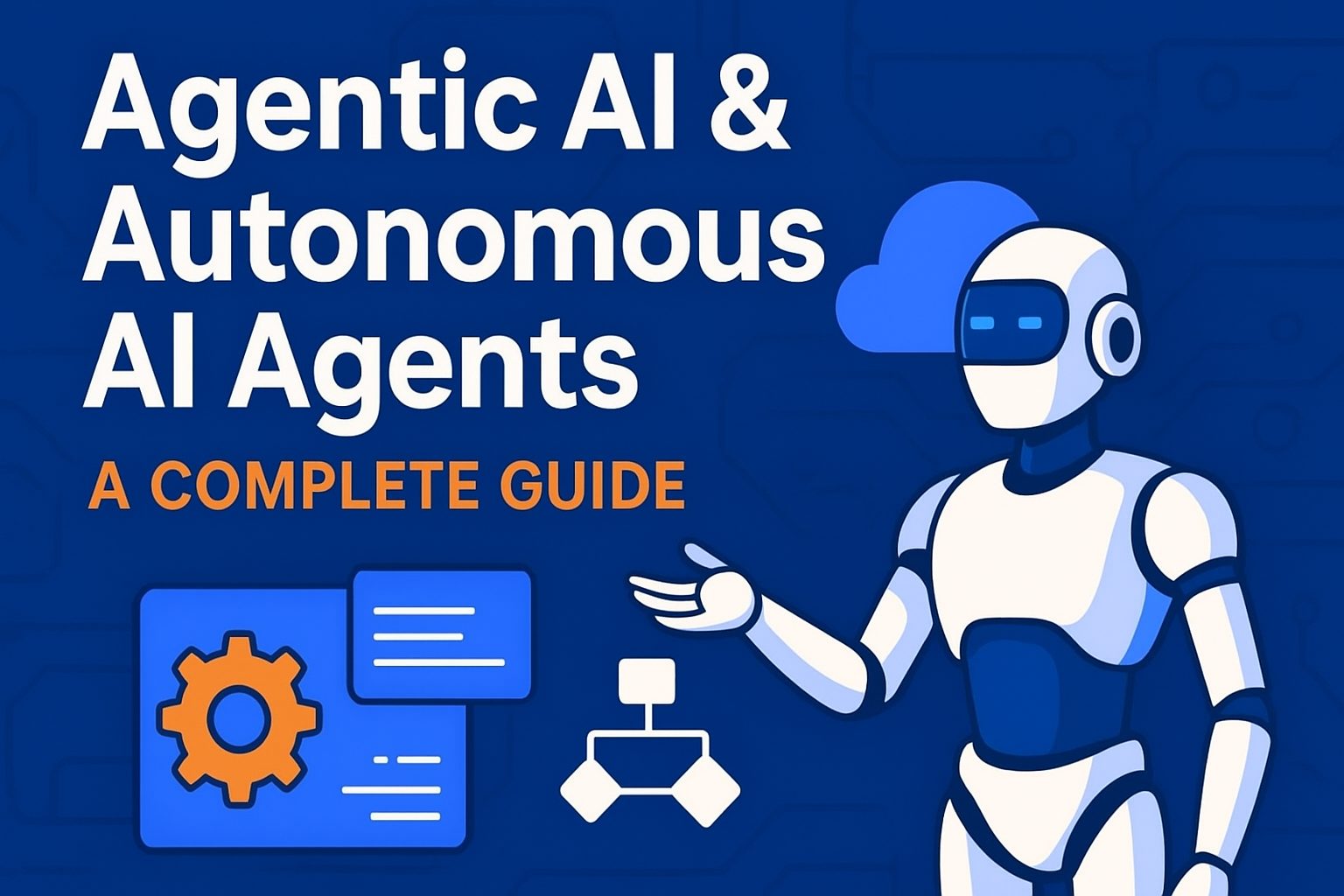
Introduction to Agentic AI & Autonomous AI Agents
AI is no longer just a helpful tool—it’s becoming an independent digital worker capable of making decisions, taking actions, and completing complex tasks without constant human guidance. This evolution is powered by Agentic AI and Autonomous AI Agents, two groundbreaking concepts that are shaping the next generation of automation.
Let’s understand what makes them so powerful and why they’re becoming essential in every industry.
What Is Agentic AI?
Agentic AI refers to AI systems that can act independently, set goals, break down tasks, and work with tools—almost like a human assistant who thinks and executes rather than simply responding.
Agentic AI can:
- Plan and reason
- Make decisions autonomously
- Use tools and APIs
- Learn from feedback
- Perform multi-step operations
It behaves like an agent, not a passive responder.
What Are Autonomous AI Agents?
Autonomous AI Agents are self-operating software entities that:
- Observe their environment
- Process information
- Decide the best next action
- Execute tasks
- Evaluate outcomes
Think of them as AI employees who can manage tasks end-to-end.
Why These Technologies Matter Today
Because businesses and individuals need:
- Faster automation
- Higher accuracy
- Lower workload
- 24/7 operations
Agentic AI solves all these needs by working independently, efficiently, and continuously.
Understanding the Core Concepts
How Traditional AI Differs from Agentic AI
Traditional AI:
- Only responds to user prompts
- Follows pre-built rules
- Cannot take independent action
Agentic AI:
- Plans and executes tasks
- Thinks contextually
- Works autonomously
It’s like upgrading from a calculator to a personal assistant.
Key Features of Autonomous AI Agents
- Autonomy in decision-making
- Memory to store context
- Tools access for executing tasks
- Goal-oriented reasoning
- Adaptive learning
Real-World Examples of Agentic Systems
- Marketing agents that run full ad campaigns
- Financial agents doing automated trading
- Workflow agents handling emails, CRM, or analytics
- Customer service agents solving tickets A to Z
How Agentic AI Works
The Architecture Behind Agentic AI
Perception Layer
Collects data: text, signals, images, web content, and system input.
Decision-Making Layer
Thinks, reasons, evaluates, and chooses the next best action.
Action Layer
Executes commands: API calls, automation, writing, coding, browsing, etc.
The Role of Memory, Context & Feedback Loops
Memory lets agents:
- Remember past tasks
- Learn user preferences
- Improve decision-making over time
Feedback loops help them get smarter with each interaction.
Tools, Actions & Multi-Step Workflows
Autonomous agents can:
- Browse the internet
- Analyze data
- Access databases
- Send emails
- Execute scripts
- Solve tasks end-to-end
They don’t just think—they act.
Types of Autonomous AI Agents
Reactive Agents
Fast responders but without long-term planning.
Deliberative Agents
Plan steps, analyze options, and choose the best path.
Hybrid Agents
Mix of reactive and deliberative behavior for balanced performance.
Multi-Agent Systems (MAS)
A digital team of agents collaborating to solve big, complex tasks.
Applications of Agentic & Autonomous AI
Business Automation
Agents can run workflows, manage data, generate reports, and streamline operations.
Customer Support
24/7 conversation agents resolve issues instantly.
Healthcare
From medical analysis to patient monitoring and scheduling.
Cybersecurity
Real-time threat detection and automated response systems.
Finance
Autonomous trading, fraud detection, and financial forecasting.
Smart Agriculture & Smart Cities
Optimizing crop irrigation, traffic monitoring, energy distribution, and more.
Benefits of Agentic AI
Efficiency & Productivity
Completes tasks in seconds that normally take hours.
Scalability
One agent can handle thousands of processes at a time.
24/7 Autonomy
Constant performance without rest.
Error Reduction & Precision
Consistently reliable outcomes with reduced human error.
Challenges & Risks
Ethical Concerns
Who is responsible for decisions made by autonomous agents?
Data Privacy & Security Issues
Agents may require access to sensitive information.
Bias Risks
AI can adopt biases present in its training data.
Overdependence on Automated Agents
Rising reliance may reduce critical human oversight.
The Future of Agentic AI
Integration with Robotics
Intelligent robots capable of autonomous action in real-world environments.
AI-as-a-Worker (AI Employees)
AI agents performing fully operational roles in companies.
Multi-Agent Ecosystems
Teams of AI agents collaborating—like digital workforces.
The Rise of Personalized AI Agents
Every individual having their own AI assistant for personal and professional life.
Conclusion
Agentic AI and Autonomous AI Agents are transforming everything—from business operations to personal productivity. With the ability to think, act, and execute independently, these AI systems are shaping the future of automation, making processes faster, smarter, and more efficient than ever before.
As this technology grows, expect to see AI becoming not just a tool—but a true collaborator.