
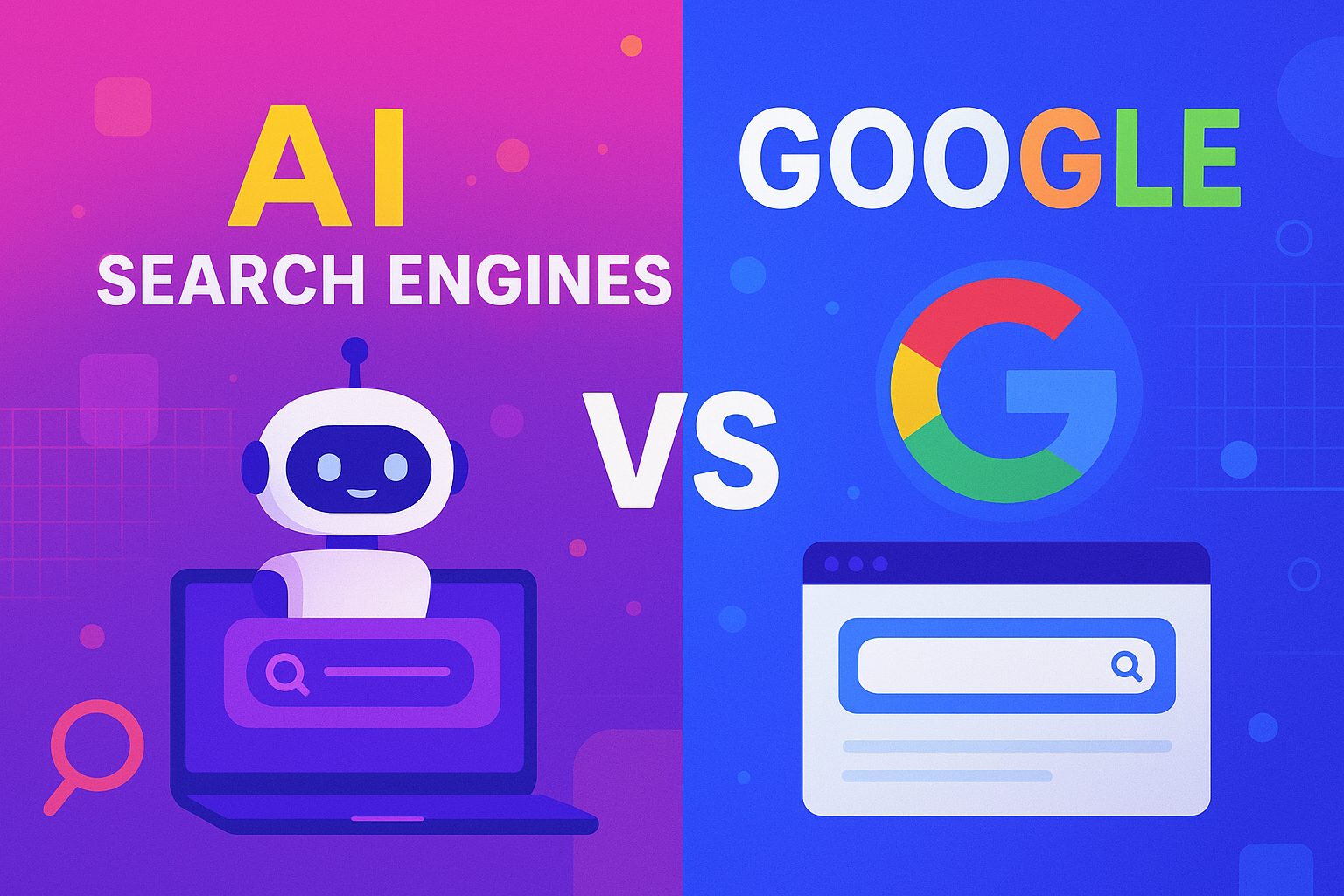
Why the Battle Between AI Search Engines and Google Matters
Search is changing faster than ever. With AI-powered platforms like ChatGPT Search, Perplexity, and others entering the scene, millions of users are now asking themselves: Should I still rely on Google? The shift is huge—because for the first time, users can get direct, conversational answers instead of scrolling through countless links.
How Search Behavior Is Rapidly Changing
People no longer want blue links; they want solutions. They want explanations, summaries, and actionable insights without jumping across 10 pages. AI search engines provide that in seconds—and that’s exactly why this debate is trending globally.
Understanding AI Search Engines
What Exactly Is an AI Search Engine?
AI search engines use large language models (LLMs) to understand queries like a human does. Instead of matching keywords, they analyze intent and generate meaningful answers.
Key Features of AI-Powered Search
Conversational Results
You can ask follow-up questions like you’re chatting with a smart friend.
Personalized Insights
AI learns context from your previous questions and tailors the response.
Multimodal Search
You can search using text, voice, images, videos—even sketches in some cases.
Understanding Google’s Traditional Search Model
How Google Search Works
Google crawls billions of pages, indexes them, and shows results based on complex ranking algorithms. It’s fast, powerful, and unmatched in scale.
Limitations of Traditional Keyword-Based Search
- Requires users to click multiple links
- Hard for beginners to understand technical topics
- Doesn’t provide a direct “answer”
- Overloaded with ads and SEO-optimized content
AI Search Engines vs Google: Core Differences
Query Processing
AI search engines understand intent; Google focuses on matching keywords.
Result Presentation
AI gives full answers.
Google gives a list of pages you must explore yourself.
Personalization and Context Awareness
AI remembers your previous questions; Google does not handle multi-turn conversations.
Real-Time Reasoning Capabilities
AI engines can summarize data, rewrite content, and provide insights instantly—something Google search alone cannot do.
Advantages of AI Search Engines
Faster Answers
You get solutions in seconds—no need to open 20 tabs.
Human-Like Understanding
AI interprets your query the way a person would.
Reduced Need for Multiple Clicks
Everything is summarized for you in one place.
Ideal for Research, Writing & Problem Solving
Students, marketers, developers, and researchers benefit massively.
Advantages of Google
Massive Indexing
Google crawls more of the internet than any other platform.
Accuracy for Factual & Real-Time Data
Weather, scores, live trends—Google wins here.
Better for Discovery, Shopping & Navigation
Google Maps, Shopping, News, and Images provide deep browsing options not found in most AI searches.
AI Search Engines vs Google: Use-Case Comparison
Best for Learning and Research
AI search engines give deeper, structured explanations.
Best for Shopping and Local Searches
Google remains the best due to reviews, listings, and maps.
Best for Technical Queries
AI engines explain debugging, coding, and logic seamlessly.
Best for News and Trending Topics
Google wins because of real-time updates and verified sources.
AI Search Engines Changing SEO
SGE (Search Generative Experience)
Google is adding AI summaries inside search to keep up.
The Decline of Blue Links
Traffic to websites is dropping as more answers appear directly.
Rise of Conversational SEO
Brands must optimize for AI-driven summaries instead of traditional ranking.
Will AI Search Replace Google?
Current Limitations
AI may hallucinate or produce outdated info without live indexing.
Why Google Still Dominates
Because of decades of infrastructure, data, and accuracy.
The Future of Hybrid Search
The future is a blend—Google’s live data + AI engines’ intelligence.
Conclusion
AI search engines are rewriting how we find information. They’re conversational, fast, and incredibly smart. But Google still leads in real-time accuracy, web indexing, and navigation. Instead of replacing each other, both are evolving into a hybrid ecosystem where AI enhances search, and search enhances AI. The future isn’t AI vs Google—it’s AI + Google.