
Introduction to AI Teams
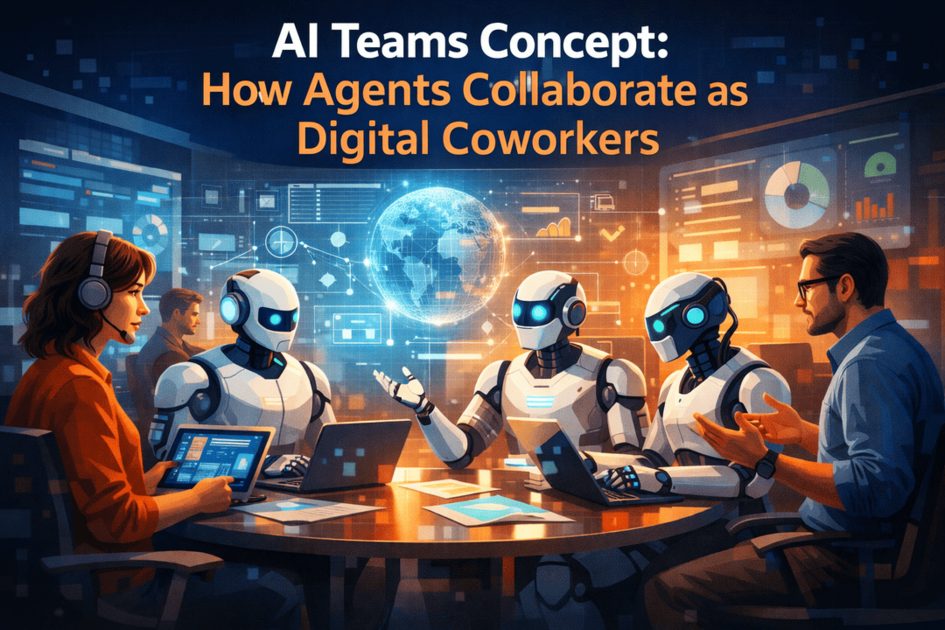
AI is no longer just a tool that waits for instructions. It’s evolving into something much more powerful—a teammate. Welcome to the world of AI Teams, where multiple AI agents collaborate like digital coworkers to achieve complex goals.
Think of it like a modern office. Instead of one employee doing everything, you have specialists—writers, analysts, planners, and reviewers—working together. AI teams work the same way, just faster and without coffee breaks ☕.
What Are AI Teams?
AI teams are groups of AI agents, each with a specific role, working together to complete tasks. Instead of relying on a single AI model, tasks are divided among multiple intelligent agents that communicate, coordinate, and make decisions collectively.
Each agent focuses on what it does best—one analyzes data, another generates content, while another checks accuracy or optimizes performance.
Why Businesses Are Moving Toward AI Collaboration
Businesses face complex challenges that one AI system can’t handle alone. AI teams offer:
- Better problem-solving
- Faster execution
- More accurate outcomes
In short, AI teams turn intelligence into a collaborative force rather than a solo act.
Evolution of AI From Tools to Teammates
Single AI Systems vs Multi-Agent Systems
Traditional AI worked like a calculator—you ask, it answers. AI teams work like a department—they plan, discuss, and execute.
Multi-agent systems allow:
- Parallel task execution
- Specialized problem-solving
- Reduced errors through cross-checking
The Shift Toward Autonomous AI Agents
Autonomous agents don’t wait for constant instructions. They can:
- Understand goals
- Decide next steps
- Adjust based on results
This autonomy is what enables true AI teamwork.
Understanding AI Agents
What Is an AI Agent?
An AI agent is a system that can perceive, decide, and act to achieve specific objectives.
Core Capabilities of AI Agents
- Goal understanding
- Reasoning and planning
- Communication with other agents
- Learning from feedback
Types of AI Agents Used in Teams
- Planner Agents – break goals into steps
- Executor Agents – perform tasks
- Reviewer Agents – validate outputs
- Coordinator Agents – manage workflows
Together, they form a well-balanced digital workforce.
How AI Teams Work Together
Task Distribution and Role Assignment
AI teams divide tasks automatically. Just like a project manager assigns work, a coordinator agent ensures each task goes to the right agent.
Communication Between AI Agents
Agents communicate through structured messages, APIs, or shared memory systems. It’s like Slack—but faster and smarter.
Decision-Making in AI Teams
AI teams compare options, evaluate outcomes, and choose the best path forward. Think of it as a mini board meeting—held in milliseconds.
AI Teams as Digital Coworkers
Comparing Human Teams and AI Teams
| Human Teams | AI Teams |
|---|---|
| Need rest | 24/7 availability |
| Emotional bias | Data-driven |
| Limited speed | Lightning fast |
AI teams don’t replace humans—they enhance them.
Agents Supporting Human Employees
AI teams handle repetitive tasks so humans can focus on creativity, strategy, and leadership. It’s like having a smart assistant team working silently in the background.
Real-World Use Cases of AI Teams
AI Teams in Software Development
- One agent writes code
- Another tests it
- Another documents it
Result? Faster and cleaner development cycles.
AI Teams in Marketing and Content Creation
AI agents collaborate to:
- Research keywords
- Write content
- Optimize SEO
- Analyze performance
Perfect for scaling digital marketing efforts.
AI Teams in Customer Support
AI teams handle:
- Ticket classification
- Automated responses
- Escalation decisions
Customers get quicker, more accurate help.
AI Teams in Data Analysis and Research
Agents gather data, clean it, analyze trends, and generate insights—turning raw data into actionable intelligence.
Benefits of AI Teams
Increased Efficiency and Productivity
Multiple agents working in parallel means faster results with fewer mistakes.
Scalability and Cost Optimization
Need more output? Add more agents—no hiring, onboarding, or overhead costs.
Faster Decision-Making
AI teams analyze thousands of scenarios instantly, enabling real-time decisions.
Challenges and Limitations of AI Teams
Coordination and Alignment Issues
Poorly defined roles can lead to confusion—just like in human teams.
Data Quality and Bias Risks
AI is only as good as the data it learns from. Bad data leads to bad decisions.
Security and Ethical Concerns
Organizations must ensure:
- Data privacy
- Transparent decision-making
- Responsible AI usage
Building an Effective AI Team
Choosing the Right AI Agents
Select agents based on task complexity and business needs.
Defining Clear Roles and Objectives
Clear goals prevent overlap and inefficiency.
Monitoring and Improving AI Collaboration
Continuous feedback ensures AI teams keep improving over time.
The Role of Humans in AI Teams
Human-in-the-Loop Approach
Humans oversee decisions, validate outputs, and handle exceptions.
AI as an Assistant, Not a Replacement
AI teams amplify human potential—they don’t eliminate it.
Future of AI Teams
Agentic AI and Autonomous Organizations
In the future, entire workflows may run autonomously with minimal human input.
AI Teams in Everyday Business Operations
From HR to finance, AI teams will become standard digital coworkers across industries.
Conclusion
AI teams represent a major shift in how work gets done. By collaborating as digital coworkers, AI agents bring speed, intelligence, and scalability to modern organizations. The future isn’t about humans versus AI—it’s about humans and AI working together. And those who embrace AI teams early will lead the next wave of innovation.