
Introduction: Why Cloud Misconfiguration Is a Growing Threat
Cloud computing has transformed how businesses operate. It allows companies to scale globally in minutes, deploy applications instantly, and innovate faster than ever before. But here’s the uncomfortable truth: while the cloud is powerful, it’s also incredibly easy to misconfigure. And when that happens, the consequences can be severe. A significant percentage of cloud-related data breaches today are directly linked to configuration errors rather than sophisticated hacking techniques. In other words, attackers often don’t need to break in — they simply walk through an open door.
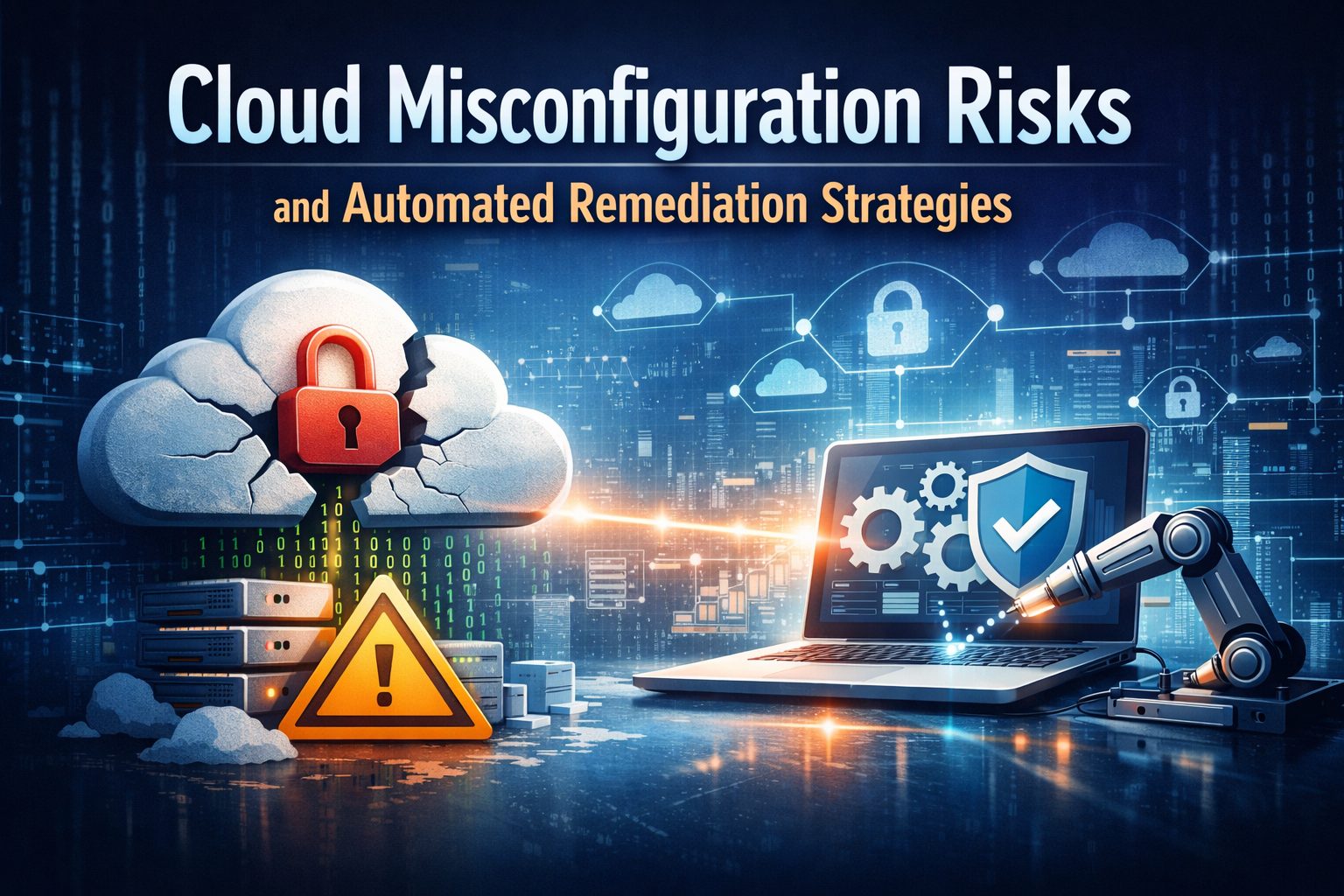
Think of your cloud environment as a high-tech office building. You’ve invested in smart locks, cameras, and alarms. But what if someone accidentally leaves the back door unlocked? That’s what a cloud misconfiguration looks like. It’s rarely intentional, often overlooked, and frequently catastrophic. As organizations adopt multi-cloud and hybrid architectures, complexity increases, and with complexity comes risk. This is why understanding cloud misconfiguration risks and implementing automated remediation strategies has become a top priority for security leaders worldwide.
What Is Cloud Misconfiguration?
Cloud misconfiguration refers to improperly set controls, policies, or security settings in a cloud environment that expose systems to risk. These misconfigurations can occur across storage services, compute resources, identity management systems, networking components, and monitoring tools. Unlike traditional infrastructure, cloud environments are dynamic and programmable. That flexibility is powerful, but it also means mistakes can spread quickly.
A misconfiguration might involve making a storage bucket publicly accessible, granting excessive administrative privileges, disabling encryption, or leaving critical ports open to the internet. These are not complex technical failures; they are simple settings left unchecked. And yet, their impact can be massive. Cloud platforms provide shared responsibility models, meaning providers secure the infrastructure, but customers must configure their own resources securely. When organizations misunderstand this division of responsibility, gaps emerge.
Common Examples in Modern Cloud Environments
In real-world scenarios, some of the most frequent cloud misconfigurations include exposed object storage, overly broad Identity and Access Management (IAM) policies, disabled logging, and missing multi-factor authentication. Organizations sometimes deploy development resources quickly and forget to restrict access before going live. Other times, permissions accumulate over time without review, creating what security professionals call “privilege creep.”
The danger lies in scale. One incorrect template or configuration script can replicate insecure settings across dozens or hundreds of cloud resources. In a fast-moving DevOps environment, that risk multiplies rapidly. That is why visibility and automation are essential components of modern cloud security.
Why Cloud Misconfigurations Happen So Often
If cloud misconfigurations are so risky, why do they keep happening? The answer lies in human nature, operational speed, and system complexity. Cloud environments are built to encourage rapid innovation. Developers can provision servers in seconds and deploy applications globally with a few commands. But speed often outruns security oversight.
Human Error and Operational Complexity
Even experienced engineers make mistakes. A single overlooked checkbox in a configuration console can expose sensitive information. In large organizations, different teams manage different cloud accounts, leading to inconsistent standards. Without centralized governance, configurations drift away from secure baselines over time.
Complexity adds another layer of difficulty. Multi-cloud strategies involve multiple dashboards, APIs, and security models. Each provider has its own terminology and default settings. Managing all of this manually is like juggling knives — eventually, something slips.
Speed of Deployment and DevOps Culture
Modern development culture emphasizes agility and continuous delivery. Code moves from development to production quickly, sometimes multiple times per day. While this accelerates innovation, it also reduces the window for manual security reviews. When deadlines are tight, teams may prioritize functionality over configuration validation.
This is not negligence; it is operational pressure. The solution is not to slow innovation but to embed security directly into automated workflows. That is where automated remediation becomes critical.
The Real Business Impact of Misconfigurations
Cloud misconfigurations are not minor technical inconveniences. They can trigger massive data breaches, regulatory fines, and long-term brand damage. When sensitive customer data becomes publicly accessible, organizations face lawsuits, compliance investigations, and public scrutiny. Recovery costs can reach millions of dollars, especially when incident response, legal fees, and reputation repair are included.
Financial, Legal, and Reputational Damage
Financial loss is often the most visible consequence, but reputational damage can be even more harmful. Customers lose trust quickly when their information is exposed. Investors question leadership decisions. Regulators may impose penalties under data protection laws. Beyond immediate costs, there is also operational disruption. Systems must be audited, patched, and reconfigured, slowing down business momentum.
The truth is simple: prevention costs far less than remediation after a breach. That is why organizations are investing heavily in automated detection and correction strategies.
The Most Common Types of Cloud Misconfigurations
Public Storage and Data Exposure
Publicly accessible storage is one of the most common and dangerous misconfigurations. Object storage services often allow administrators to configure access levels. A simple misclick can expose confidential data to the entire internet. Attackers routinely scan cloud environments looking for these open buckets.
The problem becomes worse when backups, logs, or archived data are stored insecurely. Organizations may believe the data is internal, but without proper access controls, it becomes accessible globally.
Excessive Permissions and Identity Risks
Another critical issue involves overly permissive IAM roles. When users or services have more access than necessary, attackers can exploit those privileges to escalate their reach. The principle of least privilege is often ignored because broad permissions make development easier. But convenience creates vulnerability.
Identity misconfigurations are particularly dangerous because they enable lateral movement within the environment. Once inside, an attacker can access databases, modify configurations, or disable logging.
Network and Encryption Gaps
Open ports, unrestricted inbound traffic, and missing encryption are additional risks. Cloud networks are highly configurable, but improper firewall rules can expose internal services. Encryption gaps leave data vulnerable both at rest and in transit.
These weaknesses may not cause immediate failure, but they create silent exposure. Over time, attackers discover and exploit them.
Traditional Detection Methods vs Modern Cloud Security
Traditional security approaches relied on periodic audits and manual reviews. Security teams would examine configurations quarterly or annually. In static data center environments, this approach was manageable. In the cloud, it is insufficient.
Cloud environments change daily. New resources appear, settings shift, and services scale automatically. Manual reviews cannot keep up. Modern security tools provide continuous scanning, real-time alerts, and automated risk scoring. They integrate directly with cloud APIs to maintain visibility across all accounts and regions.
Without automation, misconfigurations remain undetected for weeks or months. That delay increases the window of opportunity for attackers.
Understanding Cloud Security Posture Management (CSPM)
Cloud Security Posture Management solutions continuously assess cloud configurations against predefined security benchmarks. They identify deviations from best practices and flag risky settings immediately. Instead of relying on humans to check every configuration, CSPM platforms automate that process.
Continuous Monitoring and Policy Enforcement
CSPM tools evaluate configurations against compliance frameworks and internal security policies. If a storage bucket becomes public or encryption is disabled, alerts are generated instantly. Some advanced platforms even provide automated remediation options, allowing organizations to fix issues automatically.
This constant vigilance transforms security from reactive to proactive. Instead of responding to breaches, teams prevent them.
Infrastructure as Code (IaC) and Shift-Left Security
Infrastructure as Code allows organizations to define cloud resources through scripts and templates. This approach improves consistency and repeatability. More importantly, it enables security checks before deployment.
Shift-left security means identifying vulnerabilities early in the development lifecycle. By scanning IaC templates for insecure settings, teams can prevent misconfigurations from reaching production. It is like proofreading a document before publishing it rather than correcting errors after distribution.
Automated Remediation Strategies Explained
Automation does more than detect problems; it fixes them. Automated remediation strategies use predefined rules to correct insecure configurations instantly.
Policy-as-Code and Auto-Fix Mechanisms
Policy-as-code frameworks define security standards programmatically. When a violation occurs, automated scripts modify the configuration to restore compliance. For example, if encryption is disabled, the system can automatically enable it. If a port is exposed, it can restrict access.
This reduces response time from hours to seconds. Speed matters because attackers exploit vulnerabilities quickly.
Workflow-Based Remediation and SOAR
Security Orchestration, Automation, and Response platforms coordinate complex remediation workflows. They gather context, evaluate risk, notify stakeholders, and apply fixes systematically. Automation does not remove human oversight; it enhances efficiency.
By combining detection with orchestrated response, organizations minimize exposure windows.
Identity and Access Automation for Least Privilege
Automated identity governance tools monitor permissions continuously. They detect unused privileges, recommend access reductions, and enforce least privilege policies. Over time, this reduces privilege creep.
Automation also supports multi-factor authentication enforcement and suspicious login detection. By strengthening identity controls, organizations close one of the most common attack paths.
Integrating Automation into DevSecOps Pipelines
Security must integrate seamlessly into development workflows. Automated checks in CI/CD pipelines ensure configurations meet security standards before deployment. Developers receive immediate feedback, allowing quick correction.
This collaboration between development, operations, and security creates a culture of shared responsibility. Instead of acting as gatekeepers, security teams become enablers of safe innovation.
Artificial Intelligence in Cloud Security Automation
Artificial intelligence enhances cloud security by analyzing patterns and detecting anomalies. Machine learning models identify unusual configuration changes or suspicious behavior. AI-driven systems can prioritize risks based on context, reducing alert fatigue.
In complex multi-cloud environments, AI helps interpret massive volumes of data. It transforms raw logs into actionable insights, guiding automated remediation decisions.
Challenges of Automated Remediation
Automation is powerful, but it is not perfect. False positives can trigger unnecessary changes. Over-automation may disrupt legitimate operations. Integration between tools can be complex.
Organizations must balance automation with oversight. Testing remediation workflows in staging environments prevents unintended consequences. Clear governance policies ensure automation aligns with business objectives.
Best Practices for Effective Cloud Misconfiguration Management
Successful organizations follow structured approaches. They maintain centralized visibility, enforce least privilege, use Infrastructure as Code, and implement continuous monitoring. They also review configurations regularly and train teams on secure practices.
Automation should be phased and measured. Start with high-risk misconfigurations, validate remediation workflows, and expand gradually. Security maturity evolves over time.
Compliance Frameworks and Automation Alignment
Regulatory frameworks require secure configurations. Automation simplifies compliance by mapping controls to standards and generating audit-ready reports. Instead of scrambling during audits, organizations maintain continuous compliance.
This alignment reduces stress and strengthens overall governance.
Future Trends in Cloud Misconfiguration Security
Cloud environments will continue growing in complexity. Serverless architectures, containers, and edge computing introduce new configuration surfaces. Automation will become smarter, leveraging predictive analytics and contextual awareness.
Zero-trust architectures will further reduce reliance on perimeter security. As organizations embrace cloud-native designs, security will become embedded in code and automated by default.
Conclusion
Cloud misconfiguration remains one of the most significant risks in modern IT environments. It stems from speed, complexity, and human oversight. Yet the solution is not slowing innovation; it is strengthening automation. By implementing continuous monitoring, Infrastructure as Code validation, policy-as-code enforcement, and intelligent remediation workflows, organizations drastically reduce exposure.
Automation transforms security from reactive firefighting into proactive risk management. When detection and remediation operate in real time, cloud environments become resilient rather than vulnerable. The future of cloud security lies not in manual oversight but in intelligent, automated protection.