
Introduction: Why This Debate Matters More in 2026
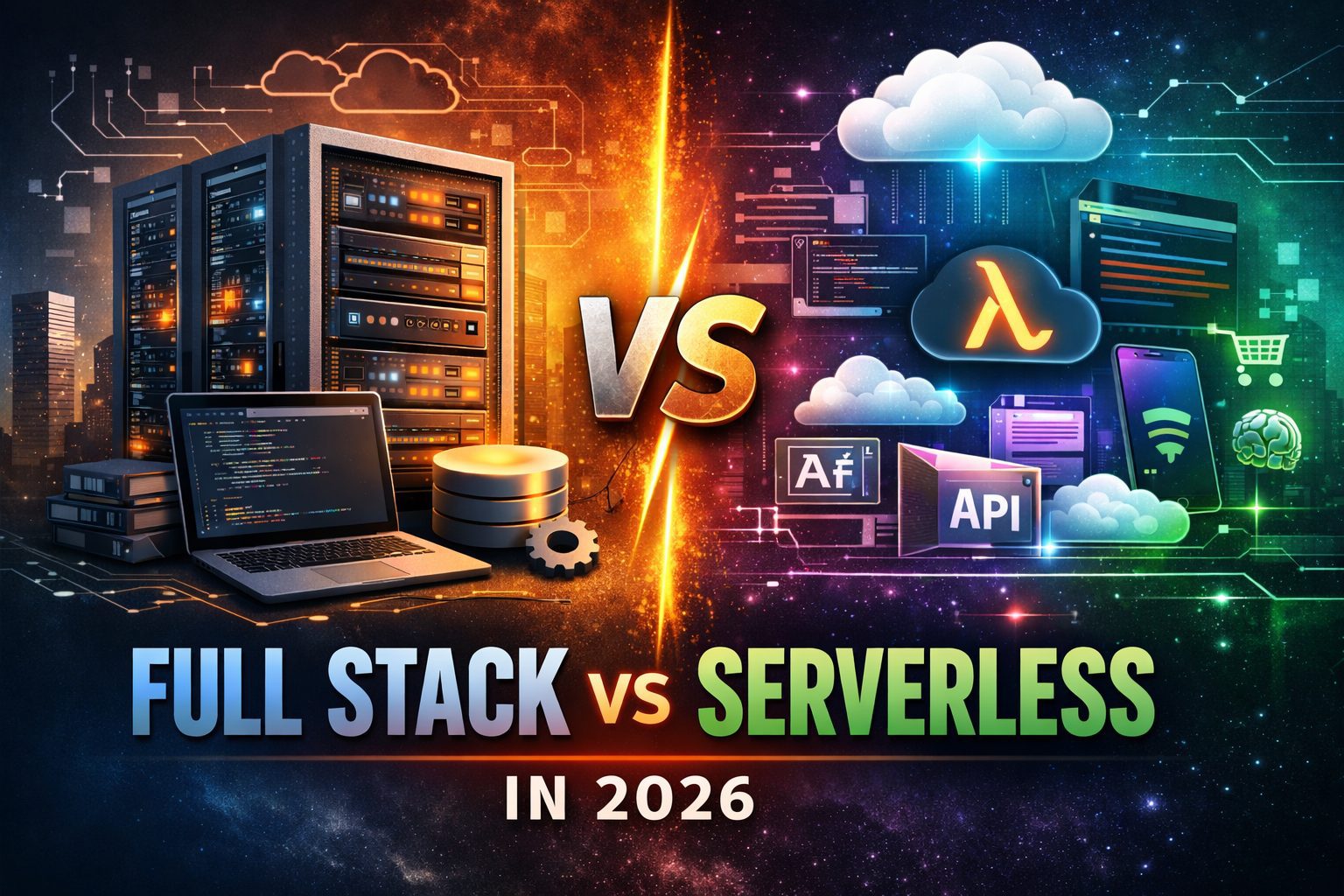
If you think the Full Stack vs Serverless debate is old news, think again. In 2026, this decision isn’t just technical—it’s strategic. With AI-driven products, global user bases, and tighter budgets, choosing the wrong architecture can slow growth like driving with the handbrake on.
So the big question is: Should you still build full stack applications, or is serverless the smarter move in 2026? Let’s break it down in simple, human terms.
What Is Full Stack Development?
Full stack development means you’re building and managing everything—frontend, backend, database, and often the server itself.
Think of it like owning a house instead of renting. You get full control, but you’re also responsible for maintenance, repairs, and bills.
Frontend Explained
This is what users see and touch. In 2026, full stack frontends commonly use:
- React, Next.js, Vue
- Tailwind CSS
- AI-powered UI personalization
The frontend talks directly to your backend through APIs.
Backend Explained
The backend handles logic, authentication, data processing, and APIs. Popular stacks include:
- Node.js
- Django
- Laravel
- Spring Boot
You decide how it runs, how it scales, and how it connects to the database.
Databases and Infrastructure
Full stack apps usually rely on:
- SQL or NoSQL databases
- Virtual machines or containers
- Kubernetes or Docker
Powerful? Yes. Simple? Not always.
What Is Serverless Architecture?
Serverless doesn’t mean “no servers.” It means you don’t manage them.
Imagine ordering food instead of cooking. You just eat—someone else handles the kitchen.
How Serverless Actually Works
Your app is broken into small functions that run only when triggered. No requests? No cost. Simple as that.
Each function:
- Executes on demand
- Scales automatically
- Stops when the task is done
Popular Serverless Platforms in 2026
By 2026, the most common platforms are:
- AWS Lambda
- Azure Functions
- Google Cloud Functions
- Cloudflare Workers
These platforms are now faster, smarter, and more AI-integrated than ever.
Key Differences Between Full Stack and Serverless
Development Approach
Full stack follows a monolithic or microservices approach. Serverless is event-driven.
Full stack feels like building a factory. Serverless feels like assembling Lego blocks.
Infrastructure Management
- Full stack: You manage servers, scaling, uptime
- Serverless: Cloud provider handles it all
Less headache wins here.
Cost Structure
Full stack often means fixed costs. Serverless is pay-as-you-go.
If your app sleeps a lot, serverless saves money.
Scalability
Serverless scales automatically. Full stack needs planning and configuration.
In 2026, speed matters. Auto-scaling matters more.
Performance Comparison in 2026
Speed and Latency
Full stack apps offer consistent performance. Serverless is fast—but depends on execution timing.
Cold Starts vs Persistent Servers
Cold starts used to be serverless’s weakness. In 2026, they’re almost invisible, thanks to edge computing and AI pre-warming.
Full stack still wins for ultra-low latency systems, but the gap is tiny now.
Cost Comparison: Which Is Cheaper in 2026?
Serverless is cheaper for:
- Startups
- MVPs
- Variable traffic apps
Full stack is cheaper for:
- High, consistent traffic
- Long-running processes
In short: spiky traffic = serverless, steady traffic = full stack.
Security Considerations
Security in Full Stack Apps
You control security, but you’re also responsible for:
- Patching
- Firewalls
- Server hardening
One missed update = risk.
Security in Serverless Apps
Serverless reduces attack surfaces. No server access means fewer entry points.
However, misconfigured permissions can still cause trouble.
Developer Experience and Productivity
In 2026, developers value speed over complexity.
Serverless:
- Faster deployments
- Less DevOps
- Cleaner workflows
Full stack:
- More flexibility
- More setup
- More responsibility
If time-to-market matters, serverless feels like a cheat code.
Use Cases: When Full Stack Makes Sense
Choose full stack if you’re building:
- Real-time gaming platforms
- Financial trading systems
- AI training pipelines
- Legacy system integrations
You need control. Full stack gives it.
Use Cases: When Serverless Is the Better Choice
Serverless shines for:
- SaaS platforms
- APIs
- Mobile backends
- E-commerce
- AI-powered microservices
If your app grows unpredictably, serverless is your best friend.
Impact of AI and Automation on Both Models
AI is changing everything.
In full stack, AI helps with:
- Monitoring
- Scaling predictions
- Code optimization
In serverless, AI:
- Optimizes execution
- Reduces cold starts
- Automates deployments
Serverless benefits more directly from AI in 2026.
Vendor Lock-in: A Hidden Risk in 2026
Serverless ties you closely to a cloud provider.
Full stack gives more portability.
If flexibility matters long-term, this is a big decision factor.
Scalability and Global Reach
Serverless apps deploy globally with a click. Full stack needs configuration and planning.
In a global-first world, serverless wins again.
Maintenance and Long-Term Sustainability
Full stack requires:
- Ongoing maintenance
- Dedicated DevOps
- Higher operational costs
Serverless:
- Minimal maintenance
- Lower operational burden
- Easier long-term scaling
Which One Should Startups Choose in 2026?
Most startups should go serverless.
Why?
- Faster MVPs
- Lower cost
- Less infrastructure stress
You can always migrate later.
Which One Is Better for Enterprises?
Enterprises often choose hybrid models:
- Core systems: Full stack
- APIs & services: Serverless
Best of both worlds.
Future Trends Beyond 2026
Expect:
- More edge-based serverless
- AI-managed full stack systems
- Blended architectures
The line between full stack and serverless will blur.
Final Verdict: Full Stack vs Serverless
There’s no universal winner.
- Want control? Go full stack.
- Want speed and scalability? Go serverless.
In 2026, the smartest teams use both strategically.