
Introduction to Kimi 2.5 and Enterprise AI Adoption
Artificial intelligence is evolving faster than most enterprise systems can comfortably keep up with. New AI models are appearing regularly, each one offering greater reasoning capabilities, automation potential, and productivity improvements. One of the newest models drawing attention is Kimi 2.5, a powerful AI system designed for advanced tasks such as coding assistance, research support, document analysis, and enterprise workflow automation.
Unlike earlier models that primarily handled text-based tasks, Kimi 2.5 introduces multimodal capabilities. This means the system can understand and process multiple types of input simultaneously, including text, images, and structured data. For enterprises, this capability opens new possibilities such as analyzing reports, interpreting diagrams, reviewing screenshots, and generating code from design concepts.
Another important feature of Kimi 2.5 is its agent swarm architecture. Instead of relying on a single AI process, the model can coordinate multiple specialized AI agents working together in parallel. Each agent focuses on a specific part of a task, such as data analysis, code generation, or research gathering. By distributing tasks across several agents, the system can complete complex workflows significantly faster than traditional AI systems.
However, these capabilities also introduce new challenges. When AI systems become capable of autonomous actions, the risks increase. An AI agent might attempt to access sensitive files, interact with enterprise systems in unexpected ways, or produce outputs that violate security policies. Because of these potential risks, organizations cannot simply deploy advanced models like Kimi 2.5 directly into production environments.
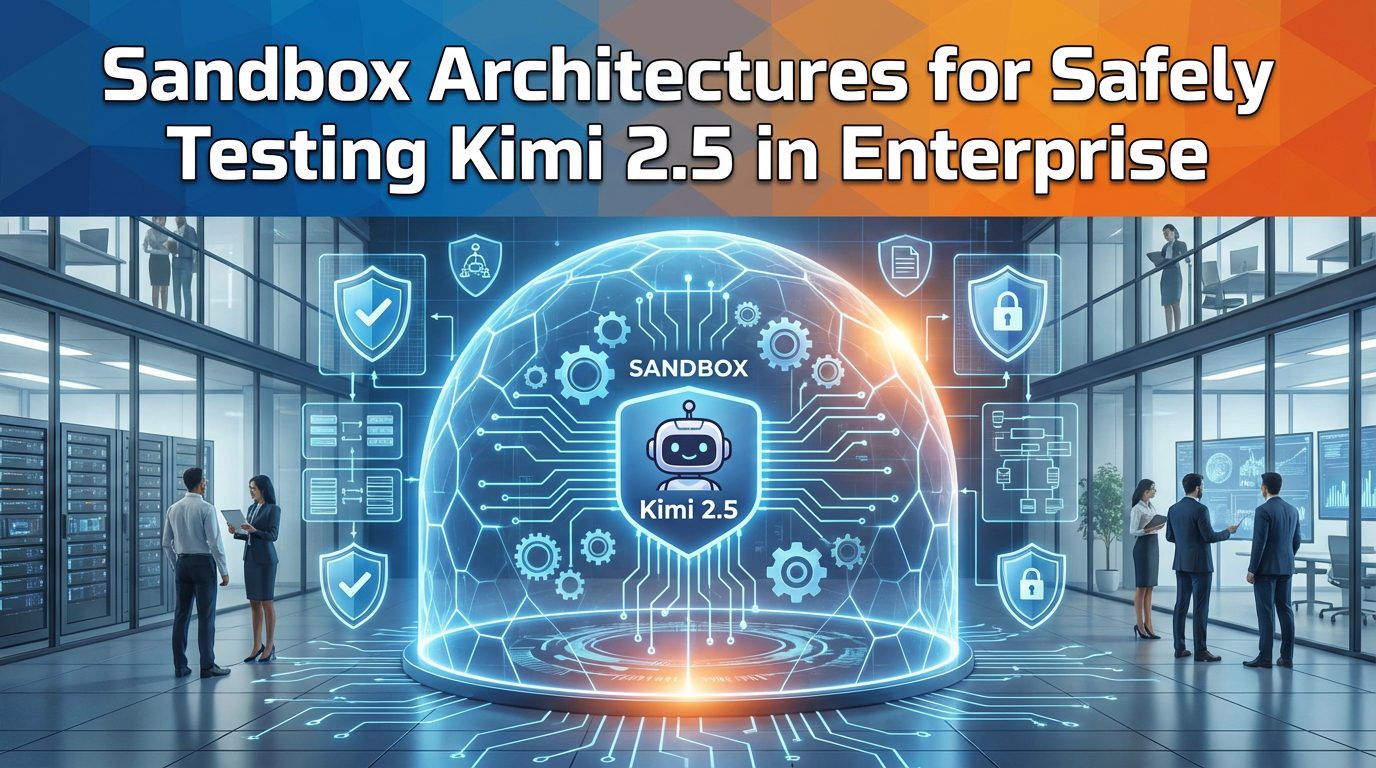
This is where sandbox architectures become critical. A sandbox is a controlled environment where new technologies can be tested safely before interacting with real systems or data. Within this environment, enterprises can observe how the AI behaves, test integrations, and identify security vulnerabilities without exposing critical infrastructure.
Think of a sandbox like a testing ground for innovation. Just as engineers test new machinery in controlled environments before deploying it in factories, enterprises test AI models inside sandboxes before integrating them into real workflows.
Why Enterprises Need Safe AI Testing Environments
Enterprise environments contain valuable assets including customer data, intellectual property, internal communications, and proprietary algorithms. Introducing an AI system that can autonomously generate code, analyze documents, and access tools requires careful planning and testing.
Safe AI testing environments provide a way to evaluate how the model behaves in realistic scenarios without exposing sensitive information. In these environments, developers can simulate workflows such as document analysis, data processing, or automated research while monitoring the model’s actions.
Another important factor is regulatory compliance. Many industries operate under strict regulations governing data security and AI usage. Organizations must demonstrate that new technologies are tested thoroughly before being deployed. Sandbox environments provide clear documentation and testing records that help organizations meet these requirements.
Safe testing environments also allow teams to experiment freely. Developers can push the AI model to its limits, test edge cases, and observe unusual behavior without worrying about breaking production systems. If something unexpected happens, the impact remains contained within the sandbox.
In practice, enterprise sandboxes help organizations achieve three key goals: reducing risk, improving reliability, and building trust in AI systems. These environments act as a bridge between experimental AI research and real-world enterprise deployment.
Understanding the Architecture of Kimi 2.5
Before building a sandbox for any AI system, organizations need to understand how the model works internally. Kimi 2.5 is built using advanced machine learning architecture designed to handle complex reasoning tasks efficiently.
The model uses a mixture-of-experts design, which means different parts of the model specialize in different types of tasks. Instead of activating every parameter for each query, the system selectively activates the most relevant components. This approach improves efficiency while maintaining high performance for complex operations.
Another notable feature is the extended context window. This allows the model to process large volumes of information in a single session. For enterprises, this capability is particularly valuable when analyzing lengthy documents, reviewing code repositories, or handling large datasets.
These architectural features make Kimi 2.5 powerful, but they also make testing more complicated. When a system can analyze extensive information and coordinate multiple AI agents simultaneously, predicting every possible behavior becomes difficult.
Multimodal Capabilities and Agent Swarm System
The multimodal capability of Kimi 2.5 allows it to interpret various forms of input in a single workflow. For example, the system might analyze a screenshot of a user interface, read associated documentation, and generate code that recreates the interface. This ability significantly expands what AI systems can accomplish in enterprise environments.
The agent swarm system is equally transformative. Instead of relying on a single reasoning process, the model can launch multiple agents that collaborate to solve complex tasks. One agent might gather information, another might write code, and a third might review the results for errors.
This distributed problem-solving approach increases efficiency but also increases complexity. Each agent may interact with different tools, datasets, or APIs. Without careful control, this could create unintended pathways to sensitive resources.
Why These Features Require Controlled Testing
Because Kimi 2.5 can perform multiple tasks simultaneously and coordinate independent agents, enterprises must carefully observe how these agents interact with each other and with external systems. Controlled testing environments allow organizations to simulate real workflows while keeping everything isolated from production systems.
In these environments, developers can track agent behavior, monitor API calls, and analyze decision-making patterns. If the system attempts to perform unauthorized actions, security teams can adjust policies or modify system permissions.
Controlled testing is especially important for identifying subtle issues that may not appear in simple tests. For example, a combination of actions across multiple agents might create a security vulnerability that would otherwise go unnoticed.
What Is an AI Sandbox in Enterprise Security?
An AI sandbox is a dedicated environment where artificial intelligence models can be tested safely without affecting production infrastructure. It provides a secure space for experimentation, allowing developers and security teams to observe how AI systems behave under controlled conditions.
Unlike standard development environments, AI sandboxes include additional layers of security. These environments restrict network access, limit system permissions, and monitor every action performed by the AI model. This level of control ensures that any unexpected behavior remains contained within the sandbox.
Sandbox environments often include simulated versions of enterprise systems. For example, a sandbox may contain mock databases, virtual APIs, or synthetic datasets that behave like real systems. This allows developers to test realistic workflows without exposing sensitive information.
Key Characteristics of a Sandbox Environment
A well-designed AI sandbox typically includes several important characteristics that make it suitable for enterprise testing.
First, strong isolation separates the sandbox from production systems. This prevents accidental interactions with real infrastructure and ensures that testing activities cannot impact operational systems.
Second, sandbox environments include comprehensive monitoring tools. These tools track system activity, log interactions, and record AI outputs. Security teams can analyze these logs to understand how the model behaves and identify potential risks.
Third, sandboxes enforce strict access policies. The AI model is only allowed to interact with approved resources. If the system attempts to access unauthorized tools or data, those actions are blocked automatically.
These features create a safe environment where organizations can explore advanced AI capabilities without compromising security.
Core Principles of Sandbox Architecture for AI Models
Isolation
Isolation ensures that the sandbox environment remains separate from production systems. This is typically achieved through virtualization technologies, containerization, or network segmentation. By isolating the AI model, enterprises prevent any unexpected behavior from spreading beyond the testing environment.
Isolation also protects sensitive data. Even if the AI system attempts to access restricted resources, the sandbox environment prevents it from reaching those systems.
Observability
Observability refers to the ability to monitor everything happening inside the sandbox. This includes tracking inputs, outputs, system commands, and resource usage. Observability tools provide visibility into how the AI model interacts with its environment.
These tools help developers understand the model’s decision-making process and identify unusual behavior patterns. For example, if the AI attempts to access files outside its permitted scope, observability systems can immediately flag the action.
Policy Enforcement
Policy enforcement ensures that the AI system operates within predefined rules. These policies may restrict network access, limit command execution, or control which datasets the AI can access.
For instance, an organization might allow the AI to analyze anonymized documents but block access to confidential customer data. Automated policy enforcement ensures that these rules are applied consistently throughout the testing process.
Infrastructure Design Patterns for Kimi 2.5 Sandboxes
Containerized Sandbox Environments
Containers provide lightweight isolation and are widely used for building sandbox environments. By packaging the AI model and its dependencies into containers, developers can quickly create repeatable testing environments.
Containers also allow teams to run multiple sandbox instances simultaneously. Each instance can simulate a different testing scenario, enabling comprehensive evaluation of the AI model’s behavior.
Virtual Machine Isolation
Virtual machines provide stronger isolation than containers because they include a full operating system layer. This makes them suitable for testing scenarios where higher security boundaries are required.
Enterprises often use virtual machines when testing AI models that interact with sensitive data or complex enterprise systems.
Air-Gapped Testing Labs
In highly secure environments, organizations may deploy air-gapped sandboxes. These systems are completely disconnected from external networks, ensuring that no data can enter or leave the testing environment.
Air-gapped labs are commonly used in industries that handle sensitive or classified information.
Secure Data Handling in AI Sandboxes
Testing AI models requires large datasets, but using real enterprise data can introduce security risks. If the AI model accidentally exposes confidential information, the consequences could be severe.
To avoid these risks, organizations often use synthetic datasets or anonymized data in sandbox environments. These datasets replicate the structure and patterns of real data without containing sensitive information.
Synthetic and Masked Data Strategies
Two common strategies help protect sensitive information during AI testing:
- Data masking replaces sensitive fields such as names or account numbers with fictional values.
- Synthetic data generation creates entirely artificial datasets that mimic real-world patterns.
These techniques allow AI models to perform realistic tasks while protecting confidential information.
Monitoring and Logging for AI Behavior
Monitoring systems play a critical role in sandbox testing. They record every interaction between the AI model and its environment, creating a detailed record of system behavior.
Logs typically capture prompt inputs, AI responses, tool usage, API calls, and system resource consumption. By analyzing these logs, developers can understand how the AI model behaves in different scenarios.
Advanced monitoring systems also include anomaly detection capabilities. If the AI begins behaving unexpectedly, the system can alert administrators immediately.
Risk Assessment and Governance Frameworks
Testing AI systems is not only a technical task but also a governance process. Organizations must evaluate potential risks, document testing results, and ensure that AI deployments comply with internal policies and industry regulations.
Risk assessment frameworks help organizations identify possible security vulnerabilities, operational risks, and ethical concerns. These frameworks guide decision-making during the testing and deployment process.
Some organizations also establish AI governance committees that review sandbox testing results before approving production deployment.
Building a Scalable Enterprise AI Sandbox Pipeline
As enterprises experiment with multiple AI models, sandbox environments must scale efficiently. Instead of manually creating testing environments, organizations often build automated pipelines that deploy sandboxes on demand.
These pipelines integrate with cloud infrastructure, container orchestration systems, and monitoring platforms. When a new AI model needs testing, the pipeline automatically provisions a sandbox environment, runs predefined tests, and collects results.
After testing is complete, the environment can be destroyed, ensuring that resources are used efficiently and securely.
Conclusion
Advanced AI systems like Kimi 2.5 are reshaping how enterprises approach automation, data analysis, and software development. With powerful capabilities such as multimodal processing and agent swarm architectures, these models can perform complex tasks that previously required entire teams of specialists.
However, these capabilities also introduce new risks. Without proper safeguards, deploying autonomous AI systems directly into enterprise environments could create security vulnerabilities or compliance issues.
Sandbox architectures provide a practical solution. By creating isolated environments with strict monitoring and access controls, organizations can safely explore AI capabilities while protecting critical systems and data.
As AI technology continues to evolve, sandbox environments will remain an essential component of responsible AI adoption. They allow enterprises to innovate confidently while maintaining the security and reliability that modern organizations require.