
Introduction to Multimodal AI
Let’s be honest—content creation has changed faster in the last two years than it did in the last two decades. We’ve gone from typing blog posts to generating full-blown visuals and videos with a single prompt. Sounds wild, right? Welcome to the era of multimodal AI.
What Does “Multimodal” Really Mean?
Multimodal AI simply means artificial intelligence that can understand and generate more than one type of content at the same time. Instead of working only with text, it can handle text, images, audio, and video—sometimes all in one workflow.
Think of it like a super-creative assistant who can write your script, design your visuals, and even produce a video without asking for coffee breaks.
Why Multimodal AI Is Gaining So Much Attention
Because people don’t consume content the way they used to. We scroll, skim, watch, swipe, and move on in seconds. Multimodal content grabs attention faster, tells richer stories, and keeps users engaged longer—and AI makes it scalable.
Evolution of Content Creation
From Text-Only AI to Visual Intelligence
Early AI tools were great at text—emails, blogs, captions. Useful? Yes. Exciting? Not really. Then came image generation, and suddenly AI wasn’t just writing—it was creating.
The jump from text-only to multimodal AI is like moving from black-and-white TV to 4K streaming.
Key Milestones in Multimodal AI Development
- Natural language processing (NLP)
- Computer vision breakthroughs
- Generative adversarial networks (GANs)
- Diffusion models for images and video
- Unified multimodal transformers
Each step brought AI closer to understanding the world the way humans do—through multiple senses.
How Multimodal AI Works
Understanding Large Multimodal Models (LMMs)
At the heart of multimodal AI are large models trained on mixed data types. These models learn relationships between words, visuals, motion, and context.
Text Processing
AI understands prompts, tone, intent, and structure using advanced language models.
Image Understanding
Computer vision allows AI to recognize objects, styles, colors, emotions, and layouts.
Video and Temporal Data Analysis
Video adds time into the equation. Multimodal AI learns how scenes change, how actions flow, and how stories unfold frame by frame.
Popular Examples of Multimodal AI
Text-to-Image Generators
Type a sentence, get an image. Simple. Powerful. Revolutionary.
Text-to-Video Platforms
From scripts to animated videos in minutes—no cameras, no studios.
All-in-One Multimodal AI Tools
These tools combine text, image, video, and even voice generation in a single platform. One prompt, multiple outputs.
Why Multimodal AI Is a Game-Changer
Speed and Efficiency
What used to take a team of writers, designers, and editors can now be done in hours—or minutes.
Creativity Without Limits
AI doesn’t get tired. It experiments endlessly, offering ideas humans might never consider.
Cost Reduction for Businesses
Lower production costs mean even small brands can compete with big players.
Use Cases Across Industries
Marketing and Advertising
Ad creatives, social posts, video ads—AI does it all at scale.
Education and E-Learning
Interactive lessons, explainer videos, visual aids—all generated instantly.
Entertainment and Media
Storyboarding, trailers, animations, and even short films.
E-Commerce and Product Visualization
AI-generated product images, demo videos, and lifestyle shots.
Healthcare and Training Simulations
Visual simulations help professionals learn faster and safer.
Impact on Digital Marketing
Personalized Campaigns at Scale
AI tailors content based on user behavior, preferences, and context.
Better Engagement Through Visual Storytelling
Stories hit harder when text, visuals, and video work together.
Social Media Content Automation
Daily posts, reels, thumbnails—automated without losing consistency.
Multimodal AI and SEO
Visual Search Optimization
Images and videos are now searchable. AI helps optimize them smartly.
AI-Generated Videos for SERPs
Video content increases dwell time and improves rankings.
Content Velocity and Consistency
More content, faster publishing, better topical authority.
Challenges and Limitations
Ethical and Copyright Concerns
Who owns AI-generated content? The rules are still evolving.
Bias in Multimodal Models
If training data is biased, outputs can be too.
Quality Control Issues
AI is powerful—but not perfect. Human review still matters.
Human Creativity vs AI Creativity
Can AI Truly Be Creative?
AI remixes patterns. Humans bring emotion, intuition, and lived experience.
The Role of Humans in an AI-Driven World
AI doesn’t replace creators—it amplifies them.
The Future of Multimodal Content Creation
Real-Time Multimodal AI
Imagine live AI-generated visuals during conversations.
Hyper-Personalized Media Experiences
Every user gets content tailored just for them.
AI as a Creative Partner
Not a tool. Not a threat. A collaborator.
How Businesses Can Prepare
Skills to Learn
Prompt engineering, AI strategy, content oversight.
Tools to Adopt
Multimodal AI platforms, automation tools, analytics.
Building an AI-Ready Strategy
Start small, experiment, scale fast.
Risks of Ignoring Multimodal AI
Falling Behind Competitors
Others will move faster, cheaper, smarter.
Losing Audience Attention
Static content won’t survive in a dynamic world.
Conclusion
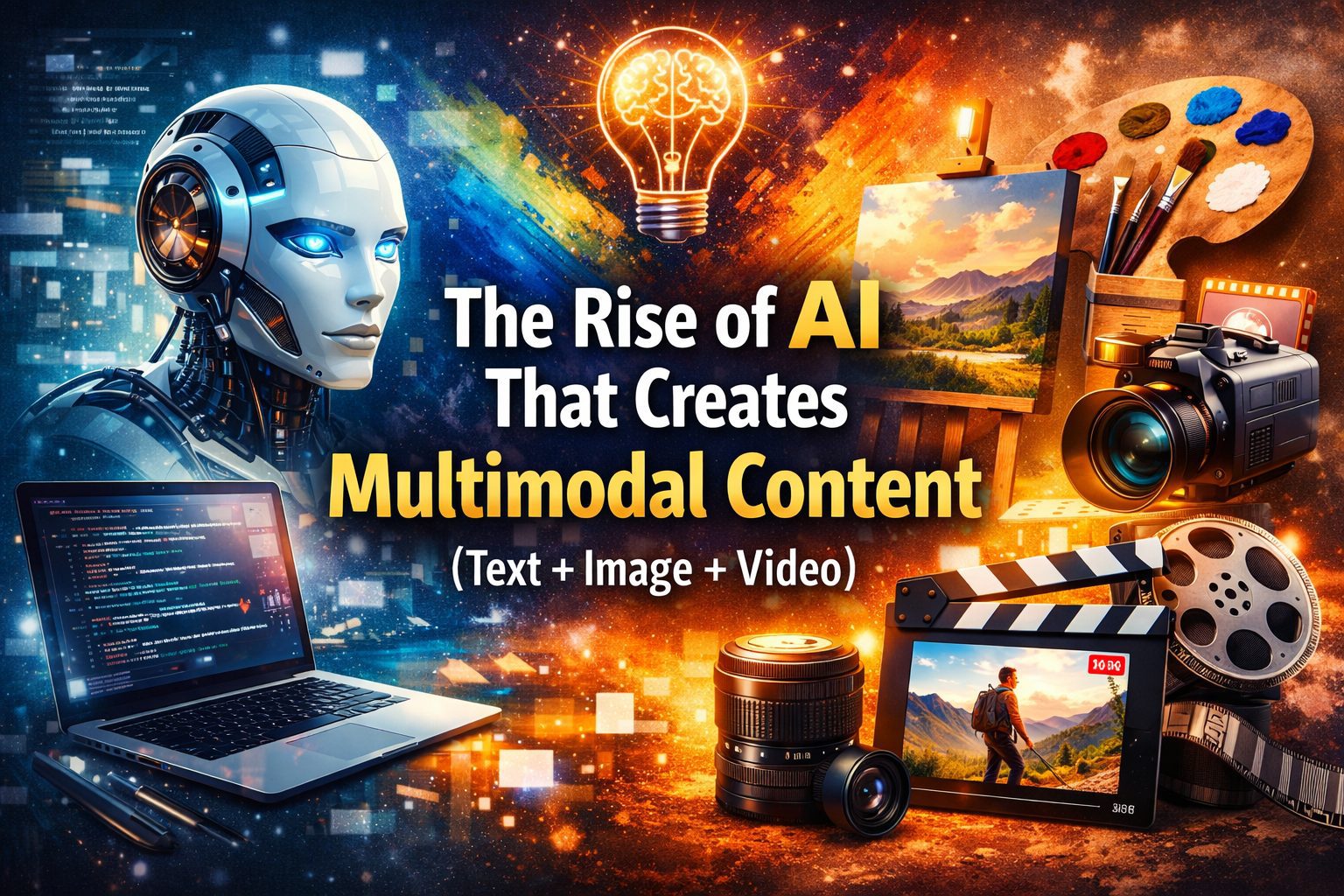
The rise of AI that creates multimodal content isn’t a trend—it’s a shift. Text, images, and videos are no longer separate lanes. They’re merging into one powerful storytelling engine. Those who adapt early will lead. Those who resist? They’ll watch from the sidelines. The future of content is multimodal—and it’s already here.