
PhishReaper Investigation: Anatomy of a JazzCash Brand-Abuse Mass Phishing Operation

PhishReaper Investigation: Anatomy of a JazzCash Brand-Abuse Mass Phishing Operation

A threat intelligence report based on research conducted by PhishReaper and presented by LogIQ Curve

Introduction

Digital payment platforms have transformed financial access across emerging markets, but their popularity has also made them prime targets for sophisticated phishing campaigns. Cybercriminals increasingly exploit trusted fintech brands to deceive users, harvest credentials, and conduct financial fraud.

As the Exclusive OEM Partner of PhishReaper in Pakistan, LogIQ Curve is pleased to share the latest cybersecurity intelligence uncovered by the PhishReaper research team. Through this collaboration, LogIQ Curve introduces the advanced phishing-detection capabilities of the PhishReaper platform to enterprises, financial institutions, telecom operators, and government organizations seeking proactive protection against modern cyber threats.

Organizations interested in strengthening their defenses against phishing infrastructure are encouraged to contact our cybersecurity specialists at security@logiqcurve.com.

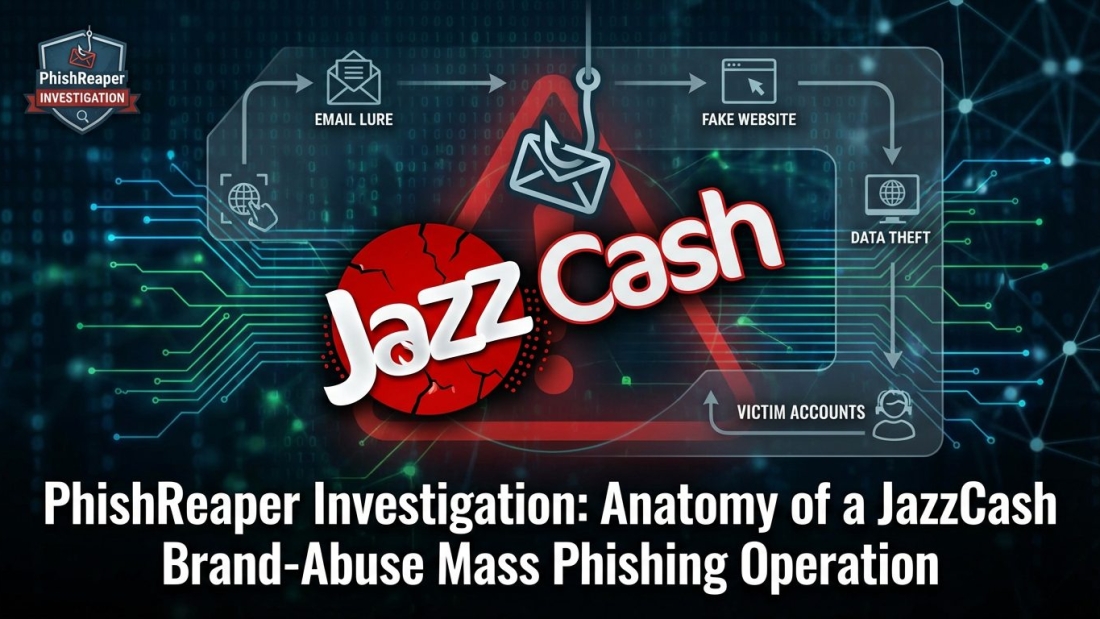
In one such investigation, PhishReaper analyzed a large-scale phishing campaign abusing the brand identity of JazzCash, a widely used mobile wallet platform in Pakistan. The campaign revealed a coordinated mass-phishing operation designed to impersonate the payment service and lure victims into fraudulent digital environments. (PhishReaper)

The Discovery: A Coordinated JazzCash Phishing Campaign

During routine threat-hunting operations, PhishReaper detected infrastructure associated with domains impersonating JazzCash services.

These malicious environments were crafted to replicate the appearance and functionality of legitimate JazzCash interfaces. Such phishing pages often encourage users to:
• Verify account information
• Update payment credentials
• Claim promotional rewards
• Authenticate their mobile wallet accounts

Once victims enter sensitive information, attackers can capture credentials and potentially gain unauthorized access to financial accounts.

The investigation revealed that the phishing activity was not limited to a single website. Instead, it appeared to be part of a coordinated mass-phishing campaign supported by multiple infrastructure components, suggesting a structured operation rather than an isolated incident. (PhishReaper)

Understanding the Infrastructure Behind the Attack

PhishReaper’s analysis examined the infrastructure supporting the JazzCash phishing ecosystem.

Several characteristics indicated an organized phishing operation:
• Domain registrations designed to mimic legitimate JazzCash branding
• Cloned login pages replicating mobile wallet interfaces
• Hosting environments capable of rapidly deploying phishing assets
• Coordinated domain clusters supporting campaign scalability

Such infrastructure allows attackers to launch multiple phishing pages simultaneously, increasing the chances that some will evade detection and reach victims.

By mapping relationships between these infrastructure components, PhishReaper was able to identify the broader phishing ecosystem supporting the campaign.

This infrastructure-level intelligence provides security teams with deeper visibility into how phishing campaigns operate behind the scenes.

Why Mobile Payment Platforms Are Attractive Targets

Digital payment platforms such as JazzCash represent highly attractive targets for cybercriminals.

These platforms handle:
• Financial transactions
• Personal identification information
• Mobile authentication credentials
• Linked bank accounts and wallets

Because users frequently interact with these platforms via SMS messages, mobile notifications, and web links, phishing campaigns can easily exploit these communication channels.

Attackers often create phishing pages that mimic account alerts, payment confirmations, or reward campaigns, messages that encourage users to interact quickly without verifying authenticity.

This social engineering tactic significantly increases the success rate of phishing attacks.

Why Traditional Security Systems Often Miss These Campaigns

Many traditional cybersecurity solutions rely on reactive detection mechanisms that depend on known indicators of compromise.

These systems typically detect phishing threats only after:
• Victims report suspicious links
• Security researchers identify malicious pages
• Domains appear on public blocklists

Such detection models introduce delays between the launch of a phishing campaign and its eventual discovery.

In large-scale phishing campaigns like the JazzCash operation, attackers may exploit this delay to distribute malicious links widely before detection systems respond.

As phishing infrastructure becomes more automated and scalable, reactive detection alone is increasingly insufficient.

PhishReaper’s Infrastructure-Level Threat Hunting

PhishReaper approaches phishing detection through intent-driven infrastructure analysis.

Instead of waiting for phishing pages to be reported, the platform analyzes signals that indicate a domain was created specifically for malicious purposes.

This includes examining:
• Suspicious domain naming patterns
• Brand token abuse
• Infrastructure relationships between domains
• Attacker deployment patterns

By identifying these signals early, PhishReaper can detect phishing infrastructure before it becomes widely visible across traditional threat-intelligence channels.

In the JazzCash case, this proactive analysis enabled investigators to identify a broader phishing ecosystem rather than focusing on isolated malicious pages.

Strategic Implications for Fintech and Telecom Ecosystems

Phishing campaigns targeting mobile payment services pose significant risks for both organizations and their customers.

Brand-abuse attacks can lead to:
• Theft of financial credentials
• Unauthorized transactions
• Identity theft
• Reputational damage for payment platforms

For fintech providers and telecom operators operating mobile wallet ecosystems, early detection of phishing infrastructure is essential to protecting users and maintaining trust.

Proactive threat-hunting platforms such as PhishReaper allow organizations to identify phishing campaigns earlier and respond before large-scale fraud occurs.

Moving Toward Proactive Cyber Defense

The JazzCash phishing operation highlights a broader trend within the cybersecurity landscape: phishing campaigns are evolving into structured, scalable operations.

Rather than deploying a single malicious website, attackers now build infrastructure capable of supporting mass-phishing activity across multiple channels.

To counter this threat, organizations must adopt proactive detection strategies capable of identifying malicious infrastructure before campaigns reach widespread distribution.

Such technologies provide:
• Earlier visibility into phishing operations
• Stronger protection against brand impersonation
• Deeper understanding of attacker infrastructure
• Enhanced threat-intelligence capabilities for SOC teams

This shift from reactive detection to proactive threat hunting represents a critical step in modern cybersecurity defense.

Conclusion

The JazzCash brand-abuse campaign uncovered by PhishReaper demonstrates how phishing operations targeting digital payment platforms can evolve into large-scale, coordinated attacks.

By analyzing the infrastructure supporting the campaign, PhishReaper’s threat-hunting technology was able to illuminate a mass-phishing ecosystem designed to impersonate a trusted financial service.
This investigation reinforces the importance of proactive phishing detection and infrastructure-level threat intelligence.

Through its collaboration with PhishReaper, LogIQ Curve remains committed to helping organizations identify phishing campaigns before they escalate into major cyber incidents.

Learn More About PhishReaper

Organizations interested in evaluating the PhishReaper phishing detection platform can contact LogIQ Curve to learn how this technology can strengthen enterprise security operations.
📧 security@logiqcurve.com

LogIQ Curve works with:
• Banks
• Telecom operators
• Government organizations
• Enterprises
• SOC teams
to identify phishing infrastructure before attacks, reach users.

Research Attribution

This analysis is based on the original threat-intelligence research conducted by PhishReaper. LogIQ Curve republishes these findings for its global audience as the Exclusive OEM Partner of PhishReaper in Pakistan, helping organizations gain early visibility into emerging phishing threats. (PhishReaper)

Description

PhishReaper uncovers a mass-phishing campaign abusing the JazzCash brand. Discover how proactive threat hunting exposed the infrastructure behind this large-scale fintech phishing operation.

#PhishReaper #LogIQCurve #CyberSecurity #PhishingDetection #ThreatIntelligence #ThreatHunting #CyberDefense #EnterpriseSecurity #SOC #AIinCybersecurity #DigitalSecurity #CyberResilience #FintechSecurity #MobileWalletSecurity #InfoSec #SecurityOperations #CyberThreats #PakistanCyberSecurity #CyberInnovation #SafwanKhan #HaiderAbbas #NajeebUlHussan #MumtazKhan #CISO #CTO #SecurityLeadership

AI Sovereignty: Why Businesses Are Moving Toward Private, Offline AI

AI Sovereignty: Why Businesses Are Moving Toward Private, Offline AI

Understanding AI Sovereignty

What AI Sovereignty Really Means

Let’s keep it simple. AI sovereignty is about control. Not partial control, not shared control—full control. When a business owns its AI systems, data pipelines, and infrastructure, it doesn’t have to rely on external platforms to function. Think of it like owning your own office instead of renting a co-working space. You decide the rules, the security, and who gets access.

This idea has become incredibly important as AI moves from being a “nice-to-have” to a core business engine. Companies are no longer experimenting—they are building entire operations around AI. That means the risks are higher too. If your AI depends on external providers, then your business is indirectly dependent on them as well. That’s a risky position to be in.

AI sovereignty also extends beyond just where your data sits. It includes how your data is processed, how your models are trained, and who can interact with them. It’s about building a system that you fully understand and fully control from end to end. For many businesses, this is no longer optional—it’s becoming a strategic necessity.

Evolution from Cloud AI to Sovereign AI

A few years ago, cloud-based AI was the obvious choice. It was fast to deploy, easy to scale, and didn’t require heavy upfront investment. Companies could plug into APIs and start building right away. It felt like the perfect solution.

But over time, cracks started to appear. Businesses began noticing issues like unpredictable costs, limited customization, and concerns around data exposure. The convenience of the cloud came with trade-offs, and those trade-offs became harder to ignore as AI workloads grew.

Now, the trend is shifting. Instead of relying entirely on cloud providers, companies are building their own AI environments or combining cloud with private infrastructure. This shift reflects a deeper realization: when AI becomes central to your operations, outsourcing control can create long-term risks. As a result, businesses are moving toward sovereign AI models that offer more stability, security, and independence.


The Shift Toward Private and Offline AI

What is Private AI Infrastructure

Private AI infrastructure means running your AI systems in an environment that you own or fully control. This could be on-premise servers, dedicated data centers, or private cloud environments that are not shared with other organizations. The key idea is exclusivity—your data and models are not mixed with anyone else’s.

This approach gives businesses a sense of ownership that public cloud solutions often cannot match. When everything runs within your own environment, you don’t have to worry about external access points or shared vulnerabilities. It’s like having a private vault instead of a shared storage unit.

Another major advantage is flexibility. With private infrastructure, companies can fine-tune their systems according to their specific needs. They are not limited by the constraints of a third-party provider. This level of customization is especially valuable for industries that rely on highly specialized data and workflows.

What is Offline (Air-Gapped) AI

Offline AI, often called air-gapped AI, takes security to the next level. These systems are completely disconnected from the internet. There is no external access, no cloud synchronization, and no risk of data leakage through online channels.

This might sound extreme, but for certain industries, it makes perfect sense. Think about defense organizations, financial institutions, or healthcare providers handling sensitive patient data. In these environments, even a small breach can have serious consequences.

Running AI in an offline environment ensures that data stays exactly where it belongs. It never leaves the system, and it is never exposed to external threats. While this approach requires more effort to maintain, it provides a level of security that is hard to achieve with connected systems.


Key Drivers Behind AI Sovereignty

Data Privacy and Security Concerns

Data is one of the most valuable assets a company has. Protecting it is not just a technical issue—it’s a business priority. As cyber threats become more advanced, companies are looking for ways to minimize their exposure.

Keeping data within a controlled environment significantly reduces the risk of breaches. When businesses rely on external platforms, they introduce additional points of vulnerability. By bringing AI systems in-house, they can limit access and maintain tighter control over sensitive information.

Rising Cloud Costs

Cloud services are often marketed as cost-effective, but that’s not always the case in the long run. As AI workloads grow, so do the costs associated with storage, computation, and data transfer. What starts as an affordable solution can quickly become expensive.

Private AI offers a different cost structure. While the initial investment may be higher, the ongoing costs are more predictable. For companies running large-scale AI operations, this can lead to significant savings over time.

Regulatory and Compliance Pressure

Governments and regulatory bodies are becoming stricter about how data is handled. Many regions now require companies to store and process data within specific geographic boundaries. This adds another layer of complexity for businesses using global cloud services.

Private AI makes compliance easier. When you control your infrastructure, you can ensure that your systems meet local regulations without relying on external providers to do it for you. This level of control simplifies compliance and reduces legal risks.

Control Over Intellectual Property

AI models are often trained on proprietary data that gives businesses a competitive edge. If that data is exposed or misused, it can have serious consequences. Public platforms may introduce risks related to data sharing or unintended exposure.

By using private AI systems, companies can protect their intellectual property. They can ensure that their models and data remain confidential and are not accessible to outside parties. This is especially important for organizations that rely on unique datasets to differentiate themselves in the market.


Benefits of Private, Offline AI

Enhanced Security and Data Protection

Security is the most obvious benefit of private AI. When systems are isolated and controlled, the risk of unauthorized access is significantly reduced. Data stays within the organization, and there are fewer entry points for potential attackers.

This level of protection is critical for industries that handle sensitive information. It allows businesses to operate with confidence, knowing that their data is secure.

Reduced Latency and Faster Processing

When AI systems run locally, they don’t need to send data to remote servers for processing. This reduces latency and improves performance. In many cases, the difference can be noticeable, especially for applications that require real-time responses.

Faster processing can lead to better user experiences and more efficient operations. It also allows businesses to make decisions more quickly, which can be a significant advantage in competitive environments.

Cost Optimization Over Time

While private AI requires upfront investment, it can be more cost-effective in the long run. Companies avoid ongoing subscription fees and reduce their reliance on external services. This makes budgeting easier and eliminates unexpected cost spikes.

Customization and Domain-Specific Intelligence

Private AI allows businesses to build models that are tailored to their specific needs. Instead of relying on generic solutions, they can create systems that understand their data and workflows in depth.

This leads to more accurate insights and better performance. It also gives companies a competitive advantage, as their AI systems are designed specifically for their industry and use cases.


Challenges of Moving to Sovereign AI

Infrastructure Complexity

Building and maintaining private AI infrastructure is not simple. It requires expertise in hardware, networking, and software development. Companies need to invest in the right tools and systems to make it work effectively.

Talent and Skill Gaps

There is a growing demand for professionals who understand AI infrastructure. Finding the right talent can be challenging, especially for organizations that are new to this space.

Initial Setup Costs

The upfront cost of setting up private AI systems can be significant. This includes hardware, software, and implementation expenses. However, many businesses view this as a long-term investment rather than a short-term cost.


Private AI vs Public Cloud AI

FeaturePrivate AIPublic Cloud AI
Data ControlFull controlLimited control
SecurityHighModerate
Cost (Long-term)LowerHigher
ScalabilityModerateHigh
ComplianceEasierComplex

Real-World Use Cases

Healthcare

In healthcare, data privacy is critical. Private AI systems allow hospitals to analyze patient data without exposing it to external networks. This helps maintain confidentiality while still benefiting from advanced analytics.

Finance and Banking

Financial institutions use private AI to detect fraud and manage transactions securely. By keeping data in-house, they reduce the risk of breaches and ensure compliance with strict regulations.

Manufacturing and Industry

Manufacturing companies use AI to monitor equipment and predict failures. Running these systems locally allows for faster responses and more reliable operations.


The Role of Edge AI and Small Language Models

Rise of Small Language Models

Large AI models are powerful, but they require significant resources. Smaller models offer a practical alternative. They are easier to deploy, faster to run, and well-suited for private environments.

These models make it possible for more businesses to adopt AI without relying on massive cloud infrastructure.

Edge Computing and Local Processing

Edge AI brings computation closer to where data is generated. This reduces the need for data transfer and improves efficiency. It also aligns perfectly with the idea of AI sovereignty, as processing happens within a controlled environment.


Hybrid AI: The Middle Ground

Combining Cloud and Private AI

Not every workload needs to be private. Many companies are adopting hybrid approaches that combine the flexibility of the cloud with the control of private systems. This allows them to balance performance, cost, and security.

Hybrid AI offers a practical path forward for organizations that want to transition gradually without giving up the benefits of cloud services entirely.


Growth of Sovereign AI Investments

Investment in sovereign AI is increasing rapidly. As more companies recognize the importance of control and security, they are allocating resources to build private AI capabilities.

AI as Critical Infrastructure

AI is becoming as essential as electricity or the internet. Businesses rely on it for decision-making, automation, and innovation. Treating AI as critical infrastructure means prioritizing reliability, security, and control.


Conclusion

AI sovereignty represents a major shift in how businesses think about technology. It’s no longer just about using AI—it’s about owning it. Private and offline AI systems give companies the control they need to operate securely and efficiently.

This shift is not without challenges, but the benefits are clear. Businesses that invest in sovereign AI are better positioned to protect their data, reduce costs, and build systems that truly serve their needs. As AI continues to evolve, control will become even more important, making sovereignty a key factor in long-term success.

Open-Source AI vs. Proprietary Models: Which Should Your Business Choose? this is title of my blog give me featured image for this article

Open-Source AI vs. Proprietary Models: Which Should Your Business Choose?

Understanding the AI Landscape in 2026

Why AI Adoption is Exploding Across Industries

Artificial intelligence has shifted from being an experimental tool to a core business driver. Companies across industries are using AI to automate workflows, enhance customer experience, and make faster, data-driven decisions. The demand is no longer limited to tech companies. Retail, healthcare, finance, and even small startups are embracing AI to stay competitive in a rapidly evolving market.

One of the biggest reasons behind this surge is efficiency. Businesses are under constant pressure to do more with less. AI helps reduce manual work, cut costs, and improve accuracy. Instead of relying on guesswork, companies can now predict trends, understand customer behavior, and optimize operations with precision. This creates a powerful advantage that is hard to ignore.

Another factor driving adoption is accessibility. AI tools are no longer restricted to large enterprises with massive budgets. Today, even smaller businesses can access powerful AI capabilities through APIs or open-source frameworks. This democratization of AI has opened the door for innovation at every level.

As organizations adopt AI, they face a critical decision early on. Should they rely on open-source solutions or invest in proprietary platforms? This choice shapes everything from cost structure to scalability, making it one of the most important strategic decisions in modern business.

The Rise of Hybrid AI Strategies

Instead of choosing one approach over the other, many companies are blending both open-source and proprietary AI models. This hybrid strategy allows businesses to take advantage of the strengths of each approach while minimizing their weaknesses.

For example, a company might use proprietary AI for general tasks like customer support or content generation. These tools are easy to implement and require minimal setup. At the same time, the same company could use open-source models for specialized applications that require customization, such as internal analytics or domain-specific automation.

This combination offers flexibility. Businesses can scale quickly with proprietary tools while maintaining control over critical systems using open-source models. It also helps reduce dependency on a single vendor, which is a growing concern in today’s market.

The rise of hybrid strategies reflects a broader trend in technology adoption. Companies are no longer looking for one-size-fits-all solutions. Instead, they are building ecosystems that align with their unique goals, resources, and challenges.


What is Open-Source AI?

Key Characteristics of Open-Source Models

Open-source AI refers to models and frameworks that are publicly available for anyone to use, modify, and distribute. This openness creates a collaborative environment where developers and researchers contribute to continuous improvement. It also allows businesses to adapt these models to their specific needs.

One of the defining features of open-source AI is transparency. Users can examine how the model works, understand its limitations, and make adjustments if needed. This level of visibility is especially important for organizations that prioritize data privacy and compliance.

Another important aspect is flexibility. Businesses are not restricted by licensing agreements or vendor limitations. They can host the models on their own infrastructure, integrate them into existing systems, and customize them as required. This makes open-source AI particularly appealing for companies with unique or complex requirements.

However, this flexibility comes with responsibility. Organizations need the technical expertise to manage and maintain these systems. Without the right skills, the benefits of open-source AI can quickly turn into challenges.

Open-source AI has grown significantly in recent years, with several powerful models gaining widespread adoption. These models are designed for a variety of use cases, including natural language processing, image recognition, and data analysis.

What makes these models stand out is their rapid evolution. Because they are developed by global communities, improvements happen quickly. New features, optimizations, and bug fixes are constantly being introduced, making open-source AI a dynamic and fast-moving field.

Another advantage is specialization. Many open-source models are designed for specific industries or tasks. This allows businesses to choose solutions that align closely with their needs, rather than relying on general-purpose tools.


What are Proprietary AI Models?

How Proprietary AI Works

Proprietary AI models are developed and owned by companies. These models are not publicly accessible, and users interact with them through APIs or software platforms. The underlying code and training data remain confidential, which is why they are often referred to as closed systems.

This approach simplifies the user experience. Businesses do not need to worry about setting up infrastructure, training models, or managing updates. Everything is handled by the provider, allowing companies to focus on using the technology rather than building it.

Proprietary AI is designed for convenience and performance. These models are typically optimized using large datasets and advanced techniques, resulting in high accuracy and reliability. They are also regularly updated to keep up with evolving industry standards.

However, this convenience comes at a cost. Businesses must rely on the provider for access, updates, and support. This dependency can create challenges, especially if pricing or policies change over time.

Leading Proprietary AI Providers

Several major companies dominate the proprietary AI space, offering a wide range of tools and services. These providers focus on delivering high-performance models that can be easily integrated into business workflows.

What sets these providers apart is their investment in research and development. They continuously improve their models, ensuring that users have access to cutting-edge technology. They also provide support, documentation, and integration tools, making it easier for businesses to get started.

For organizations that prioritize speed and simplicity, proprietary AI offers a compelling solution. It allows them to deploy advanced capabilities without the need for in-house expertise or infrastructure.


Core Differences Between Open-Source and Proprietary AI

Transparency vs. Control

One of the biggest differences between open-source and proprietary AI is transparency. Open-source models allow users to see how they work, making it easier to understand and trust their outputs. Proprietary models, on the other hand, operate as black boxes, where the internal processes are hidden from users.

Control is another key factor. Open-source AI gives businesses full control over how the model is used and modified. Proprietary AI limits this control, as users must operate within the constraints set by the provider.

Cost Structures Compared

The cost structure of each approach is very different. Open-source AI often has low initial costs because there are no licensing fees. However, businesses must invest in infrastructure, development, and maintenance.

Proprietary AI typically involves subscription fees or usage-based pricing. While this can be more expensive over time, it reduces the need for upfront investment and technical resources.

Customization Capabilities

Customization is where open-source AI truly shines. Businesses can modify the model to fit their exact needs, making it ideal for specialized applications. Proprietary AI offers limited customization, usually through configuration settings or APIs.

Ease of Deployment

Proprietary AI is designed for quick and easy deployment. Businesses can integrate it into their systems with minimal effort. Open-source AI requires more time and expertise, as it involves setup, configuration, and ongoing management.


Advantages of Open-Source AI for Businesses

Flexibility and Customization

Open-source AI provides unmatched flexibility. Businesses can tailor models to their specific needs, whether it involves training on custom data or optimizing for particular tasks. This level of control allows companies to create solutions that are highly aligned with their goals.

Customization also leads to innovation. Companies can experiment with different approaches, test new ideas, and develop unique capabilities that set them apart from competitors. This is especially valuable in industries where differentiation is key.

Cost Efficiency Over Time

While open-source AI may require an initial investment, it can be more cost-effective in the long run. Businesses are not tied to recurring licensing fees, and they have control over resource usage.

This makes open-source AI an attractive option for organizations that plan to scale their operations. As usage increases, the cost savings become more significant compared to proprietary solutions.


Disadvantages of Open-Source AI

Technical Complexity

Open-source AI requires a high level of technical expertise. Businesses need skilled professionals to set up, manage, and maintain the system. Without the right team, implementation can become challenging and time-consuming.

Infrastructure Requirements

Running open-source AI models often involves significant infrastructure. This includes servers, storage, and data pipelines. For smaller businesses, these requirements can be a barrier to entry.


Advantages of Proprietary AI Models

Ease of Use and Integration

Proprietary AI models are designed to be user-friendly. Businesses can integrate them into existing systems without extensive technical knowledge. This makes them ideal for companies that want quick results.

High Performance and Support

Proprietary AI often delivers high performance due to advanced optimization and large datasets. Additionally, providers offer support and regular updates, ensuring reliability and continuous improvement.


Disadvantages of Proprietary AI

Vendor Lock-in Risks

Using proprietary AI can create dependency on a single provider. Switching to another platform can be difficult, especially if systems are deeply integrated.

Long-Term Costs

Subscription fees and usage-based pricing can add up over time. For businesses with high usage, this can become a significant expense.


Businesses are increasingly adopting hybrid approaches, combining open-source and proprietary AI to meet their needs. This trend reflects the growing understanding that no single solution fits all scenarios.


How to Choose the Right AI Strategy for Your Business

Choosing the right AI strategy depends on your business goals, resources, and technical capabilities. Companies should evaluate their needs carefully and consider factors such as cost, scalability, and customization.


Conclusion

The choice between open-source and proprietary AI is not about which is better, but which is more suitable for your business. Each approach has its strengths and challenges, and the best solution often involves a combination of both.

A threat intelligence report based on research conducted by PhishReaper and presented by LogIQ Curve

PhishReaper Investigation: Google’s New Year Phishing Hellscape, Detected on Day-1

Introduction

The start of a new year often brings new innovations in technology, but unfortunately, it also introduces new waves of cyber threats. Among the most dangerous of these are phishing campaigns that exploit globally trusted brands to lure victims into revealing sensitive data or downloading malicious software.

As the Exclusive OEM Partner of PhishReaper in Pakistan, LogIQ Curve is pleased to present the latest threat-intelligence insights uncovered by the PhishReaper research team. Through this strategic partnership, LogIQ Curve brings the powerful phishing-detection capabilities of the PhishReaper platform to enterprises, financial institutions, telecom operators, and government organizations seeking to proactively defend their digital ecosystems.

Organizations interested in identifying phishing infrastructure before attacks escalate are invited to contact our cybersecurity specialists at security@logiqcurve.com.

In a recent investigation, PhishReaper identified a cluster of Google-impersonating domains that had begun appearing in the wild early in 2026. These domains were part of a broader phishing ecosystem designed to evade conventional detection systems through techniques such as redirect laundering, dormant infrastructure staging, and abuse of trusted cloud platforms. (PhishReaper)

The Discovery: A Network of Google-Impersonation Domains

PhishReaper’s threat-hunting platform detected multiple domains impersonating Google services shortly after they were registered.

Examples included domains such as:
• Protected-google[.]com
• Helps-google[.]com
• Accountrecover-google[.]com

Some of these domains appeared harmless because they simply redirected visitors to legitimate Google websites. However, this behavior was intentionally designed to evade automated security scanners that check only the homepage of a domain before classifying it as benign. (PhishReaper)

This technique, known as reputation laundering, allows attackers to disguise malicious infrastructure behind legitimate redirects while preparing the domain for future phishing activity.

PhishReaper’s early detection revealed that these domains were part of a coordinated infrastructure cluster rather than isolated incidents.

Dormant Infrastructure: The “Inactive” Domains That Are Not Inactive

One particularly revealing example identified during the investigation was a domain that appeared inactive when scanned.

For most security systems, such a domain would appear harmless because it returned a hosting error page. However, PhishReaper’s analysis indicated that the infrastructure was pre-positioned phishing infrastructure, not an abandoned website.

These domains may display no active content yet still possess key operational components:
• Active DNS configuration
• Valid TLS certificates
• Prepared hosting infrastructure
• Domain reputation that improves over time

Attackers often stage such domains months in advance so they can activate phishing campaigns instantly when needed.

PhishReaper’s detection methodology identifies these patterns even when the infrastructure appears dormant.

Fake Software Distribution: Chrome Look-Alike Payload

Another domain identified during the investigation served what appeared to be a Google Chrome download page.

However, deeper inspection revealed that the binary distributed through the site was not legitimate software.

At the time of discovery:
• The payload was undetected by common antivirus engines
• The hosting infrastructure appeared clean
• No signature-based detection systems triggered alerts

This scenario represents a particularly dangerous form of phishing infrastructure because it combines brand impersonation with malware delivery, enabling attackers to distribute malicious software under the appearance of trusted downloads. (PhishReaper)

Abuse of Trusted Platforms

The investigation also uncovered phishing surfaces hosted on legitimate cloud infrastructure.

One example involved a Flutter web application deployed via Google Cloud infrastructure, built using the FlutterFlow platform.

Key observations included:
• Deliberate instructions preventing search engine indexing
• Legitimate cloud hosting infrastructure
• Dynamic content rendering typical of modern applications

Because the hosting platform itself is trusted, many security systems hesitate to classify such environments as malicious.

However, from a threat-intelligence perspective, a Google-branded application deployed outside of Google’s official infrastructure represents a clear signal of potential brand abuse.

PhishReaper’s detection systems flagged these signals immediately.

Why Traditional Security Tools Failed to Detect the Campaign

The investigation revealed a broader weakness within the global phishing-detection ecosystem.

Many traditional security tools rely on:
• Static reputation scoring
• Blocklists
• Signature-based malware scanning
• Basic redirect checks

Modern attackers have adapted to these mechanisms by building infrastructure designed specifically to evade them.

The Google phishing infrastructure identified in this investigation demonstrated several advanced evasion techniques, including:
• Staged infrastructure deployment
• Conditional payload delivery
• Cloud platform abuse
• Redirect reputation laundering

These techniques allow phishing infrastructure to remain undetected even when publicly accessible.

PhishReaper’s Agentic AI Threat Hunting

PhishReaper approaches phishing detection from a fundamentally different perspective.

Instead of asking whether a domain is already known to be malicious, the platform analyzes why the domain exists at all.

The platform’s Agentic AI examines signals such as:
• Large-scale brand token abuse
• Suspicious domain naming patterns
• Infrastructure staging behaviors
• Redirect deception strategies
• Hosting semantics and framework misuse

By focusing on intent rather than reputation, PhishReaper can detect phishing infrastructure immediately after it appears, without waiting for victims or external reports.

This approach allowed the platform to detect the Google impersonation infrastructure on the first day of its appearance. (PhishReaper)

Strategic Implications for Enterprises

Phishing campaigns that impersonate globally trusted brands such as Google present significant risks for organizations and their users.

These risks include:
• Credential theft
• Malware infection
• Account takeover
• Data exfiltration
• Reputational damage

The investigation highlights the importance of detecting phishing infrastructure before campaigns reach their distribution phase.

Organizations that rely solely on reactive detection models may remain exposed during the early stages of sophisticated phishing operations.

Moving Toward Proactive Cyber Defense

The Google phishing infrastructure uncovered by PhishReaper demonstrates how phishing campaigns are evolving into highly structured cybercrime ecosystems.

To defend against these threats, organizations must adopt technologies capable of identifying malicious infrastructure before it becomes widely visible.

Proactive threat-hunting platforms provide organizations with:
• Early visibility into emerging phishing campaigns
• Stronger protection against brand impersonation attacks
• Deeper understanding of attacker infrastructure
• Enhanced threat-intelligence capabilities for security teams

By shifting toward proactive cyber defense, enterprises can significantly reduce the impact of phishing operations.

Conclusion

The Google impersonation campaign identified by PhishReaper illustrates how modern phishing infrastructure can operate in plain sight while evading traditional detection systems.

By analyzing attacker intent and infrastructure behavior, PhishReaper’s Agentic AI detected the campaign immediately, without waiting for user reports, malware callbacks, or external threat intelligence feeds.

This early detection highlights the importance of proactive threat hunting in modern cybersecurity strategies.

Through its collaboration with PhishReaper, LogIQ Curve remains committed to helping organizations identify phishing infrastructure before it escalates into large-scale cyber incidents.

Learn More About PhishReaper

Organizations interested in evaluating the PhishReaper phishing detection platform can contact LogIQ Curve to learn how this technology can strengthen enterprise security operations.
📧 security@logiqcurve.com

LogIQ Curve works with:
• Banks
• Telecom operators
• Government organizations
• Enterprises
• SOC teams

to identify phishing infrastructure before attacks, reach users.

Research Attribution

This analysis is based on the original threat-intelligence research conducted by PhishReaper. LogIQ Curve republishes these findings for its global audience as the Exclusive OEM Partner of PhishReaper in Pakistan, helping organizations gain early visibility into emerging phishing threats.

Description

PhishReaper uncovers a Google-impersonation phishing infrastructure detected on Day-1. Learn how AI-driven threat hunting exposed redirect laundering, fake Chrome downloads, and staged phishing domains.

#PhishReaper #LogIQCurve #CyberSecurity #PhishingDetection #ThreatIntelligence #ThreatHunting #CyberDefense #EnterpriseSecurity #SOC #AIinCybersecurity #DigitalSecurity #CyberResilience #GooglePhishing #BrandProtection #InfoSec #SecurityOperations #CyberThreats #CISO #CTO #PakistanCyberSecurity #CyberInnovation #SafwanKhan #HaiderAbbas #MumtazKhan
#NajeebUlHussan #SecurityLeadership

Zero trust security: A practical roadmap for mid-sized businesses

Zero trust security: A practical roadmap for mid-sized businesses

Understanding Zero Trust Security

What Zero Trust Really Means

Let’s cut through the buzzwords—Zero Trust security isn’t about trusting nothing; it’s about verifying everything.

In traditional security models, once someone gets inside your network, they’re often trusted by default. That’s like letting someone into your house and assuming they’ll behave perfectly just because they’re inside. Sounds risky, right?

Zero Trust flips that idea completely. It works on a simple rule: never trust, always verify. Every user, device, and application must prove its legitimacy—every single time.

This approach doesn’t just secure the perimeter. It secures everything inside it too. And in today’s world, where threats can come from anywhere—even inside your organization—that mindset is critical.

Why Traditional Security Models Fail

Old-school security was built for a different era—when everything lived inside one office network. Firewalls and VPNs were enough back then.

But today? Businesses are spread across cloud platforms, remote teams, and mobile devices. The “perimeter” has basically disappeared.

Here’s the problem: once attackers breach the outer layer, they can move freely inside. That’s exactly what Zero Trust is designed to stop.

It’s not about building higher walls—it’s about locking every door inside the building.


Why Mid-Sized Businesses Need Zero Trust Now

Rising Cyber Threats

Cyberattacks are no longer targeting just big corporations. Mid-sized businesses are now prime targets because they often have valuable data but weaker defenses.

Hackers know this—and they exploit it.

From ransomware to phishing attacks, the threats are growing more sophisticated. And without a strong security model, even a single breach can cause serious damage—financially and reputationally.

Remote Work and Cloud Adoption

Let’s face it—work isn’t tied to an office anymore.

Employees are logging in from home, coffee shops, and different countries. At the same time, companies are moving data and applications to the cloud.

This creates a complex environment where traditional security simply can’t keep up.

Zero Trust is built for this new reality. It secures access no matter where users are or what device they’re using.


Core Principles of Zero Trust

Verify Explicitly

Every access request must be verified using multiple data points—identity, location, device health, and more.

It’s like a security checkpoint that checks your ID, your ticket, and even your behavior before letting you through.

Least Privilege Access

Users should only have access to what they absolutely need—nothing more.

This minimizes risk. Even if an account is compromised, the damage stays limited.

Assume Breach Mindset

Zero Trust assumes that breaches will happen. Instead of hoping for the best, it prepares for the worst.

This mindset ensures that systems are always monitored and threats are quickly contained.


Key Components of a Zero Trust Architecture

Identity and Access Management

Identity is the new perimeter.

Strong authentication methods like multi-factor authentication (MFA) ensure that only verified users gain access. This is the foundation of Zero Trust.

Device Security

Not all devices are safe. Some may be outdated or compromised.

Zero Trust checks device health before granting access. If something looks suspicious, access is denied.

Network Segmentation

Instead of one big open network, Zero Trust divides it into smaller segments.

This prevents attackers from moving freely if they gain access. It’s like having multiple locked rooms instead of one big hall.

Data Protection

Data is the most valuable asset—and it needs strong protection.

Encryption, access controls, and monitoring ensure that sensitive information stays secure at all times.


Step-by-Step Zero Trust Implementation Roadmap

Step 1: Assess Current Security Posture

Start by understanding where you stand.

Identify vulnerabilities, existing tools, and gaps in your current security setup. You can’t fix what you don’t see.

Step 2: Define Critical Assets

Not all data is equal.

Focus on protecting your most important assets—customer data, financial records, and intellectual property.

Step 3: Implement Strong Identity Controls

Introduce MFA and identity verification systems.

Make sure every user is authenticated before accessing any resource.

Step 4: Segment Networks and Limit Access

Break your network into smaller zones and control access between them.

This reduces the risk of lateral movement in case of a breach.

Step 5: Monitor and Continuously Improve

Security isn’t a one-time task.

Continuously monitor activity, detect anomalies, and update policies as needed. Zero Trust is an ongoing process.


Benefits of Zero Trust for Mid-Sized Businesses

Zero Trust offers several advantages that make it ideal for mid-sized organizations.

  • Stronger Security: Reduced risk of breaches
  • Better Visibility: Clear insights into user activity
  • Flexibility: Supports remote and cloud environments
  • Cost Efficiency: Prevents expensive security incidents

It’s not just about protection—it’s about control and confidence.


Challenges and Common Pitfalls

Adopting Zero Trust isn’t always easy.

One common challenge is complexity. Implementing new systems and processes can feel overwhelming.

There’s also resistance to change. Employees may find new security measures inconvenient at first.

And then there’s cost. While Zero Trust saves money in the long run, the initial investment can be a hurdle.

But here’s the thing—doing nothing is often more expensive.


Best Practices for Successful Adoption

To make Zero Trust work, businesses need a clear strategy.

Start small. Focus on critical areas first instead of trying to do everything at once.

Educate your team. Security is everyone’s responsibility, not just IT’s.

And most importantly, keep improving. Zero Trust isn’t a destination—it’s a journey.


Future of Zero Trust Security

Zero Trust is quickly becoming the standard for modern cybersecurity.

As threats evolve, businesses need smarter, more adaptive defenses. Zero Trust provides exactly that.

In the future, we’ll see more automation, AI-driven threat detection, and seamless security experiences.

The goal? Strong security without slowing down business operations.


Conclusion

Zero Trust security isn’t just a trend—it’s a necessity.

For mid-sized businesses, it offers a practical way to protect data, reduce risks, and adapt to modern work environments.

The journey may seem challenging, but the payoff is worth it. With the right approach, Zero Trust can transform your security from reactive to proactive.

And in today’s digital world, that’s exactly what you need.

How AI is changing UI/UX design: Tools, workflows, and what's still human

How AI is changing UI/UX design: Tools, workflows, and what’s still human

How AI is Changing UI/UX Design

The Rise of AI in Design

Why AI Became Essential in 2026

Let’s be real—UI/UX design has gone through a serious glow-up. Not long ago, designers were stuck doing repetitive work: adjusting pixels, building wireframes manually, and running endless usability tests. It was slow, sometimes frustrating, and definitely time-consuming.

Now enter AI—and everything changed.

In 2026, AI isn’t just a helpful add-on; it’s deeply embedded into the design process. From research to final delivery, AI acts like a supercharged assistant that speeds things up and reduces the heavy lifting. It helps designers skip the boring parts and focus on what actually matters—creating meaningful user experiences.

Think of AI like a high-performance engine. It doesn’t decide where to go, but it gets you there faster. Designers are still in control—they just have better tools now.

Key Statistics Driving Adoption

The shift toward AI in UI/UX isn’t just hype—it’s backed by real momentum. A huge percentage of design teams worldwide are already using AI tools in their daily workflows. That means AI isn’t the future anymore—it’s the present.

Here’s what’s pushing this change:

  • Faster product development cycles
  • Growing demand for personalized user experiences
  • Pressure to deliver more with fewer resources

And honestly, once teams start using AI, there’s no going back. Tasks that used to take hours—like building layouts or testing variations—can now be done in minutes. It’s like switching from a bicycle to a sports car.


Core Ways AI is Transforming UI/UX

AI-Powered Personalization

Have you ever opened an app and felt like it just gets you? That’s not magic—that’s AI.

AI-powered personalization allows interfaces to adapt based on user behavior. Instead of showing the same layout to everyone, apps now change dynamically depending on what users click, how long they stay, and what they prefer.

This creates a more engaging experience. Users feel understood, and that leads to better retention and satisfaction. It’s like walking into a store where everything is already tailored to your taste.

Generative Design Systems

This is where things get really interesting. AI can now generate entire UI designs from simple text prompts.

Imagine typing, “Design a clean mobile app for fitness tracking,” and instantly getting multiple layout options. That’s the power of generative design systems.

Designers are no longer starting from scratch. Instead, they’re guiding AI, refining outputs, and adding creative direction. It’s a shift from doing everything manually to collaborating with intelligent systems.

Predictive UX Optimization

AI doesn’t just react—it predicts.

By analyzing user data, AI can identify where users might struggle or drop off. It can suggest improvements before problems even happen. That’s a game-changer for UX.

Instead of fixing issues after users complain, designers can proactively improve the experience. It’s like having a crystal ball for usability.


AI Tools Designers Are Using Today

AI Design Assistants

Modern design tools now come with built-in AI features that assist with layout creation, component generation, and design consistency.

These assistants can:

  • Suggest design improvements
  • Automatically create variations
  • Maintain consistent styles across projects

It’s like having a teammate who never gets tired and always follows the design system perfectly.

UI Generation Tools

Prompt-based design tools are becoming incredibly popular. These platforms allow designers to create wireframes and UI screens simply by describing what they want.

No sketching. No dragging elements for hours. Just type—and watch the design come to life.

This doesn’t replace designers—it empowers them to move faster and explore more ideas.

Research & Testing Tools

AI has completely changed how research works in UX.

Instead of manually analyzing feedback or data, AI tools can process massive amounts of information in seconds. They can identify patterns, highlight user pain points, and even suggest solutions.

This frees up designers to focus on insights rather than getting stuck in spreadsheets.


The New AI-Driven Workflow

Research Phase with AI

Research used to be one of the slowest parts of the design process. Gathering data, conducting interviews, analyzing results—it all took time.

Now, AI speeds up everything. It can analyze user behavior, summarize feedback, and uncover trends almost instantly.

But here’s the important part: AI gives you data, not meaning. Designers still need to interpret the results and decide what actions to take.

Ideation and Wireframing

Staring at a blank screen? That’s becoming a thing of the past.

AI helps generate multiple design concepts quickly, giving designers a starting point. Instead of one idea, you get ten. That means more creativity and better outcomes.

Designers can experiment freely without worrying about time constraints.

Prototyping and Iteration

Iteration is where great design happens—and AI makes it faster than ever.

Designers can test multiple variations, refine layouts, and improve usability in real time. Some tools even simulate user interactions, giving a preview of how users will experience the product.

This leads to better designs with fewer mistakes.

Handoff and Development

The gap between designers and developers is shrinking.

AI tools can now convert design files into code, making the handoff process smoother. This reduces miscommunication and speeds up development.

The result? Faster launches and fewer revisions.


Benefits of AI in UI/UX Design

AI brings a ton of advantages to the table, and it’s easy to see why designers are embracing it.

  • Speed: Work gets done faster than ever
  • Efficiency: Less manual effort, more focus on creativity
  • Consistency: Design systems stay uniform
  • Scalability: Easier to handle large projects
  • Innovation: New possibilities emerge

AI doesn’t just improve the process—it expands what’s possible in design.


Challenges and Limitations

Of course, AI isn’t perfect.

One major issue is that AI-generated designs can feel generic. When everyone uses similar tools, designs start to look the same. Creativity can take a hit if designers rely too heavily on automation.

There’s also the problem of quality. AI can produce visually appealing layouts, but they don’t always work well from a usability standpoint.

And then there’s trust. Users can sense when something feels off. AI still struggles to capture the subtle human touch that makes designs truly engaging.


What Still Requires Human Creativity

Emotional Intelligence in Design

Design is about more than just visuals—it’s about emotion.

AI can analyze behavior, but it doesn’t truly understand how people feel. It can’t experience frustration, excitement, or confusion.

Designers bring empathy into the process. They understand users on a deeper level and create experiences that connect emotionally.

Ethical Decision-Making

AI doesn’t have a moral compass.

Designers must make important decisions about privacy, data usage, and fairness. These aren’t technical challenges—they’re ethical ones.

Without human oversight, AI-driven design could easily cross boundaries.

Strategic Thinking

AI can generate ideas, but it doesn’t think strategically.

Designers define goals, align with business needs, and create long-term visions. They decide what to build and why it matters.

AI supports the process—but humans lead it.


The future of UI/UX design is exciting—and a little unpredictable.

We’re moving toward more adaptive interfaces, where designs change in real time based on user behavior. Voice interactions and invisible interfaces are also becoming more common.

AI will continue to evolve, becoming more integrated into every stage of the design process. But one thing is clear: human creativity isn’t going anywhere.

The best designs will come from a combination of human insight and AI efficiency.


Conclusion

AI is transforming UI/UX design at every level. It’s making workflows faster, smarter, and more efficient. But it’s not replacing designers—it’s redefining their role.

Designers are now collaborators with AI, using it to enhance their creativity rather than replace it. The real value comes from blending human intuition with machine intelligence.

That’s where the magic happens.