

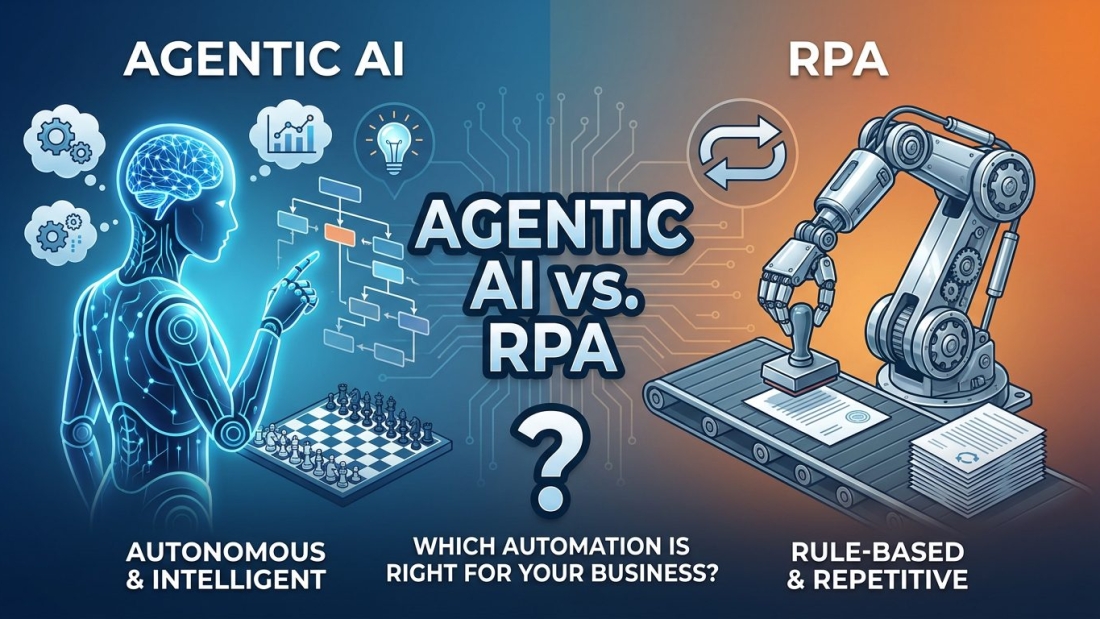
Agentic AI vs. RPA: Which Automation Is Right for Your Business? Businesses everywhere want one thing: less manual work and faster results. That is why automation tools are growing so quickly. Two of the biggest names in this space are Agentic AI and RPA (Robotic Process Automation). Both can save time, reduce costs, and improve productivity, but they work in very different ways. RPA is like a worker who follows fixed instructions every single time. It is great for repetitive tasks like data entry, invoice processing, or moving files between systems. Agentic AI, on the other hand, acts more like a smart assistant that can make decisions, learn from data, and adapt when situations change. Instead of just following rules, it can think through problems and respond dynamically. The real challenge for businesses is choosing the right solution. Picking the wrong automation system can waste money and create more complexity. Some companies only need simple task automation, while others need intelligent systems that can handle customer interactions, planning, and decision-making. What Is RPA? RPA stands for Robotic Process Automation. It uses software bots to complete repetitive digital tasks. Imagine copying data from one spreadsheet into another every day. An RPA bot can do that work automatically without getting tired or making typing mistakes. RPA works best when tasks follow strict rules. The bot needs clear instructions like: Open this file Copy this data Paste it into another system Send an email confirmation The process stays the same every time. That is where RPA shines. Banks, hospitals, and retail companies often use RPA to automate routine operations. It saves employees from boring tasks so they can focus on more valuable work. One of the biggest advantages of RPA is speed. Businesses can often deploy it quickly without changing their existing systems. It also reduces human error, which improves accuracy in daily operations. What Is Agentic AI? Agentic AI is a more advanced form of automation. Instead of just following instructions, it can make decisions and adapt to new situations. Think of it as moving from a calculator to a personal assistant. Agentic AI systems use technologies like machine learning, natural language processing, and reasoning models. They can understand context, analyze information, and even improve over time. This allows them to handle tasks that are too complex for traditional automation. For example, an AI agent in customer support can understand customer questions, search for solutions, respond naturally, and escalate issues when needed. Unlike RPA, it does not need every step pre-programmed. This flexibility makes Agentic AI powerful for businesses dealing with unpredictable workflows. It can support marketing teams, sales departments, HR operations, and customer service without relying on fixed rules alone. Key Differences Between Agentic AI and RPA Although both technologies automate work, they operate very differently. The table below shows the main differences. Feature RPA Agentic AI Works on fixed rules Yes No Learns from data No Yes Handles changing situations Limited Strong Best for repetitive tasks Excellent Moderate Decision-making ability Basic Advanced Setup complexity Lower Higher Human-like interaction Minimal Strong RPA is like a train running on tracks. It performs well as long as the route never changes. Agentic AI is more like a self-driving car that can react to traffic, weather, and unexpected obstacles. When RPA Is the Better Choice Not every business needs advanced AI systems. In many cases, RPA is still the smartest option. If your company deals with repetitive, predictable tasks, RPA can provide fast results at a lower cost. Industries like finance and insurance often rely on structured workflows. Invoice processing, payroll updates, and compliance reporting are perfect examples. These tasks rarely change, so rule-based automation works extremely well. RPA is also ideal for companies starting their automation journey. It is easier to implement and usually requires less technical expertise. Businesses can automate small processes first and expand later. Another benefit is reliability. Since RPA follows fixed instructions, the outcomes stay consistent. That makes it useful for operations where precision matters more than flexibility. When Agentic AI Makes More Sense Agentic AI becomes valuable when businesses need systems that can think, adapt, and respond intelligently. Modern companies deal with huge amounts of data and changing customer expectations. Fixed workflows are no longer enough in many situations. Customer support is a great example. People ask questions in different ways, and problems are not always predictable. An AI agent can understand intent, generate responses, and personalize interactions in real time. Sales and marketing teams also benefit from Agentic AI. It can analyze customer behavior, recommend strategies, and automate personalized communication. Instead of simply moving data, it creates insights and actions. Companies working in fast-changing industries often prefer Agentic AI because it can adapt without constant manual updates. It helps businesses stay competitive in environments where speed and intelligence matter. Challenges of RPA Even though RPA is useful, it has limitations. The biggest issue is rigidity. If a workflow changes, the bot may stop working correctly. Small changes in software layouts or data formats can break the automation process. RPA also struggles with unstructured data. It cannot easily understand emails, customer conversations, or documents without additional tools. Businesses often need human involvement for exceptions and unusual cases. Scaling can become difficult too. Managing hundreds of bots across multiple departments may create complexity over time. Without proper governance, automation systems can turn messy and hard to maintain. Challenges of Agentic AI Agentic AI is powerful, but it also comes with challenges. The biggest concern is complexity. These systems require strong data, computing resources, and careful monitoring. Cost is another factor. Building intelligent AI systems can be expensive compared to traditional automation. Businesses may need AI specialists, cloud infrastructure, and ongoing training. There are also concerns about trust and accuracy. AI systems can sometimes generate incorrect outputs or make decisions that are difficult to explain. That is why human oversight remains important, especially in sensitive industries like healthcare or finance. Which One Should Your Business Choose? The answer depends on your business goals. If you need fast automation for repetitive tasks, RPA is often the better starting point. It is simple, cost-effective, and reliable for structured workflows. If your business needs smarter systems that can adapt, communicate, and make decisions, Agentic AI offers much more flexibility. It is better suited for dynamic environments where tasks constantly change. Some companies combine both technologies. RPA handles repetitive processes while Agentic AI manages decision-making and customer interactions. Together, they create a more complete automation strategy. The future of automation is not about replacing people completely. It is about helping teams work faster, smarter, and more efficiently. Businesses that choose the right automation approach today will have a major advantage tomorrow. Conclusion Agentic AI and RPA both play important roles in modern business automation. RPA is perfect for repetitive, rule-based work that requires speed and accuracy. Agentic AI goes further by handling complex tasks, understanding context, and adapting to change. Choosing between them is not about which technology is better overall. It is about which one fits your business needs. Companies focused on stable workflows may gain more value from RPA, while businesses needing intelligent decision-making may benefit more from Agentic AI. The smartest approach is understanding your operations first. Once you know where your bottlenecks are, the right automation choice becomes much clearer.

Agentic AI vs. RPA: Which Automation Is Right for Your Business?

Agentic AI vs. RPA: Which Automation Is Right for Your Business?

Businesses today want faster workflows, lower costs, and less repetitive work. That is why automation tools are becoming essential. Two major technologies leading this shift are Agentic AI and RPA (Robotic Process Automation). While both improve efficiency, they function in completely different ways.

RPA works like a digital employee that follows strict instructions every time. It handles repetitive tasks such as data entry, invoice processing, and file transfers with speed and accuracy. Agentic AI is more advanced. It can analyze information, adapt to changing situations, and make decisions without relying only on fixed rules.

What Is RPA?

RPA uses software bots to automate structured digital tasks. These bots perform actions like copying data, updating records, or sending confirmations. Since the workflow stays predictable, RPA performs extremely well in industries such as banking, healthcare, and retail.

One of its biggest strengths is reliability. It reduces human mistakes and improves operational consistency. Businesses also prefer RPA because it is easier and cheaper to implement compared to advanced AI systems.

What Is Agentic AI?

Agentic AI goes beyond rule-based automation. Instead of simply following commands, it understands context and reacts intelligently. It uses technologies like machine learning and natural language processing to handle complex tasks.

For example, an AI support agent can understand customer questions, suggest solutions, and personalize responses in real time. This makes Agentic AI valuable for customer service, marketing, HR, and sales operations where flexibility matters.

Key Differences Between Agentic AI and RPA

FeatureRPAAgentic AI
Works on fixed rulesYesNo
Learns from dataNoYes
Handles changing situationsLimitedStrong
Best for repetitive tasksExcellentModerate
Decision-making abilityBasicAdvanced

RPA is ideal for stable workflows, while Agentic AI performs better in dynamic environments where situations constantly change.

Which One Should Your Business Choose?

If your business needs quick automation for repetitive tasks, RPA is usually the better option. It is affordable, dependable, and simple to deploy.

If your company requires smarter systems that can adapt, communicate, and analyze information, Agentic AI offers greater flexibility and intelligence.

Many organizations now combine both technologies. RPA manages repetitive operations, while Agentic AI handles decision-making and customer interactions. Together, they create a more balanced automation strategy.

Final Thoughts

RPA and Agentic AI both play major roles in modern business automation. RPA delivers speed and precision for structured tasks, while Agentic AI brings adaptability and intelligent problem-solving.

The right choice depends on your business goals, workflow complexity, and long-term automation plans. Companies that understand their operational needs clearly can choose the automation strategy that delivers the greatest value.