
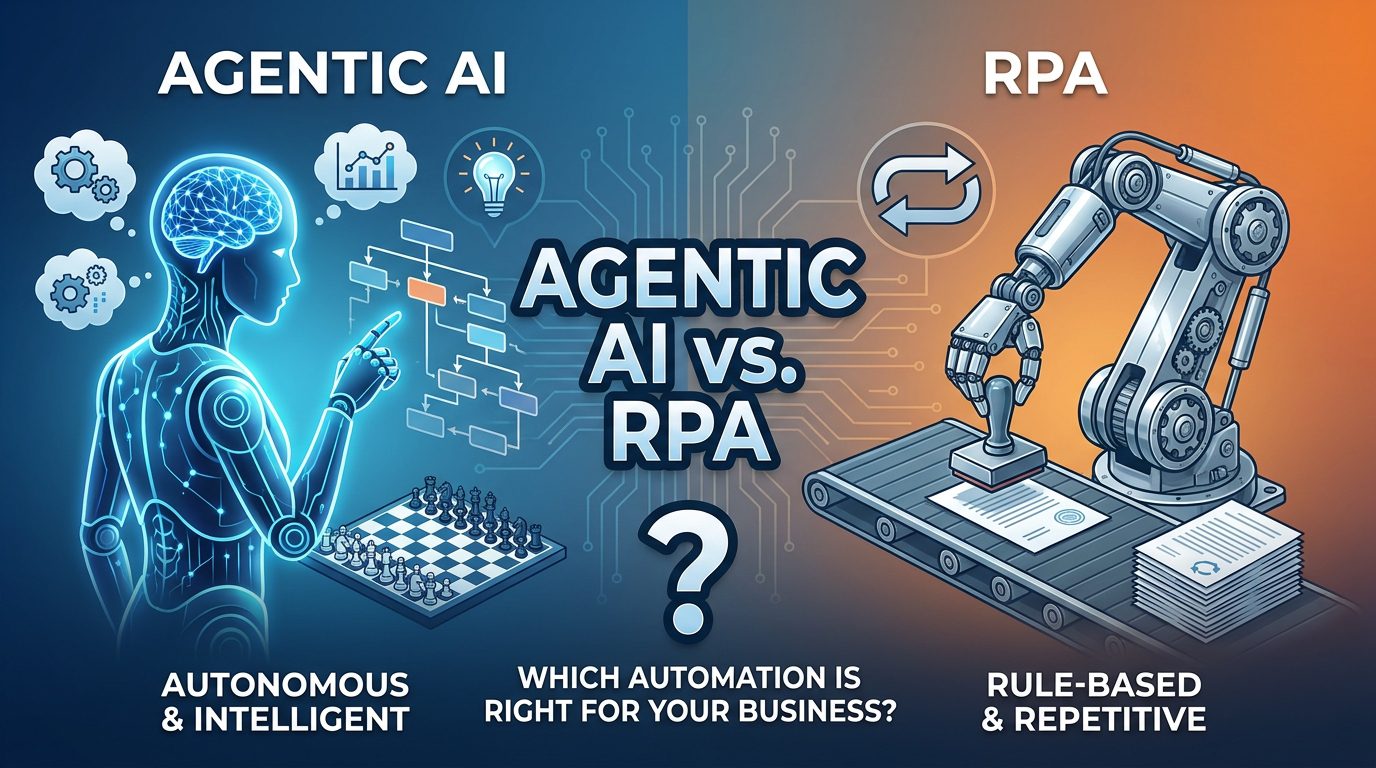
Agentic AI vs. RPA: Which Automation Is Right for Your Business?
Businesses today want faster workflows, lower costs, and less repetitive work. That is why automation tools are becoming essential. Two major technologies leading this shift are Agentic AI and RPA (Robotic Process Automation). While both improve efficiency, they function in completely different ways.
RPA works like a digital employee that follows strict instructions every time. It handles repetitive tasks such as data entry, invoice processing, and file transfers with speed and accuracy. Agentic AI is more advanced. It can analyze information, adapt to changing situations, and make decisions without relying only on fixed rules.
What Is RPA?
RPA uses software bots to automate structured digital tasks. These bots perform actions like copying data, updating records, or sending confirmations. Since the workflow stays predictable, RPA performs extremely well in industries such as banking, healthcare, and retail.
One of its biggest strengths is reliability. It reduces human mistakes and improves operational consistency. Businesses also prefer RPA because it is easier and cheaper to implement compared to advanced AI systems.
What Is Agentic AI?
Agentic AI goes beyond rule-based automation. Instead of simply following commands, it understands context and reacts intelligently. It uses technologies like machine learning and natural language processing to handle complex tasks.
For example, an AI support agent can understand customer questions, suggest solutions, and personalize responses in real time. This makes Agentic AI valuable for customer service, marketing, HR, and sales operations where flexibility matters.
Key Differences Between Agentic AI and RPA
| Feature | RPA | Agentic AI |
|---|---|---|
| Works on fixed rules | Yes | No |
| Learns from data | No | Yes |
| Handles changing situations | Limited | Strong |
| Best for repetitive tasks | Excellent | Moderate |
| Decision-making ability | Basic | Advanced |
RPA is ideal for stable workflows, while Agentic AI performs better in dynamic environments where situations constantly change.
Which One Should Your Business Choose?
If your business needs quick automation for repetitive tasks, RPA is usually the better option. It is affordable, dependable, and simple to deploy.
If your company requires smarter systems that can adapt, communicate, and analyze information, Agentic AI offers greater flexibility and intelligence.
Many organizations now combine both technologies. RPA manages repetitive operations, while Agentic AI handles decision-making and customer interactions. Together, they create a more balanced automation strategy.
Final Thoughts
RPA and Agentic AI both play major roles in modern business automation. RPA delivers speed and precision for structured tasks, while Agentic AI brings adaptability and intelligent problem-solving.
The right choice depends on your business goals, workflow complexity, and long-term automation plans. Companies that understand their operational needs clearly can choose the automation strategy that delivers the greatest value.