
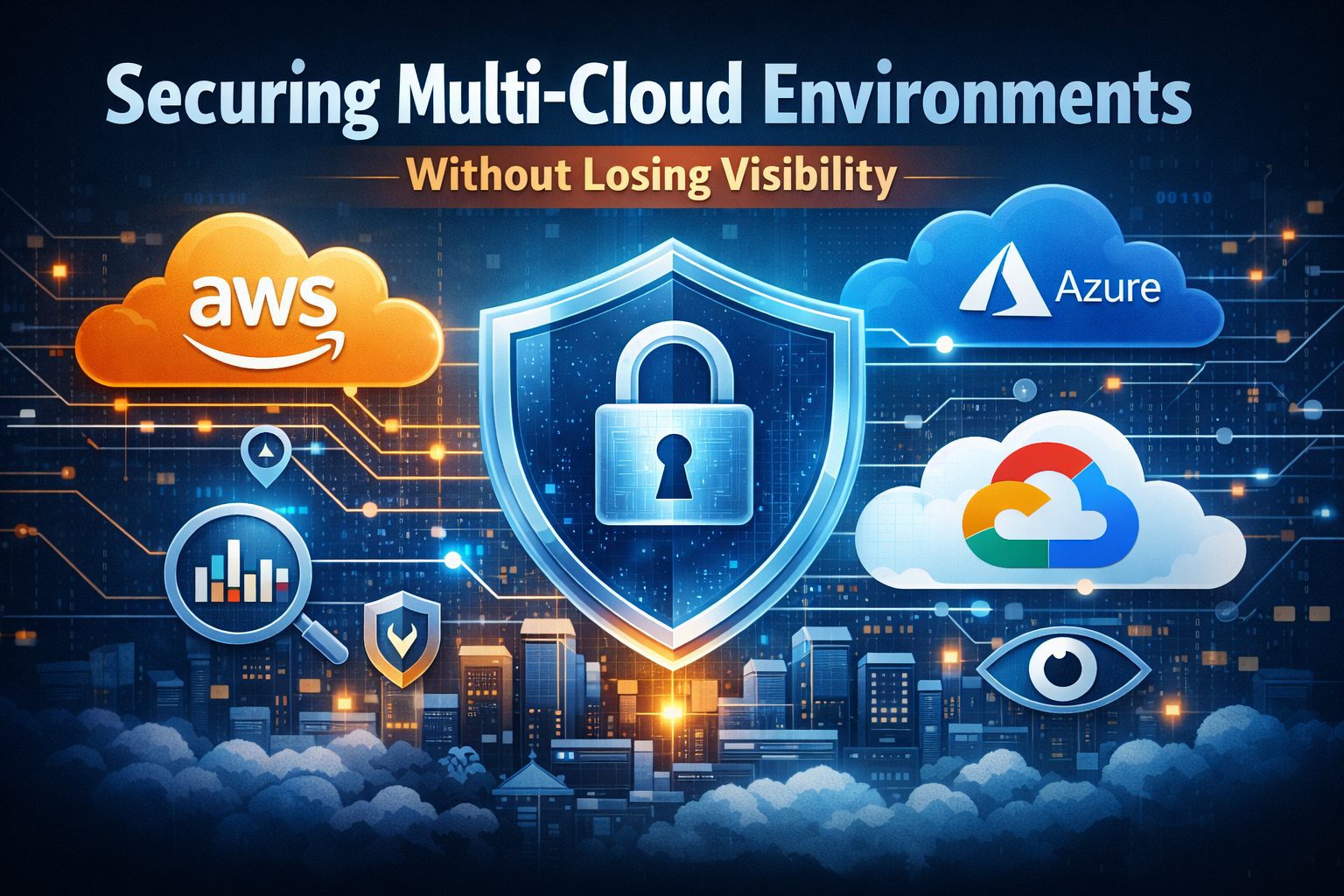
Multi-cloud environments are no longer experimental. They are now part of everyday enterprise IT strategy. Companies rely on multiple cloud providers to avoid vendor lock-in, improve resilience, optimize costs, and leverage best-in-class services. But as organizations expand across platforms, one serious issue emerges: visibility gaps. When logs, alerts, configurations, and user permissions are scattered across different providers, security teams struggle to see the full picture.
Think of it like managing security across multiple office buildings in different cities without a central control room. Each building has cameras and guards, but none of them share information. If something suspicious happens in one location, you may not detect patterns forming elsewhere. That is exactly how security risks grow inside multi-cloud environments. Without unified oversight, even small misconfigurations can escalate into major breaches.
This guide walks you through how to secure multi-cloud environments without losing visibility. You will learn how to unify monitoring, implement Zero Trust principles, centralize identity management, automate compliance, and create resilient disaster recovery plans. Let’s break it down step by step.
Understanding Multi-Cloud Environments
What Exactly Is Multi-Cloud?
Multi-cloud refers to the use of two or more cloud computing services from different providers. A company might run analytics on one platform, host applications on another, and store backups somewhere else entirely. This strategy allows businesses to choose the strongest features from each provider instead of relying on a single vendor.
While this flexibility brings operational advantages, it also introduces complexity. Each cloud provider has its own security tools, identity systems, logging formats, and configuration models. Security teams must understand and manage all of them simultaneously. When policies are inconsistent across platforms, it becomes difficult to enforce uniform controls. Visibility begins to fragment, and that fragmentation becomes fertile ground for risk.
Multi-cloud does not automatically mean insecure. The challenge lies in coordination. Without a deliberate strategy to unify monitoring and governance, organizations can lose track of assets, permissions, and exposures. Security becomes reactive rather than proactive.
Why Businesses Choose Multi-Cloud
Organizations adopt multi-cloud strategies for practical reasons. First, it reduces dependency on a single provider. If one platform experiences downtime or price increases, workloads can shift elsewhere. Second, different providers specialize in different services. Some offer stronger AI capabilities, others better analytics or global reach.
Regulatory compliance is another major driver. Certain industries require geographic data storage or specific certifications. Running workloads across different clouds helps meet regional compliance requirements more effectively. However, regulatory complexity also increases. Each cloud environment must adhere to security standards, and maintaining compliance visibility across all platforms becomes essential.
Cost optimization plays a role as well. Companies compare pricing structures and choose providers strategically for storage, compute, or networking. But managing financial optimization across clouds often overshadows security oversight. Without unified governance, cost efficiency can unintentionally create security blind spots.
The Visibility Challenge in Multi-Cloud Security
Fragmented Monitoring Tools
Each cloud provider offers its own native monitoring tools. While these tools are powerful individually, they are not designed to provide seamless cross-cloud integration. Security teams often end up switching between dashboards, exporting logs manually, and correlating alerts by hand.
This fragmented monitoring structure creates delays in threat detection. If suspicious behavior appears in one cloud and related activity happens in another, identifying that connection can take hours or days. In cybersecurity, time is everything. The longer it takes to detect a breach, the more damage attackers can cause.
The lack of standardization also contributes to confusion. Log formats differ. Alert severities vary. Access control policies operate under different terminologies. Without a unified monitoring approach, teams struggle to maintain a comprehensive, real-time overview of their entire infrastructure.
Siloed Logs and Alerts
When logs are siloed, incident response becomes inefficient. Security analysts must investigate multiple systems separately before understanding the scope of a threat. This slows down containment and remediation.
Alert fatigue becomes another problem. Each provider generates its own notifications. Analysts receive overlapping warnings that may or may not be related. Distinguishing real threats from noise becomes difficult. As a result, important signals can be overlooked.
Centralized logging solves this by consolidating telemetry data into one system. Correlating events across clouds helps detect patterns early. Instead of reacting to isolated incidents, teams can identify coordinated attack behavior and respond decisively.
Core Security Risks When Visibility Is Lost
Misconfigurations Across Clouds
Misconfigurations remain one of the leading causes of cloud breaches. Storage buckets left publicly accessible, overly permissive firewall rules, or disabled encryption settings can expose sensitive data. In a multi-cloud environment, these misconfigurations multiply because each provider has its own configuration standards.
Without centralized visibility, it is easy to miss configuration drift. A policy enforced in one cloud might not exist in another. As teams scale quickly, small inconsistencies accumulate. Attackers often scan for precisely these weak points.
Automated configuration scanning tools can detect vulnerabilities, but they must operate across all platforms. Manual auditing is insufficient. Consistency is key, and that consistency depends on centralized oversight and automation.
Identity and Access Chaos
Identity and access management becomes significantly more complex in multi-cloud deployments. Users may have separate credentials for each provider. Permissions might differ between environments. Without synchronization, access control becomes inconsistent.
Overprivileged accounts are particularly dangerous. If a compromised user has administrative access in multiple clouds, the impact of a breach expands dramatically. Visibility into user activity across platforms is critical for detecting unusual behavior.
Federated identity systems and centralized access policies reduce this risk. When authentication and authorization are unified, monitoring becomes simpler. You can track user behavior across environments and enforce consistent security standards.
Centralized Monitoring as the Foundation
Unified SIEM Platforms
A centralized Security Information and Event Management (SIEM) platform acts as the backbone of multi-cloud visibility. It aggregates logs from every provider, normalizes them, and enables real-time correlation.
With unified monitoring, analysts gain a single source of truth. Suspicious login attempts, configuration changes, and network anomalies appear in one dashboard. This drastically improves detection speed and investigative efficiency.
Modern SIEM solutions also leverage machine learning to identify anomalies that humans might overlook. By analyzing behavior patterns across clouds, they can detect subtle deviations that indicate compromise. Centralization transforms fragmented data into actionable intelligence.
Cross-Cloud Dashboards
Cross-cloud dashboards provide operational clarity. They display system health, compliance status, user activity, and threat indicators in a unified interface. Instead of juggling multiple consoles, teams operate from a centralized command center.
This visibility supports strategic decision-making. Leaders can assess risk exposure, evaluate compliance posture, and allocate resources effectively. When visibility is strong, security shifts from reactive firefighting to proactive governance.
Zero Trust: The Go-To Security Philosophy
Zero Trust Explained
The Zero Trust model is based on a simple principle: never trust, always verify. In traditional security models, anything inside the network perimeter was considered safe. Multi-cloud environments do not have a single perimeter. Workloads and users operate across distributed infrastructures.
Zero Trust requires continuous verification of users, devices, and services. Authentication is not a one-time event. Authorization decisions are based on context, risk level, and least privilege principles. This reduces the chance of lateral movement within cloud environments.
By implementing Zero Trust, organizations reduce reliance on implicit trust and strengthen identity-centric security controls.
Implementing Zero Trust Across Clouds
Applying Zero Trust in multi-cloud requires strong identity federation, multi-factor authentication, and micro-segmentation. Each workload should communicate only with explicitly authorized components.
Continuous monitoring supports this model. Behavioral analytics detect deviations in user or service activity. If anomalies appear, access can be restricted automatically. Zero Trust complements visibility efforts by ensuring that every interaction is observable and verified.
Identity and Access Management Strategies
Single Sign-On and Federation
Single Sign-On (SSO) simplifies authentication across cloud providers. Users authenticate once and gain access to authorized systems without juggling multiple passwords. Federation extends this concept by linking identities between different platforms.
Centralized identity management improves visibility because all authentication events flow through a unified system. Security teams can monitor login attempts, detect suspicious patterns, and enforce consistent password policies.
Least Privilege Access Policies
The principle of least privilege ensures users receive only the permissions necessary for their roles. This limits the potential damage if credentials are compromised.
Regular access reviews are essential. Permissions that were appropriate months ago may no longer be necessary. Automated access governance tools help maintain least privilege consistently across clouds.
Encryption and Data Protection Best Practices
Encryption At Rest and In Transit
No doubt, encryption protects data regardless of where it resides. Whether stored in databases or transmitted between services, sensitive information must be encrypted using strong cryptographic standards.
Uniform encryption policies across clouds prevent inconsistencies. Centralized oversight ensures that no environment operates with weaker protections.
Key Management Approaches
Encryption keys require careful management. Storing keys alongside encrypted data defeats the purpose. Dedicated key management systems provide secure storage, rotation, and auditing of cryptographic keys.
Centralized key management increases visibility into key usage. Security teams can monitor who accesses keys and detect unauthorized attempts.
Automating Security and Compliance Checks
CSPM and Compliance Automation
Cloud Security Posture Management (CSPM) tools continuously evaluate configurations against best practices and regulatory standards. They identify vulnerabilities and provide remediation guidance.
Automation reduces human error and accelerates compliance reporting. Instead of manual audits, organizations receive real-time posture assessments across all cloud environments.
Policy as Code
Policy as Code treats security rules as programmable artifacts. Policies are version-controlled, tested, and deployed automatically. This ensures consistent enforcement across clouds and reduces drift.
DevSecOps and Infrastructure as Code
IaC for Consistency
Infrastructure as Code (IaC) allows teams to define infrastructure configurations programmatically. Secure configurations can be replicated across environments reliably.
Embedding security checks into IaC pipelines prevents misconfigurations before deployment. This proactive approach enhances both security and visibility.
Shift-Left Security
Shift-left security integrates security testing early in development cycles. Instead of waiting for production audits, vulnerabilities are addressed during coding and deployment stages.
This reduces remediation costs and strengthens the overall security posture of multi-cloud systems.
Disaster Recovery & Incident Response in Multi-Cloud
Cross-Cloud Backup Strategies
Multi-cloud architectures support resilient backup strategies. Storing backups across providers protects against regional outages or provider-specific disruptions.
Regular testing ensures backups remain recoverable. Visibility into replication processes prevents unnoticed failures.
Unified Incident Playbooks
Incident response plans must operate consistently across platforms. Unified playbooks define roles, communication procedures, and technical steps regardless of where the incident originates.
Centralized monitoring supports rapid response by providing comprehensive context.
Conclusion
Securing multi-cloud environments without losing visibility requires strategy, discipline, and the right tools. Centralized monitoring, identity federation, Zero Trust architecture, encryption, automation, and DevSecOps integration form the backbone of effective multi-cloud security. When visibility is unified, security teams gain clarity, speed, and control. Instead of reacting to isolated incidents, they manage risk holistically across all platforms.
Strong visibility transforms multi-cloud complexity into a manageable, secure ecosystem.