
What is Agentic AI?
From AI Tools to Autonomous Agents
Let’s keep it simple. Agentic AI is not just another buzzword floating around in tech conversations. It represents a deep shift in how artificial intelligence actually functions in real-world environments. Instead of waiting for commands like traditional AI tools, agentic systems are designed to think, plan, and act independently to achieve defined goals.
Think of traditional AI as a tool sitting on your desk. You pick it up, use it, and put it down. Agentic AI, on the other hand, feels more like hiring a digital employee who understands your objective and figures out how to get there. You do not have to guide every step. You simply define the outcome, and the system handles the rest.
This evolution comes from combining language models with planning engines, memory systems, and access to external tools. These agents can break down complex workflows into smaller steps, execute them, evaluate results, and refine their approach. Instead of just generating a response, they can manage entire processes from start to finish.
That shift is why businesses are no longer asking whether AI is useful. They are asking how much of their workload can be handled without human involvement.
Key Capabilities of Agentic Systems
What makes agentic AI so powerful is not just its intelligence, but its ability to act with purpose. These systems are built to operate autonomously while still adapting to changing conditions.
At the core, agentic systems are defined by several capabilities. They operate based on goals rather than instructions, meaning you tell them what you want, not how to do it. Moreover, they can make decisions on their own, selecting the best actions based on context and available data. They also integrate with tools such as APIs, databases, and platforms, allowing them to perform real-world actions instead of just generating text.
Another key feature is memory. These systems learn from past actions and outcomes, improving their performance over time. On top of that, multiple agents can collaborate, forming a coordinated system that handles complex workflows more efficiently than a single system ever could.
This combination of autonomy, learning, and collaboration is what separates agentic AI from everything that came before it.
Why 2026 is a Breakthrough Year for Agentic AI
Explosive Market Growth
The momentum behind agentic AI in 2026 is impossible to ignore. Businesses across industries are investing heavily, not just out of curiosity but out of necessity. The demand for faster operations, lower costs, and higher efficiency has pushed organizations to look beyond traditional automation.
Agentic AI answers that demand by offering systems that are flexible and adaptive. Unlike rigid automation tools, these agents can handle unpredictable situations and continuously improve. This makes them ideal for modern business environments where change is constant.
As a result, companies are scaling their use of autonomous agents rapidly. What started as small experiments has turned into full-scale integration across departments. This growth is fueled by measurable results, including improved productivity, faster execution, and reduced operational costs.
The pace of adoption suggests that agentic AI is not just a trend. It is becoming a foundational layer of modern business operations.
Enterprise Adoption Trends
Organizations are no longer experimenting cautiously. They are actively restructuring how work gets done. A significant number of companies are already using agentic AI in real workflows, and many more are planning to follow.
The biggest shift lies in how these organizations approach implementation. Instead of adding AI to existing processes, they are redesigning workflows from the ground up. This allows them to fully leverage the capabilities of autonomous agents.
Companies that take this approach are seeing better results. They are able to automate complex processes, reduce human intervention, and achieve outcomes faster. Meanwhile, those that try to fit agentic AI into outdated systems often struggle to unlock its full potential.
The lesson is clear. Success with agentic AI requires a new way of thinking about work, one that prioritizes outcomes over tasks.
How Autonomous Agents Work
The Core Architecture of AI Agents
Behind the scenes, agentic AI operates through a structured system that allows it to function independently. While the technology may seem complex, the underlying logic mirrors how humans approach problem-solving.
An autonomous agent typically includes several core components. First is perception, where the system gathers and interprets data from its environment. Next comes reasoning, where it decides what actions to take. Planning follows, breaking down larger goals into smaller, manageable steps.
The agent then executes actions using available tools and systems. Finally, it stores information in memory, allowing it to learn from past experiences. This continuous loop of observing, deciding, acting, and learning enables the agent to improve over time.
This process is similar to how a person approaches a task. You assess the situation, make a plan, take action, and adjust based on feedback. Agentic AI simply does this faster and at a much larger scale.
Multi-Agent Systems Explained
One of the most important developments in 2026 is the shift toward multi-agent systems. Instead of relying on a single agent to handle everything, organizations are deploying multiple specialized agents that work together.
Each agent is designed for a specific task. One may focus on gathering data, another on analyzing it, another on generating content, and another on reporting results. These agents communicate and coordinate with each other, creating a seamless workflow.
This approach improves efficiency and reduces errors. By dividing tasks among specialized agents, organizations can achieve higher accuracy and better scalability. It also allows systems to adapt more easily, as individual agents can be updated or replaced without disrupting the entire workflow.
Multi-agent systems are quickly becoming the standard for businesses looking to fully automate complex processes.
Agentic AI vs Traditional Automation
Key Differences
| Feature | Traditional Automation | Agentic AI |
|---|---|---|
| Flexibility | Low | High |
| Decision-making | Rule-based | Context-aware |
| Adaptability | Static | Dynamic |
| Human input | Required | Minimal |
| Complexity handling | Limited | Advanced |
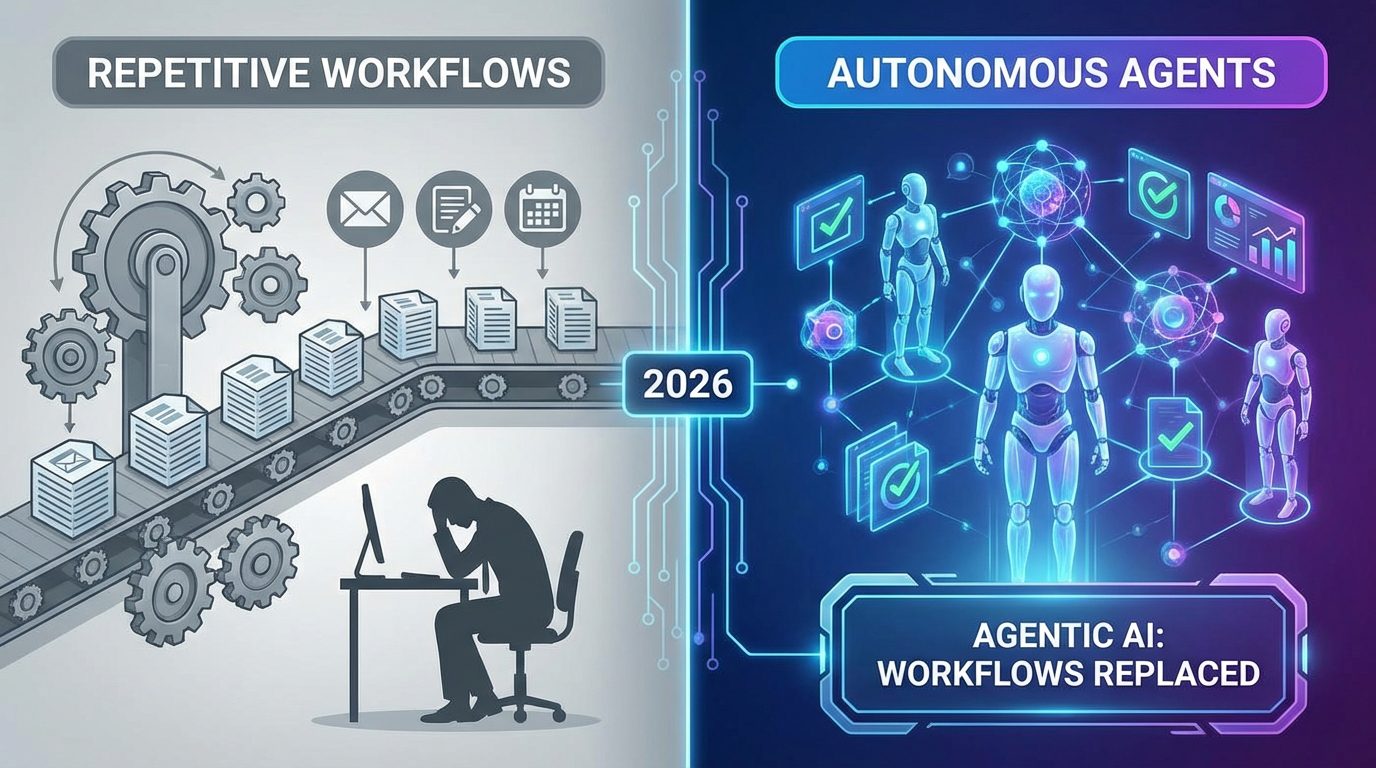
Traditional automation relies on predefined rules. It works well for repetitive tasks with clear instructions but struggles when conditions change. Agentic AI, by contrast, is dynamic and adaptable, capable of handling complex and unpredictable scenarios.
Why Agents Are More Powerful
The strength of agentic AI lies in its flexibility. Traditional systems break when something unexpected happens because they cannot adjust beyond their programmed rules. Agentic systems, however, can evaluate new situations and modify their behavior accordingly.
They can handle exceptions, learn from mistakes, and continuously improve their performance. This makes them far more effective in real-world environments where variables are constantly changing.
As a result, businesses are moving away from rigid automation systems and adopting intelligent agents that can handle a wider range of tasks with greater efficiency.
Real-World Use Cases Replacing Repetitive Workflows
Customer Support Automation
Customer support has always been a high-volume, repetitive function. Handling endless tickets, emails, and chat requests can overwhelm even the largest teams. Agentic AI is transforming this area by automating the entire process.
Autonomous agents can respond to customer inquiries, resolve common issues, and escalate complex cases when necessary. This reduces the workload on human agents and allows them to focus on more nuanced interactions.
The result is faster response times, improved customer satisfaction, and lower operational costs. Businesses can provide better service without increasing their workforce.
Marketing and Content Creation
Marketing is another area experiencing a major shift. Traditionally, campaigns required constant manual effort, from content creation to performance analysis. Agentic AI changes this completely.
AI agents can generate content, test different variations, analyze results, and optimize campaigns continuously. This creates a system that improves itself over time without requiring constant human input.
For marketers, this means less time spent on repetitive tasks and more time focused on strategy and creative direction. It transforms marketing from a manual process into an intelligent, automated system.
Software Development
In software development, agentic AI is acting as a powerful assistant rather than a replacement. Autonomous agents can write code, review it, identify bugs, and run tests.
This accelerates development cycles and improves code quality. Developers are no longer tied down by repetitive tasks. Instead, they can focus on designing systems and solving complex problems.
This shift is changing the role of developers, turning them into architects and supervisors of AI-driven processes.
Industries Being Transformed by Agentic AI
Finance and Accounting
Finance relies heavily on accuracy and speed. Agentic AI is helping organizations streamline processes such as reconciliation, fraud detection, and reporting.
Tasks that once required hours or days can now be completed in minutes. This reduces errors and allows financial professionals to focus on strategic decision-making rather than routine tasks.
Healthcare and Operations
Healthcare is also benefiting from agentic AI. Autonomous agents are being used to manage scheduling, process patient data, and coordinate workflows.
This reduces administrative burdens and improves efficiency. It also enhances patient care by ensuring that processes run smoothly and accurately.
Benefits of Agentic AI
Efficiency and Cost Savings
One of the biggest advantages of agentic AI is its ability to improve efficiency while reducing costs. By automating repetitive tasks, businesses can operate more effectively and allocate resources where they are needed most.
Autonomous agents work continuously without fatigue, ensuring consistent productivity. This leads to faster results and better overall performance.
Scalability and Speed
Agentic AI allows organizations to scale operations quickly and efficiently. Whether handling customer requests or processing large volumes of data, AI agents can manage tasks simultaneously.
This level of scalability is difficult to achieve with human workers alone, making it a key advantage for growing businesses.
Challenges and Risks
Security and Governance
With increased autonomy comes the need for strong governance. Organizations must ensure that AI agents operate within defined boundaries and follow established guidelines.
This includes implementing monitoring systems, access controls, and safeguards to prevent unintended actions.
Reliability and Trust Issues
Despite their capabilities, agentic AI systems are not flawless. They can make errors, especially when dealing with incomplete or inaccurate data.
Building trust requires continuous monitoring, testing, and improvement. Human oversight remains essential to ensure that systems perform reliably and align with business objectives.
Human + AI Collaboration: The New Workforce
Rise of AI Supervisors
The rise of agentic AI is reshaping the workforce. Instead of performing repetitive tasks, employees are transitioning into roles where they oversee and manage AI systems.
These AI supervisors ensure that agents operate effectively, handle exceptions, and continuously improve performance. This shift allows humans to focus on higher-value work that requires creativity and critical thinking.
The Future of Work with Agentic AI
What to Expect Beyond 2026
Looking ahead, agentic AI will continue to expand its role in the workplace. Organizations will move toward fully autonomous workflows where most routine tasks are handled by AI agents.
However, human involvement will remain crucial, particularly for strategic decisions and complex problem-solving. The future will be defined by collaboration between humans and AI, rather than replacement.
Conclusion
Agentic AI is redefining how work gets done. By replacing repetitive workflows with autonomous agents, businesses can achieve greater efficiency, scalability, and innovation.
The shift is not just technological. It is a change in mindset. Organizations that embrace this transformation will be better positioned to succeed in an increasingly automated world.