
Introduction to Data Mesh
Let’s be honest.
Most companies are drowning in data… yet starving for insights.
That’s the paradox.
Why Traditional Data Architectures Are Breaking
For years, organizations relied on centralized data warehouses and massive data lakes. Everything flowed into one central team. Sounds organized, right?
In reality? It becomes a bottleneck.
- Data requests pile up
- Teams wait weeks for reports
- Quality drops
- Innovation slows
It’s like having one kitchen for an entire city. Chaos is guaranteed.
The Rise of Domain-Oriented Thinking
Modern companies work in domains—marketing, sales, finance, product, operations. Each domain understands its data better than anyone else.
So why not let them own it?
That’s where data mesh architecture steps in.
What Is Data Mesh Architecture?
Definition and Core Philosophy
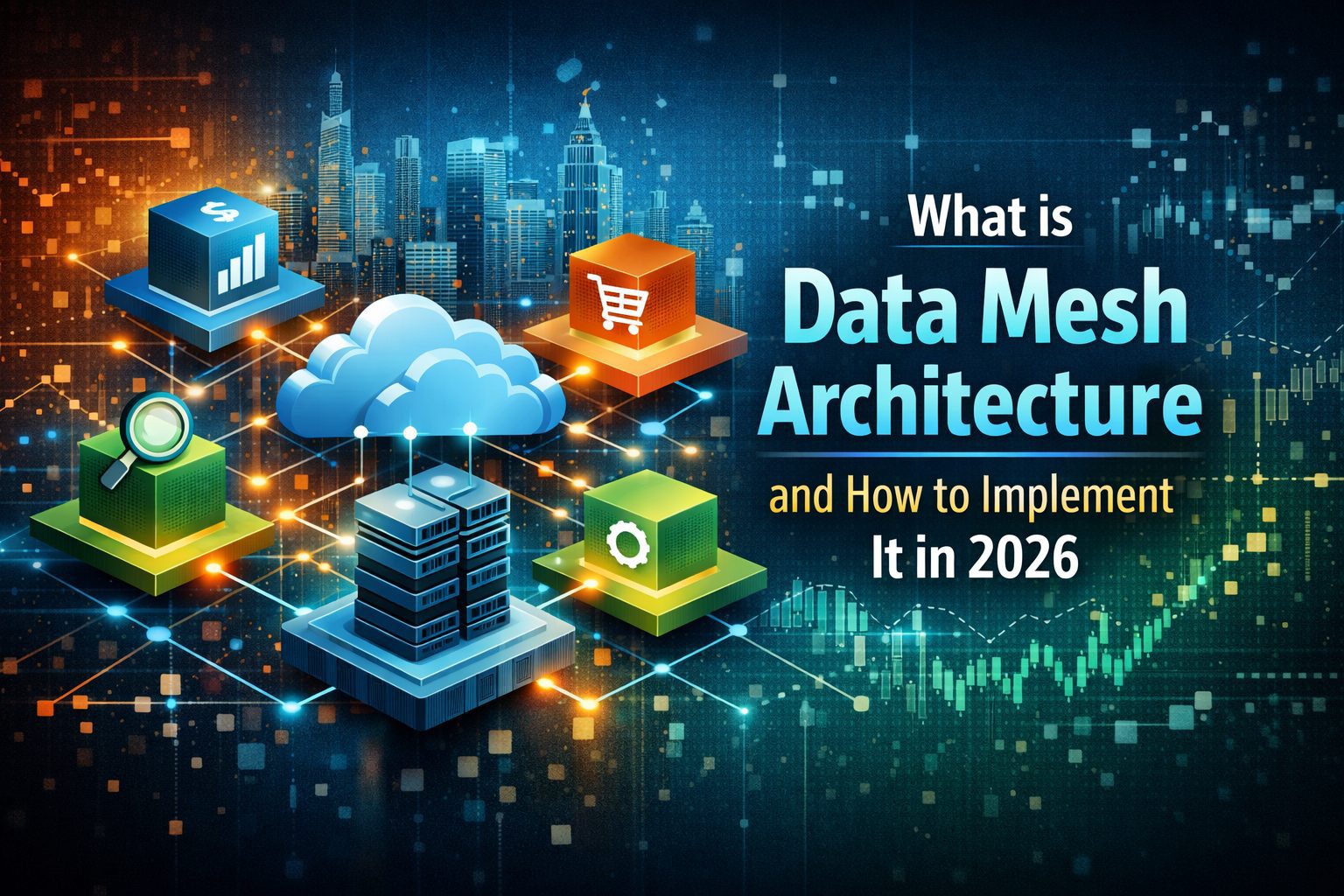
Data mesh is a decentralized data architecture approach where domain teams own, manage, and serve their data as products.
Simple idea. Big impact.
Instead of one central data team doing everything, responsibility is distributed across business domains.
Origin of Data Mesh Concept
The term “data mesh” was introduced by Zhamak Dehghani in 2019. But in 2026, it’s no longer a trend—it’s a strategic necessity for scaling data operations.
The Four Core Principles of Data Mesh
Let’s break it down.
1. Domain-Oriented Decentralized Ownership
Each business domain owns its data.
Marketing owns marketing data. Finance owns finance data. Product owns product data.
Accountability increases. Context improves. Speed accelerates.
2. Data as a Product
Think about your favorite app. It’s designed, maintained, and improved constantly.
Data in a mesh works the same way.
Each dataset:
- Has an owner
- Has documentation
- Has quality standards
- Has SLAs
It’s no longer “just data.” It’s a product customers (internal teams) use.
3. Self-Serve Data Infrastructure
To avoid chaos, you need strong infrastructure.
A self-serve platform allows domains to:
- Publish data
- Discover data
- Monitor quality
- Ensure security
Without depending on a central bottleneck.
4. Federated Computational Governance
Total decentralization without rules? Disaster.
Governance is shared. Standards for:
- Security
- Compliance
- Naming conventions
- Data interoperability
Are enforced through automation, not manual policing.
How Data Mesh Differs from Data Lake and Data Warehouse
Centralized vs Decentralized Models
Traditional warehouse = centralized ownership.
Data mesh = distributed ownership.
It’s the difference between monarchy and democracy.
Scalability Comparison
Centralized systems struggle as organizations grow.
Data mesh scales with the business. New domains? New data products. No overload.
Organizational Impact
Data mesh changes culture. Teams become accountable. Data literacy improves across departments.
Why Data Mesh Matters in 2026
Explosion of Data Volumes
By 2026, enterprises generate petabytes daily.
IoT. AI systems. Real-time apps. Everything produces data.
Central teams can’t handle this scale alone.
AI and Real-Time Analytics Demand
AI models require clean, domain-specific data fast.
Data mesh reduces friction between raw data and machine learning systems.
Cross-Functional Teams
Modern teams are agile. They need autonomy.
Waiting weeks for a dashboard? Not acceptable anymore.
Benefits of Data Mesh Architecture
Faster Data Access
No more waiting in line. Domains serve their own data products.
Improved Data Quality
Ownership drives accountability. Accountability improves quality.
Increased Team Autonomy
Teams move independently without depending on a centralized backlog.
Better Scalability
As business grows, architecture grows naturally.
Challenges of Implementing Data Mesh
It’s not magic.
Cultural Resistance
Teams are used to central data teams handling everything.
Change requires mindset shifts.
Governance Complexity
Balancing autonomy with control isn’t easy.
Tooling and Skill Gaps
Not every domain has data engineering expertise.
Training and platform investment are necessary.
Step-by-Step Guide to Implement Data Mesh in 2026
Let’s get practical.
Step 1: Define Domain Boundaries
Identify clear business domains.
Avoid overlaps. Clarity prevents chaos.
Step 2: Assign Data Ownership
Each domain needs:
- Data product owners
- Data engineers
- Accountability metrics
Ownership must be formal—not optional.
Step 3: Build Self-Serve Data Platform
Invest in cloud-native infrastructure:
- Automated pipelines
- Monitoring systems
- Data catalog
- Access control
Platform teams enable; domains execute.
Step 4: Implement Federated Governance
Define:
- Global policies
- Compliance standards
- Security models
Automate enforcement wherever possible.
Step 5: Measure and Iterate
Track:
- Data product adoption
- Quality metrics
- Time-to-insight
- Incident frequency
Refine continuously.
Technology Stack for Data Mesh in 2026
Cloud Platforms
Modern implementations rely heavily on scalable cloud providers.
Data Product Catalog Tools
Discoverability is critical. Metadata management tools help teams find trusted data.
Automation and AI Observability
AI-powered monitoring ensures data freshness, anomaly detection, and performance optimization.
Real-World Example of Data Mesh in Action
Imagine a global e-commerce company.
Marketing builds its own customer behavior data product.
Supply chain builds inventory forecasting data product.
Finance publishes revenue performance data product.
Insights flow faster. Decisions improve. Bottlenecks disappear.
Is Data Mesh Right for Your Organization?
When to Adopt
- Large enterprise
- Multiple business domains
- Data bottlenecks slowing innovation
- Strong engineering culture
When to Avoid
- Small startup with minimal data complexity
- Weak data maturity
- No platform investment budget
Data mesh isn’t a silver bullet. It’s a scaling strategy.
The Future of Data Mesh Beyond 2026
By 2026 and beyond, data mesh will integrate deeper with:
- AI-driven governance
- Automated data contracts
- Real-time streaming architectures
- Data marketplaces inside organizations
The future? Fully autonomous data ecosystems.
Conclusion
So, what is data mesh architecture?
It’s a decentralized, domain-driven approach to managing data at scale.
And how do you implement it in 2026?
By combining:
- Cultural transformation
- Clear domain ownership
- Self-serve platforms
- Federated governance
Data mesh isn’t just architecture.
It’s a mindset shift.
And in a world exploding with data, that shift might be the difference between surviving… and leading.