
The Rise of Chatbots in Modern Business
What Are Chatbots and How Do They Work?
Before AI agents became the center of attention, chatbots were the first big leap toward automation in business communication. Think of them as digital assistants that follow a script. You ask a question, and they respond based on pre-programmed rules or simple AI patterns. They were designed to simulate conversation, but not to actually understand it at a deeper level.
Most chatbots work using decision trees or keyword-based systems. For example, if a customer types “Where is my order?”, the chatbot recognizes the intent and provides a tracking link. This works well for predictable, repetitive questions. Businesses loved this because it reduced the need for human agents to handle basic queries over and over again.
Over time, chatbots became slightly more advanced with natural language processing. This allowed them to interpret user input better, but the core limitation remained. They could respond, but they couldn’t think or adapt beyond their programming. Still, for many companies, this was enough to improve efficiency and customer experience in a noticeable way.
Why Businesses Rapidly Adopted Chatbots
The adoption of chatbots didn’t happen slowly. It was fast and widespread because they solved a real problem. Businesses were dealing with high volumes of customer queries, and response times were becoming a serious issue. Chatbots offered a simple solution: instant replies, 24 hours a day.
Another big factor was cost. Hiring and training customer service teams requires time and money. Chatbots reduced that burden by handling routine interactions automatically. This allowed companies to scale their support operations without significantly increasing expenses.
Customers also played a role in this shift. People began expecting immediate responses. Waiting hours for an email reply or sitting on hold was no longer acceptable. Chatbots matched this expectation perfectly by delivering instant answers. They also ensured consistency, meaning every customer received the same information without variation.
Even though chatbots were not perfect, they became a reliable tool for handling simple tasks. However, as customer expectations grew and business needs became more complex, their limitations started to become more obvious.
The Limitations of Traditional Chatbots
Scripted Conversations vs Real Intelligence
Chatbots may sound smart at first, but their intelligence is limited. They rely heavily on predefined scripts, which means they can only operate within a fixed range of scenarios. The moment a user asks something slightly different or more complex, the system begins to struggle.
This creates a major gap between conversation and understanding. Chatbots can mimic human responses, but they do not truly comprehend context. It is similar to talking to someone who memorized answers without understanding the subject. The interaction feels shallow and often frustrating.
Even with more advanced models, chatbots remain reactive. They wait for input and then provide output. They do not plan ahead, make decisions, or take independent action. This makes them unsuitable for tasks that require deeper reasoning or multiple steps.
As businesses grow, they need systems that can go beyond answering questions. They need tools that can solve problems, handle complexity, and adapt in real time. This is where chatbots fall short.
Customer Frustration and Missed Opportunities
From a customer’s perspective, chatbots can sometimes feel like a dead end. You ask a question, and instead of getting help, you are stuck in a loop of irrelevant responses. This not only wastes time but also damages trust.
Every failed interaction is more than just a bad experience. It is a lost opportunity. A frustrated customer is less likely to complete a purchase, return for future business, or recommend the brand to others. In competitive markets, even small frustrations can have a big impact.
Chatbots also miss opportunities to engage customers in meaningful ways. They cannot analyze behavior deeply, personalize interactions effectively, or suggest relevant solutions based on context. This limits their ability to contribute to revenue growth.
Businesses started realizing that while chatbots reduce costs, they also limit potential. This realization opened the door for a more advanced solution.
Enter AI Agents: The Next Big Leap
What Exactly Is an AI Agent?
An AI agent is not just an upgraded chatbot. It is a completely different approach to automation. Instead of simply responding to queries, AI agents are designed to achieve goals. You give them an objective, and they figure out how to complete it.
This means they can plan, make decisions, and execute tasks across different systems. For example, instead of just providing order details, an AI agent can process refunds, update shipping information, and even suggest alternative products. It acts more like a digital employee than a support tool.
AI agents operate with a higher level of autonomy. They do not require constant human input to function. They can handle complex workflows, learn from interactions, and improve over time. This makes them far more powerful than traditional chatbots.
For business leaders, this represents a major shift. It is no longer about automating conversations. It is about automating outcomes.
How AI Agents Differ From Chatbots
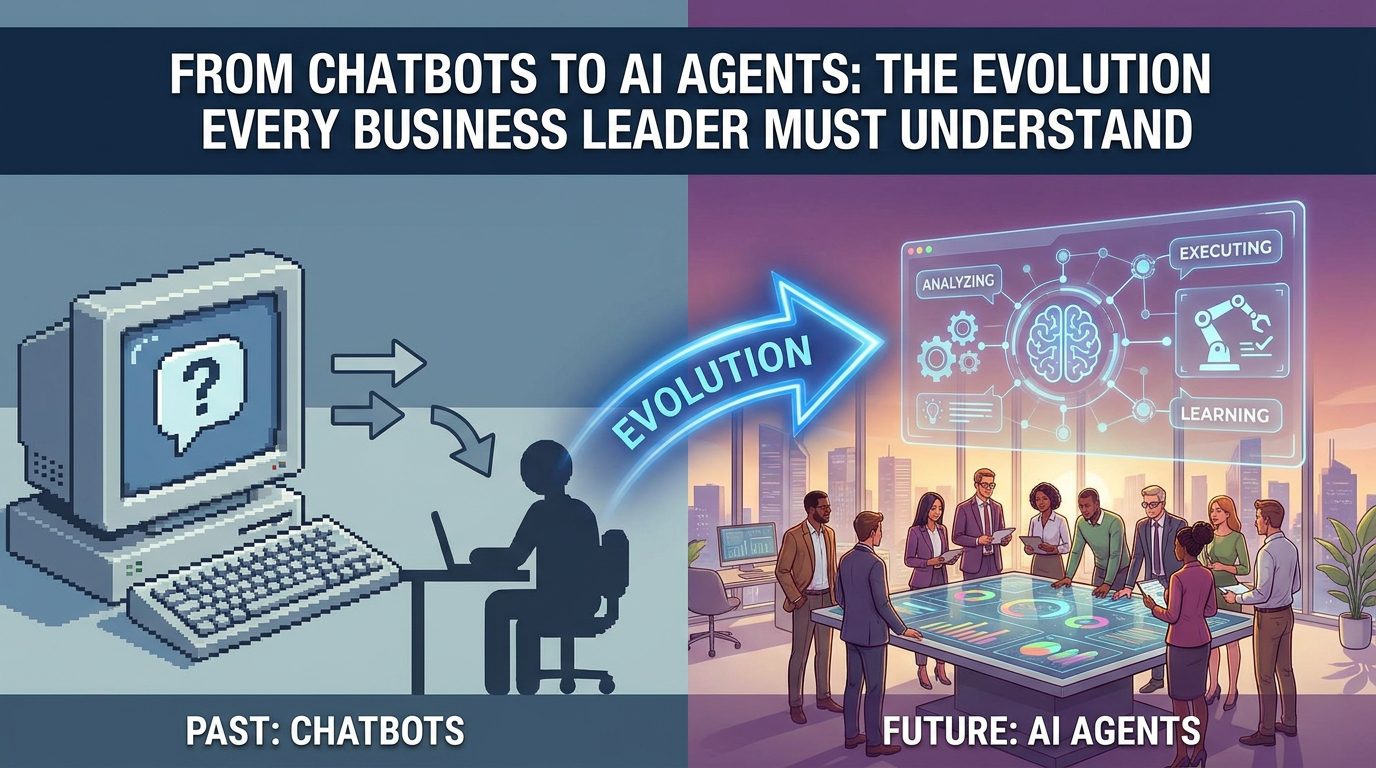
The difference between chatbots and AI agents can be summed up in one idea: action versus reaction. Chatbots react to user input, while AI agents take action based on goals and context.
AI agents can connect multiple systems, access real-time data, and perform tasks end-to-end. They understand not just what the user is asking, but why they are asking it. This allows them to deliver more relevant and effective solutions.
Another key difference is adaptability. AI agents learn from each interaction, which means they become more efficient over time. Chatbots, on the other hand, remain largely static unless manually updated.
This shift in capability leads to better outcomes. Higher resolution rates, improved customer satisfaction, and increased operational efficiency are just a few of the benefits. For businesses looking to scale, this difference is critical.
The Technology Powering AI Agents
Role of Large Language Models (LLMs)
At the core of AI agents are Large Language Models (LLMs). These models enable machines to understand and generate human language in a way that feels natural and intuitive. They move beyond simple keyword matching and focus on meaning, context, and intent.
LLMs allow AI agents to handle complex conversations without breaking down. They can interpret vague questions, follow multi-step instructions, and adapt their responses based on context. This creates a more human-like interaction experience.
However, LLMs are only one part of the equation. On their own, they are powerful but limited. The real value comes from how they are integrated into broader systems that enable action and decision-making.
Integration With Tools, Data, and Systems
AI agents become truly effective when they are connected to business systems. This includes customer databases, CRM platforms, inventory systems, and external APIs. These integrations allow them to access data and perform actions in real time.
For example, an AI agent in a retail business can check stock levels, process orders, and update customer records in a single interaction. This eliminates the need for multiple steps and reduces friction in the customer journey.
This level of integration transforms AI from a support feature into a core operational tool. It allows businesses to automate not just communication, but entire workflows.
Real-World Use Cases of AI Agents
Customer Service Automation
Customer service is one of the most common applications of AI agents. They handle everything from basic inquiries to complex problem resolution. This reduces the workload on human agents and improves response times.
AI agents can also provide consistent service across different channels, including chat, email, and voice. This ensures a seamless experience for customers, regardless of how they choose to interact.
Sales, Marketing, and Personalization
In sales and marketing, AI agents analyze customer behavior and deliver personalized experiences. They can recommend products, nurture leads, and even assist in closing deals.
This level of personalization increases engagement and drives revenue. It allows businesses to connect with customers in a more meaningful way.
Key Statistics Business Leaders Must Know
Adoption Rates and Market Growth
The adoption of AI agents is growing rapidly. A large percentage of organizations are already using or exploring this technology. This indicates a strong shift toward more advanced automation solutions.
The market for AI agents is also expanding quickly, with significant growth expected in the coming years. This reflects increasing demand and investment in the space.
ROI and Efficiency Gains
Businesses are seeing measurable benefits from AI agents. These include cost savings, improved efficiency, and higher customer satisfaction. In many cases, the return on investment is significant.
This makes AI agents not just a technological upgrade, but a strategic advantage.
Chatbots vs AI Agents: A Clear Comparison
Feature Comparison Table
| Feature | Chatbots | AI Agents |
|---|---|---|
| Functionality | Answer questions | Perform tasks |
| Intelligence | Script-based | Context-aware |
| Autonomy | Low | High |
| Integration | Limited | Advanced |
| Adaptability | Static | Learns over time |
| Business Impact | Cost reduction | Growth and efficiency |
Why Businesses Are Shifting to AI Agents
From Cost-Cutting to Growth Driving
The focus is shifting from reducing costs to driving growth. AI agents enable businesses to generate revenue through better customer engagement and personalized experiences.
They turn automation into a growth engine rather than just a cost-saving tool.
Competitive Advantage in 2026 and Beyond
Companies that adopt AI agents early gain a significant advantage. They can operate more efficiently, respond faster, and deliver better customer experiences.
As competition increases, this advantage becomes even more important.
Challenges and Risks of AI Agents
Governance, Security, and Trust Issues
With increased autonomy comes increased responsibility. Businesses need to ensure that AI agents operate within defined boundaries and comply with regulations.
Security and data privacy are also critical concerns that must be addressed.
Implementation Barriers
Implementing AI agents requires investment in technology and expertise. It also involves changes to existing workflows and processes.
This can be challenging, but the long-term benefits often outweigh the initial effort.
How to Transition From Chatbots to AI Agents
Step-by-Step Migration Strategy
Start by identifying areas where AI agents can add the most value. Then gradually expand their role as the system proves effective.
This approach reduces risk and allows for continuous improvement.
Best Practices for Adoption
Focus on integration, training, and monitoring. Treat AI agents as part of the team and ensure they are aligned with business goals.
The Future of AI Agents in Business
Autonomous Enterprises and AI-Driven Workflows
The future of business is increasingly automated. AI agents will play a central role in managing workflows and driving efficiency.
This will lead to more agile and responsive organizations.
What Leaders Should Do Today
Business leaders should start exploring AI agents now. Early adoption provides valuable experience and positions companies for future success.
Conclusion
The evolution from chatbots to AI agents marks a turning point in how businesses operate. While chatbots introduced automation, AI agents take it to a whole new level by enabling action, decision-making, and continuous improvement. Companies that embrace this shift will not only improve efficiency but also unlock new opportunities for growth. Those that delay may find themselves struggling to keep up in an increasingly competitive landscape.