
The Reality of AI Project Failure Rates
What the Latest Data Shows
AI sounds like the ultimate shortcut to success. Faster decisions, smarter systems, and better results. But once you step into the real world, things get messy. A large percentage of AI projects never reach their full potential. Some stall halfway, others quietly disappear, and a few never even make it past the testing phase.
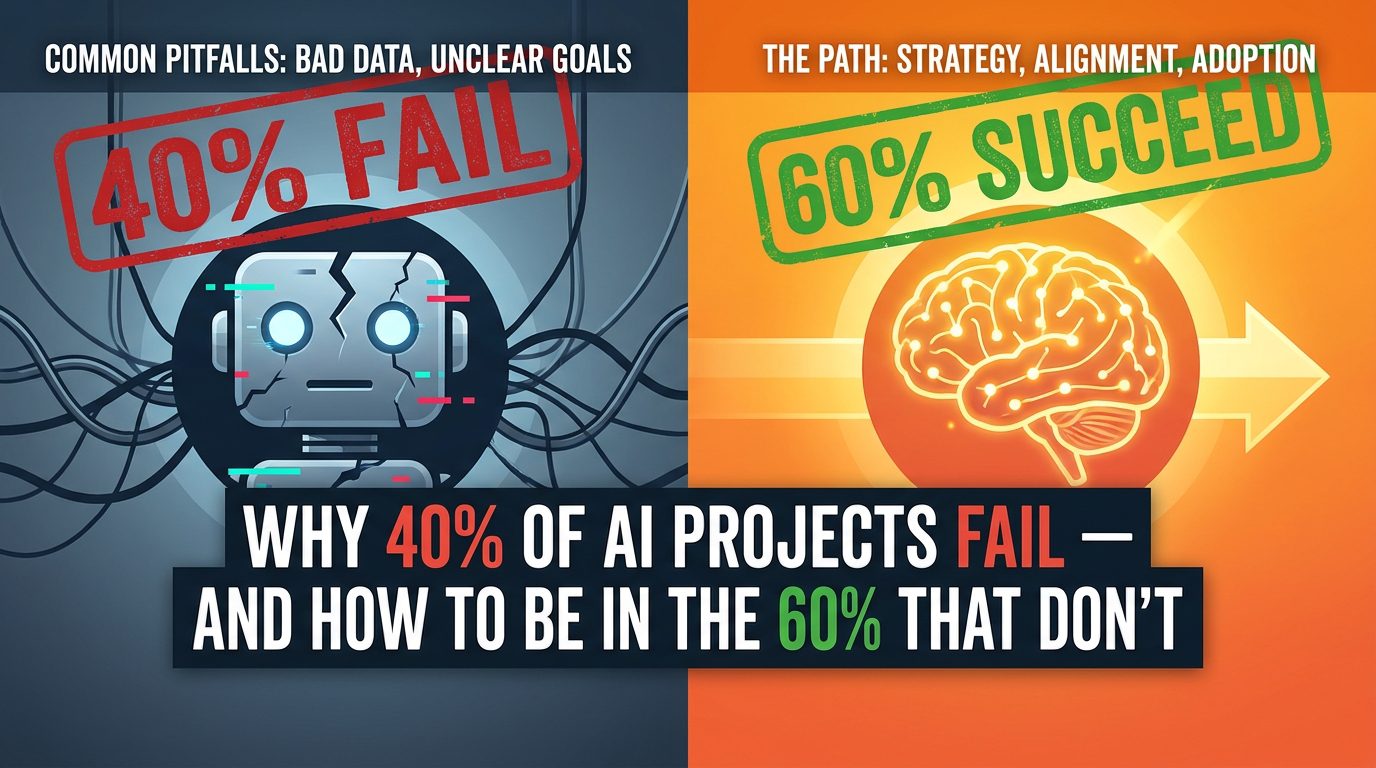
The idea that around 40% of AI projects fail is actually a conservative way of looking at the problem. In many cases, the failure rate is even higher, especially when companies try to scale AI across multiple departments. What this really tells us is simple: building AI is easy, but making it work in real business conditions is hard.
Think of AI projects like building a house. On paper, everything looks perfect. You have a design, a plan, and the best tools. But once construction starts, you face delays, budget issues, and unexpected problems. That is exactly what happens with AI. The gap between theory and reality is where most projects fall apart.
Why the “40% Failure” Idea Still Matters
Even if the actual failure rate is higher, the 40% figure is still useful. It creates a clear picture: success is possible. If some projects are failing, it means others are succeeding. That difference is not random. It comes down to how the project is planned, executed, and managed.
Instead of focusing on the fear of failure, it makes more sense to focus on patterns of success. What do the winning teams do differently? Why do some projects grow while others collapse? The answer is not hidden in complex algorithms. It is usually found in simple business decisions.
The companies that succeed treat AI as a business tool, not just a technical experiment. They align it with real goals, real users, and real outcomes. That is what separates the 60% from the rest.
The Hidden Truth: It’s Not About the Technology
Organizational vs Technical Failures
Most people assume AI projects fail because the technology is not good enough. That is rarely the case. In reality, the biggest problems are not technical at all. They are organizational.
Poor communication, unclear goals, and weak planning are far more dangerous than a flawed algorithm. You can fix a technical issue with time and expertise. But fixing a broken process or a confused team is much harder.
Imagine giving a powerful tool to a team that does not know how to use it. The tool is not the problem. The system around it is. AI works the same way. It amplifies whatever environment it is placed in. If your organization is structured and focused, AI will enhance it. If it is chaotic, AI will make that chaos even worse.
The Pilot vs Production Gap
Another major issue is the gap between testing and real-world use. Many AI projects look impressive in controlled environments. They perform well in demos, experiments, and small-scale trials. But once they move into production, everything changes.
Real-world systems are unpredictable. Data is inconsistent, users behave differently, and systems do not always connect smoothly. This is where many AI projects fail. They were built for ideal conditions, not real ones.
It is like testing a car on a smooth track and then expecting it to perform the same way on rough roads. Without proper preparation, the transition from pilot to production becomes a breaking point.
Top Reasons Why AI Projects Fail
Poor Data Quality and Readiness
Data is the foundation of any AI system. If the data is weak, the entire project becomes unstable. Many companies underestimate how much effort is required to prepare data. It is not just about collecting information. It is about cleaning it, organizing it, and making it usable.
When data is incomplete or inconsistent, AI models produce unreliable results. This leads to poor decisions and loss of trust. Once trust is lost, the project starts to collapse.
Think of data as the fuel for AI. If the fuel is dirty, the engine cannot run properly. No matter how advanced the system is, it will fail without clean and reliable data.
Lack of Clear Business Objectives
A common mistake is starting with technology instead of purpose. Many teams jump into AI because it sounds exciting. But without a clear goal, the project loses direction.
Successful AI projects always start with a problem. They focus on solving something specific, whether it is reducing costs, improving efficiency, or enhancing customer experience. Without that clarity, it becomes difficult to measure success.
When teams do not know what they are trying to achieve, they end up building solutions that do not matter. This leads to wasted time and resources.
Weak Leadership and Strategy
Leadership plays a critical role in AI success. Without strong direction, even the best teams struggle. Leaders need to understand not just what AI can do, but also how it fits into the bigger picture.
A lack of vision often leads to scattered efforts. Different teams work on different ideas without alignment. This creates confusion and slows down progress.
AI is not just a technical upgrade. It is a strategic shift. Without leadership guiding that shift, projects lose momentum.
Lack of Adoption and Change Management
Even a perfectly built AI system can fail if people do not use it. This is one of the most overlooked challenges. Employees may resist change or feel uncomfortable with new tools.
Adoption requires more than just training. It requires trust. People need to understand how the system works and how it benefits them. Without that understanding, they are likely to ignore it.
AI success depends on human behavior. If the users are not engaged, the system becomes irrelevant.
Scaling and Infrastructure Issues
Scaling AI is one of the hardest parts of the process. What works on a small scale does not always work at a larger level. Systems need to handle more data, more users, and more complexity.
Without the right infrastructure, performance drops. Systems become slow, unreliable, or too expensive to maintain. This creates frustration and limits growth.
Scaling should be planned from the beginning. Otherwise, the project hits a wall as soon as it starts growing.
The Cost of Failed AI Projects
Financial Losses and Wasted Investment
AI projects require significant investment. Companies spend money on tools, talent, and infrastructure. When a project fails, that investment is lost.
But the real cost goes beyond money. It also includes time and effort. Teams spend months or even years working on something that never delivers value. This creates frustration and reduces confidence in future initiatives.
Wasted investment also makes companies more cautious. They become hesitant to try again, which slows down innovation.
Lost Opportunities and Competitive Risk
While one company struggles with failed AI projects, another moves ahead. This creates a gap that becomes harder to close over time.
Successful AI adoption can improve efficiency, reduce costs, and create better customer experiences. Companies that fail to adopt it properly risk falling behind.
The competitive landscape is changing fast. AI is becoming a key factor in success. Missing out on it can have long-term consequences.
What Successful AI Projects Do Differently
Clear ROI and Business Alignment
Successful projects always focus on results. They define clear goals and measure progress consistently. This keeps the team aligned and motivated.
When AI is connected to business outcomes, it becomes easier to justify investment and track success.
Strong Data Foundations
Winning teams invest in their data. They build systems to manage, clean, and organize it effectively. This creates a strong base for AI to operate on.
Good data leads to better models and better decisions.
Cross-Functional Collaboration
AI is not just for technical teams. It requires input from different parts of the organization. Business teams provide context, while technical teams provide solutions.
This collaboration ensures that AI systems are practical and relevant.
Continuous Testing and Iteration
Successful projects evolve over time. They are tested, improved, and refined continuously. This allows them to adapt to changing conditions.
Instead of aiming for perfection, they focus on progress.
A Simple Framework to Be in the Winning 60%
Start with a Real Problem
Focus on solving something meaningful. If the problem is not important, the solution will not matter.
Build Around Data, Not Tools
Tools change quickly. Data remains constant. Building strong data systems creates long-term value.
Focus on Adoption Early
Engage users from the beginning. Make the system easy to understand and use.
Scale Gradually and Smartly
Start small and expand step by step. This reduces risk and improves stability.
Future of AI Success
The future of AI will not be defined by better algorithms alone. It will be shaped by how well companies integrate AI into their daily operations.
Organizations that invest in culture, training, and processes will have a clear advantage. They will treat AI as part of their workflow, not just an add-on.
Those that fail to adapt will continue to struggle, repeating the same mistakes.
Conclusion
AI projects do not fail because the technology is flawed. They fail because of poor planning, weak data, and lack of alignment. The good news is that these problems are preventable.
By focusing on clear goals, strong data, and user adoption, companies can significantly improve their chances of success. The difference between failure and success often comes down to simple decisions made early in the process.
Being part of the successful 60% is not about luck. It is about doing the basics right and staying consistent.