
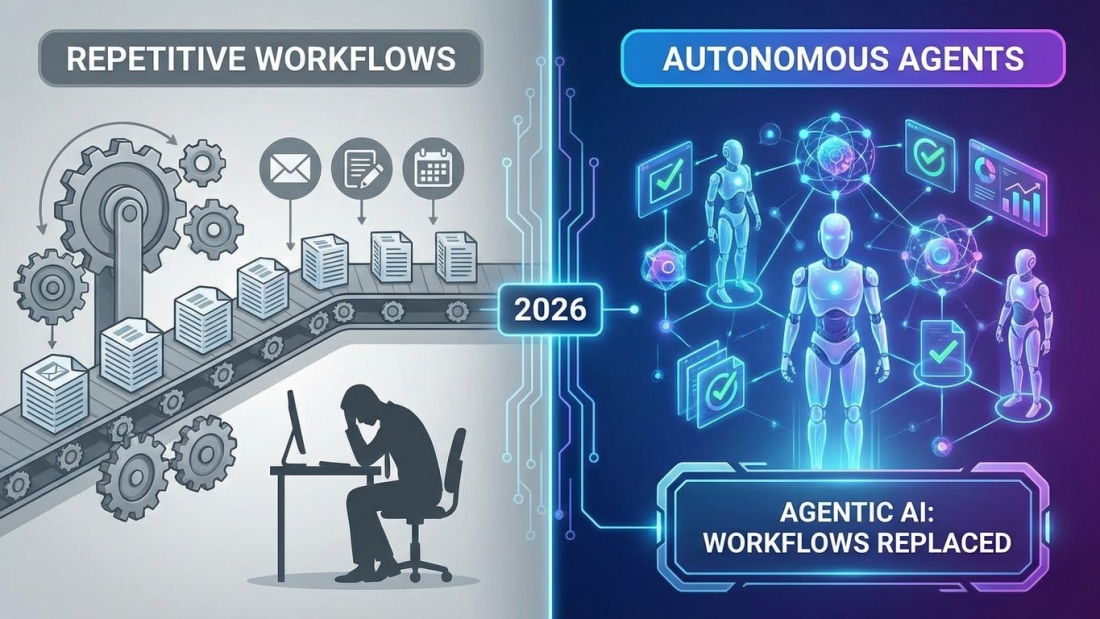
Agentic AI in 2026: How autonomous agents are replacing repetitive workflows

Agentic AI in 2026: How autonomous agents are replacing repetitive workflows

What is Agentic AI?

From AI Tools to Autonomous Agents

Let’s keep it simple. Agentic AI is not just another buzzword floating around in tech conversations. It represents a deep shift in how artificial intelligence actually functions in real-world environments. Instead of waiting for commands like traditional AI tools, agentic systems are designed to think, plan, and act independently to achieve defined goals.

Think of traditional AI as a tool sitting on your desk. You pick it up, use it, and put it down. Agentic AI, on the other hand, feels more like hiring a digital employee who understands your objective and figures out how to get there. You do not have to guide every step. You simply define the outcome, and the system handles the rest.

This evolution comes from combining language models with planning engines, memory systems, and access to external tools. These agents can break down complex workflows into smaller steps, execute them, evaluate results, and refine their approach. Instead of just generating a response, they can manage entire processes from start to finish.

That shift is why businesses are no longer asking whether AI is useful. They are asking how much of their workload can be handled without human involvement.

Key Capabilities of Agentic Systems

What makes agentic AI so powerful is not just its intelligence, but its ability to act with purpose. These systems are built to operate autonomously while still adapting to changing conditions.

At the core, agentic systems are defined by several capabilities. They operate based on goals rather than instructions, meaning you tell them what you want, not how to do it. Moreover, they can make decisions on their own, selecting the best actions based on context and available data. They also integrate with tools such as APIs, databases, and platforms, allowing them to perform real-world actions instead of just generating text.

Another key feature is memory. These systems learn from past actions and outcomes, improving their performance over time. On top of that, multiple agents can collaborate, forming a coordinated system that handles complex workflows more efficiently than a single system ever could.

This combination of autonomy, learning, and collaboration is what separates agentic AI from everything that came before it.


Why 2026 is a Breakthrough Year for Agentic AI

Explosive Market Growth

The momentum behind agentic AI in 2026 is impossible to ignore. Businesses across industries are investing heavily, not just out of curiosity but out of necessity. The demand for faster operations, lower costs, and higher efficiency has pushed organizations to look beyond traditional automation.

Agentic AI answers that demand by offering systems that are flexible and adaptive. Unlike rigid automation tools, these agents can handle unpredictable situations and continuously improve. This makes them ideal for modern business environments where change is constant.

As a result, companies are scaling their use of autonomous agents rapidly. What started as small experiments has turned into full-scale integration across departments. This growth is fueled by measurable results, including improved productivity, faster execution, and reduced operational costs.

The pace of adoption suggests that agentic AI is not just a trend. It is becoming a foundational layer of modern business operations.

Organizations are no longer experimenting cautiously. They are actively restructuring how work gets done. A significant number of companies are already using agentic AI in real workflows, and many more are planning to follow.

The biggest shift lies in how these organizations approach implementation. Instead of adding AI to existing processes, they are redesigning workflows from the ground up. This allows them to fully leverage the capabilities of autonomous agents.

Companies that take this approach are seeing better results. They are able to automate complex processes, reduce human intervention, and achieve outcomes faster. Meanwhile, those that try to fit agentic AI into outdated systems often struggle to unlock its full potential.

The lesson is clear. Success with agentic AI requires a new way of thinking about work, one that prioritizes outcomes over tasks.


How Autonomous Agents Work

The Core Architecture of AI Agents

Behind the scenes, agentic AI operates through a structured system that allows it to function independently. While the technology may seem complex, the underlying logic mirrors how humans approach problem-solving.

An autonomous agent typically includes several core components. First is perception, where the system gathers and interprets data from its environment. Next comes reasoning, where it decides what actions to take. Planning follows, breaking down larger goals into smaller, manageable steps.

The agent then executes actions using available tools and systems. Finally, it stores information in memory, allowing it to learn from past experiences. This continuous loop of observing, deciding, acting, and learning enables the agent to improve over time.

This process is similar to how a person approaches a task. You assess the situation, make a plan, take action, and adjust based on feedback. Agentic AI simply does this faster and at a much larger scale.

Multi-Agent Systems Explained

One of the most important developments in 2026 is the shift toward multi-agent systems. Instead of relying on a single agent to handle everything, organizations are deploying multiple specialized agents that work together.

Each agent is designed for a specific task. One may focus on gathering data, another on analyzing it, another on generating content, and another on reporting results. These agents communicate and coordinate with each other, creating a seamless workflow.

This approach improves efficiency and reduces errors. By dividing tasks among specialized agents, organizations can achieve higher accuracy and better scalability. It also allows systems to adapt more easily, as individual agents can be updated or replaced without disrupting the entire workflow.

Multi-agent systems are quickly becoming the standard for businesses looking to fully automate complex processes.


Agentic AI vs Traditional Automation

Key Differences

FeatureTraditional AutomationAgentic AI
FlexibilityLowHigh
Decision-makingRule-basedContext-aware
AdaptabilityStaticDynamic
Human inputRequiredMinimal
Complexity handlingLimitedAdvanced

Traditional automation relies on predefined rules. It works well for repetitive tasks with clear instructions but struggles when conditions change. Agentic AI, by contrast, is dynamic and adaptable, capable of handling complex and unpredictable scenarios.

Why Agents Are More Powerful

The strength of agentic AI lies in its flexibility. Traditional systems break when something unexpected happens because they cannot adjust beyond their programmed rules. Agentic systems, however, can evaluate new situations and modify their behavior accordingly.

They can handle exceptions, learn from mistakes, and continuously improve their performance. This makes them far more effective in real-world environments where variables are constantly changing.

As a result, businesses are moving away from rigid automation systems and adopting intelligent agents that can handle a wider range of tasks with greater efficiency.


Real-World Use Cases Replacing Repetitive Workflows

Customer Support Automation

Customer support has always been a high-volume, repetitive function. Handling endless tickets, emails, and chat requests can overwhelm even the largest teams. Agentic AI is transforming this area by automating the entire process.

Autonomous agents can respond to customer inquiries, resolve common issues, and escalate complex cases when necessary. This reduces the workload on human agents and allows them to focus on more nuanced interactions.

The result is faster response times, improved customer satisfaction, and lower operational costs. Businesses can provide better service without increasing their workforce.

Marketing and Content Creation

Marketing is another area experiencing a major shift. Traditionally, campaigns required constant manual effort, from content creation to performance analysis. Agentic AI changes this completely.

AI agents can generate content, test different variations, analyze results, and optimize campaigns continuously. This creates a system that improves itself over time without requiring constant human input.

For marketers, this means less time spent on repetitive tasks and more time focused on strategy and creative direction. It transforms marketing from a manual process into an intelligent, automated system.

Software Development

In software development, agentic AI is acting as a powerful assistant rather than a replacement. Autonomous agents can write code, review it, identify bugs, and run tests.

This accelerates development cycles and improves code quality. Developers are no longer tied down by repetitive tasks. Instead, they can focus on designing systems and solving complex problems.

This shift is changing the role of developers, turning them into architects and supervisors of AI-driven processes.


Industries Being Transformed by Agentic AI

Finance and Accounting

Finance relies heavily on accuracy and speed. Agentic AI is helping organizations streamline processes such as reconciliation, fraud detection, and reporting.

Tasks that once required hours or days can now be completed in minutes. This reduces errors and allows financial professionals to focus on strategic decision-making rather than routine tasks.

Healthcare and Operations

Healthcare is also benefiting from agentic AI. Autonomous agents are being used to manage scheduling, process patient data, and coordinate workflows.

This reduces administrative burdens and improves efficiency. It also enhances patient care by ensuring that processes run smoothly and accurately.


Benefits of Agentic AI

Efficiency and Cost Savings

One of the biggest advantages of agentic AI is its ability to improve efficiency while reducing costs. By automating repetitive tasks, businesses can operate more effectively and allocate resources where they are needed most.

Autonomous agents work continuously without fatigue, ensuring consistent productivity. This leads to faster results and better overall performance.

Scalability and Speed

Agentic AI allows organizations to scale operations quickly and efficiently. Whether handling customer requests or processing large volumes of data, AI agents can manage tasks simultaneously.

This level of scalability is difficult to achieve with human workers alone, making it a key advantage for growing businesses.


Challenges and Risks

Security and Governance

With increased autonomy comes the need for strong governance. Organizations must ensure that AI agents operate within defined boundaries and follow established guidelines.

This includes implementing monitoring systems, access controls, and safeguards to prevent unintended actions.

Reliability and Trust Issues

Despite their capabilities, agentic AI systems are not flawless. They can make errors, especially when dealing with incomplete or inaccurate data.

Building trust requires continuous monitoring, testing, and improvement. Human oversight remains essential to ensure that systems perform reliably and align with business objectives.


Human + AI Collaboration: The New Workforce

Rise of AI Supervisors

The rise of agentic AI is reshaping the workforce. Instead of performing repetitive tasks, employees are transitioning into roles where they oversee and manage AI systems.

These AI supervisors ensure that agents operate effectively, handle exceptions, and continuously improve performance. This shift allows humans to focus on higher-value work that requires creativity and critical thinking.


The Future of Work with Agentic AI

What to Expect Beyond 2026

Looking ahead, agentic AI will continue to expand its role in the workplace. Organizations will move toward fully autonomous workflows where most routine tasks are handled by AI agents.

However, human involvement will remain crucial, particularly for strategic decisions and complex problem-solving. The future will be defined by collaboration between humans and AI, rather than replacement.


Conclusion

Agentic AI is redefining how work gets done. By replacing repetitive workflows with autonomous agents, businesses can achieve greater efficiency, scalability, and innovation.

The shift is not just technological. It is a change in mindset. Organizations that embrace this transformation will be better positioned to succeed in an increasingly automated world.
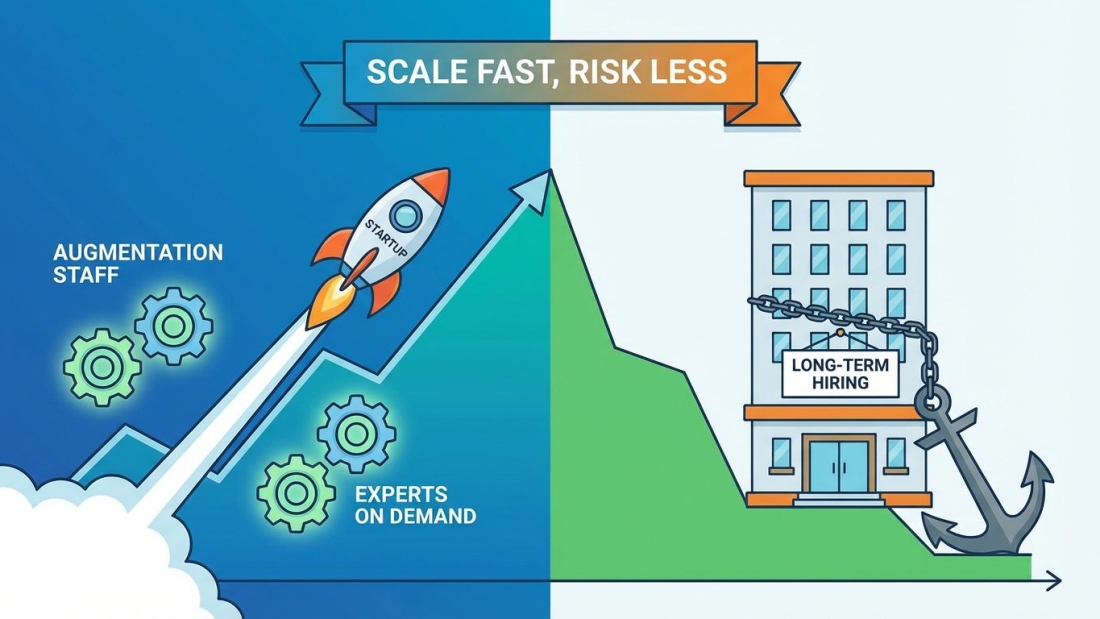

How staff augmentation helps startups scale without long-term hiring risk

How staff augmentation helps startups scale without long-term hiring risk

Understanding the Startup Scaling Challenge

Why Traditional Hiring Slows Startups Down

Startups operate in a fast-moving environment where timing can determine success or failure. When you rely on traditional hiring processes, you are essentially slowing down your own momentum. The process of finding, interviewing, and onboarding employees takes time, and that delay can cost you opportunities in a competitive market.

Think about how long it typically takes to fill a role. You create job postings, screen dozens of candidates, conduct interviews, and negotiate offers. Even after hiring, new employees need time to adjust before they become fully productive. For startups, this lag can disrupt product timelines and delay launches.

It is similar to trying to build a high-speed train while it is already moving. You need immediate results, but traditional hiring forces you into a slow and rigid process. This mismatch between speed and structure creates friction, making it harder for startups to scale efficiently.

The Hidden Risks of Full-Time Hiring

Hiring full-time employees is not just time-consuming; it is also a financial and strategic risk. Every hire comes with long-term commitments, including salaries, benefits, and operational costs. For startups with limited budgets, these fixed expenses can quickly become overwhelming.

There is also the risk of hiring the wrong person. Even with careful selection, not every candidate will meet expectations. A poor hire can impact team performance, delay projects, and require additional time and resources to fix.

Another major concern is uncertainty. Startups often pivot their strategies based on market feedback or funding changes. However, full-time employees represent fixed commitments that do not easily adapt to these changes. This lack of flexibility can put unnecessary pressure on a growing business.


What is Staff Augmentation?

Definition and Core Concept

Staff augmentation is a flexible hiring approach that allows startups to bring in external professionals on a temporary or project basis. Instead of committing to permanent hires, you add skilled experts to your team only when needed.

These professionals work alongside your internal team, contributing to projects just like regular employees. They follow your processes, participate in meetings, and help achieve your goals. The key difference is that their involvement is temporary and adaptable.

Imagine needing a cybersecurity expert for a specific project. Hiring someone full-time might not make sense if the requirement is short-term. With staff augmentation, you can bring in that expert for the duration of the project and then scale back once the work is complete.

How It Differs from Outsourcing

Staff augmentation is often compared to outsourcing, but they serve different purposes. Outsourcing involves handing over entire projects to external teams who manage everything independently. This can reduce control and visibility over the work.

In contrast, staff augmentation keeps you in control. The external professionals integrate into your team and work under your direction. You manage the workflow, assign tasks, and ensure quality.

Think of outsourcing as handing over the steering wheel, while staff augmentation is like adding more drivers to help you reach your destination faster. For startups that value control and flexibility, staff augmentation offers a more balanced approach.


Why Staff Augmentation is Booming in 2025

Talent Shortages in Tech

The demand for skilled professionals continues to grow, especially in areas like software development, artificial intelligence, and cloud computing. However, finding the right talent quickly has become increasingly difficult.

This shortage makes traditional hiring even more challenging for startups. Competing with larger companies for top talent can be tough, especially when resources are limited. Staff augmentation solves this problem by providing access to a wider talent pool.

Instead of searching locally, startups can tap into global expertise. This increases the chances of finding the right skills quickly and efficiently.

Rise of Remote Work and Global Talent

Remote work has transformed how businesses operate. Teams are no longer limited by geography, and companies can collaborate with professionals from different parts of the world.

Staff augmentation takes full advantage of this shift. Startups can build distributed teams without the need for physical offices or relocation costs. This approach not only reduces expenses but also opens the door to diverse perspectives and ideas.

By leveraging global talent, startups can stay competitive and innovate faster.


Key Benefits of Staff Augmentation for Startups

Flexibility and Scalability

One of the biggest advantages of staff augmentation is its flexibility. Startups often experience fluctuations in workload, and having a fixed team size can be limiting.

With staff augmentation, you can scale your team up or down based on your current needs. If you are launching a new feature, you can bring in additional developers. Once the project is complete, you can reduce the team size without complications.

This adaptability ensures that you are always operating efficiently without overcommitting resources.

Cost Efficiency

Managing costs is crucial for startups. Traditional hiring involves multiple expenses, including recruitment, salaries, benefits, and infrastructure. Staff augmentation reduces these costs by offering a more flexible model.

You only pay for the work that is done, which makes budgeting easier and more predictable. This allows startups to allocate resources more effectively and focus on growth.

Faster Time-to-Market

Speed is essential in the startup world. The quicker you can launch your product, the sooner you can gather feedback and improve it.

Staff augmentation accelerates this process by providing immediate access to skilled professionals. There is no need to wait for lengthy hiring cycles. You can bring in experts who are ready to contribute from day one.

Access to Specialized Skills

Startups often require niche expertise that may not be needed on a full-time basis. Hiring permanent employees for short-term needs is not practical.

Staff augmentation allows you to access specialized skills when required. Whether it is machine learning, DevOps, or user experience design, you can find professionals with the right expertise for your project.


Reducing Long-Term Hiring Risks

Avoiding Bad Hires

Hiring the wrong person can be costly and disruptive. Staff augmentation reduces this risk by offering flexibility. If a resource does not meet expectations, you can replace them without long-term consequences.

This approach allows startups to maintain productivity and focus on their goals without being tied to unsuitable hires.

Eliminating Fixed Payroll Burden

Fixed payroll expenses can strain a startup’s budget. Staff augmentation eliminates this burden by offering a pay-as-you-go model.

You only pay for the resources you need, which helps manage cash flow and reduces financial risk. This flexibility is especially valuable for startups operating in uncertain environments.


Real-World Use Cases

MVP Development

When building a minimum viable product, speed and efficiency are critical. Startups often use staff augmentation to quickly assemble a team of developers, designers, and testers.

This approach allows them to launch faster, validate their ideas, and make improvements based on user feedback.

Post-Funding Growth Phase

After securing funding, startups need to scale quickly to meet expectations. Staff augmentation enables rapid team expansion without long-term commitments.

This helps startups handle increased workloads and deliver results efficiently.


Staff Augmentation vs Traditional Hiring

Key Differences Table

FeatureStaff AugmentationTraditional Hiring
CommitmentShort-termLong-term
CostFlexibleFixed
Hiring SpeedFastSlow
RiskLowHigh
ScalabilityHighLimited

Challenges of Staff Augmentation

Communication and Integration

Working with external professionals can create communication challenges, especially when teams are distributed across different time zones.

Clear communication and structured processes are essential to ensure smooth collaboration.

Managing Remote Teams

Managing a remote team requires effective tools and strong leadership. Without proper coordination, productivity can suffer.

Startups need to establish clear workflows and maintain regular communication to keep everyone aligned.


Best Practices for Startups

Choosing the Right Partner

Selecting the right staff augmentation partner is crucial. Look for providers with proven experience and strong communication skills.

A reliable partner can significantly improve project outcomes.

Onboarding and Collaboration Tips

Treat augmented staff as part of your team. Include them in meetings, provide clear instructions, and encourage open communication.

A strong onboarding process helps them integrate quickly and contribute effectively.


Future of Staff Augmentation

Staff augmentation is expected to grow as startups continue to prioritize flexibility and efficiency. Advances in technology and remote work will make it even easier to connect with global talent.

This model will play an increasingly important role in helping startups adapt to changing market conditions.


Conclusion

Staff augmentation provides startups with a powerful way to scale without taking on unnecessary risks. It combines flexibility, cost efficiency, and access to specialized talent, making it an ideal solution for modern businesses.

By adopting this approach, startups can stay agile, reduce financial pressure, and focus on what truly matters—building great products and growing their business.

PhishReaper_Investigation_Stripe…_202603242149

PhishReaper Investigation: LIVE Stripe Phishing Campaign Turns 14 Days Old, Still Undetected Worldwide

A threat intelligence report based on research conducted by PhishReaper and presented by LogIQ Curve

Introduction

Modern phishing campaigns are becoming increasingly sophisticated, leveraging polished user interfaces, trusted brand identities, and carefully staged infrastructure to evade detection. Payment platforms, widely used across global commerce, have become particularly attractive targets for cybercriminals seeking to harvest financial data at scale.

As the Exclusive OEM Partner of PhishReaper in Pakistan, LogIQ Curve is pleased to share the latest cybersecurity intelligence uncovered by the PhishReaper research team. Through this partnership, LogIQ Curve brings the proactive threat-hunting capabilities of the PhishReaper platform to enterprises, financial institutions, telecom operators, and government organizations looking to detect phishing infrastructure before attacks reach their users.

Organizations interested in strengthening their cyber-defense capabilities and proactively identifying phishing infrastructure are invited to contact our cybersecurity team at security@logiqcurve.com.
In a recent investigation, PhishReaper uncovered an active phishing campaign impersonating Stripe, one of the most widely used global payment gateways. The campaign had been operating for more than two weeks without detection by the broader cybersecurity ecosystem, illustrating how modern phishing infrastructure can quietly operate in plain sight. (phishreaper.ai)

The Discovery: A Two-Week Undetected Stripe Phishing Operation

During its threat-hunting operations, PhishReaper’s AI agents detected suspicious infrastructure targeting the Stripe brand. This intelligence trail led investigators to a phishing campaign involving several domains designed to mimic Stripe payment verification workflows.
One domain identified during the investigation, StripePay.online, serves as a representative example of the campaign’s infrastructure. The domain was created on 13th November 2025 and initially remained dormant before being activated to harvest credit card data from victims worldwide. (phishreaper.ai)
By the time the investigation documented the campaign publicly, the infrastructure had been active for 14 days without detection by traditional security tools, highlighting the delay often associated with reactive threat-intelligence systems. (phishreaper.ai)

Understanding the Phishing Infrastructure

The phishing site impersonating Stripe replicated the visual appearance of Stripe’s verification flow, including branding elements and a user interface designed to build trust with victims.
However, deeper analysis revealed several clear indicators of phishing infrastructure:
• Absence of Stripe’s legitimate Stripe.js payment integration
• Raw HTML fields capturing credit card data directly
• Externally hosted brand assets used to mimic authenticity
• A backend script designed to collect stolen payment details
• Artificial loading delays intended to disguise data exfiltration
These characteristics demonstrate how phishing kits are engineered to imitate legitimate services while silently extracting sensitive information from victims. (phishreaper.ai)

Why the Global Detection Ecosystem Missed It

The Stripe phishing campaign highlights a fundamental challenge in modern cybersecurity: many security tools operate using reactive detection models.
Traditional detection systems often rely on:
• Known malicious indicators
• Threat-intelligence feeds
• User-reported phishing pages
• Blocklists populated after attacks occur
Because the Stripe phishing infrastructure had not yet been widely reported or abused at large scale, it remained invisible to many detection systems.
This delay allowed the phishing site to remain operational and collect credit-card data for an extended period.
Research into phishing ecosystems confirms that such delays are common because many detection systems identify threats only after campaigns become visible through historical indicators or abuse reports. (arXiv)

PhishReaper’s Agentic AI Detection Approach

PhishReaper identified the campaign during its earliest stages, when the domain infrastructure first appeared.
Rather than waiting for reports or reputation signals, the platform analyzes patterns associated with malicious intent.
This proactive approach examines signals such as:
• Suspicious domain registration patterns
• Brand impersonation indicators
• Infrastructure relationships between domains
• Behavioral anomalies associated with phishing kits
By analyzing these early indicators, PhishReaper can detect phishing infrastructure before attacks reach widespread distribution.
In this case, the platform detected the campaign immediately upon encountering the infrastructure, long before it was recognized by other systems. (phishreaper.ai)

Strategic Implications for Payment Platforms

Phishing campaigns targeting payment gateways represent a significant risk for both organizations and consumers.
Successful attacks may lead to:
• Stolen credit-card information
• Financial fraud
• Identity theft
• Reputational damage for targeted brands
Because payment platforms handle large volumes of sensitive financial data, attackers often prioritize them as high-value targets.
The Stripe phishing campaign demonstrates how attackers can build convincing infrastructure capable of harvesting payment information while evading detection.
Early detection of such infrastructure is therefore essential to protecting financial ecosystems.

Moving Toward Proactive Cyber Defense

The Stripe phishing investigation highlights the growing importance of proactive cybersecurity strategies.
Instead of waiting for phishing campaigns to appear in threat feeds, organizations must adopt technologies capable of identifying malicious infrastructure during its earliest stages.
Proactive threat-hunting platforms provide organizations with:
• Earlier detection of phishing infrastructure
• Improved protection against brand impersonation attacks
• Greater visibility into attacker infrastructure
• Stronger threat-intelligence capabilities for SOC teams
This shift from reactive detection to intent-driven infrastructure analysis is becoming essential in modern cybersecurity defense.

Conclusion

The Stripe phishing campaign uncovered by PhishReaper illustrates how sophisticated phishing infrastructure can remain active for extended periods when detection systems rely solely on reactive intelligence.
Despite operating for 14 days without global detection, the campaign was identified immediately by PhishReaper’s proactive threat-hunting platform.
This investigation highlights the importance of infrastructure-level threat intelligence and demonstrates how early detection technologies can disrupt phishing operations before they cause widespread harm.
detect emerging phishing campaigns and strengthen their defenses against modern cyber threats.

Learn More About PhishReaper

Organizations interested in evaluating the PhishReaper phishing detection platform can contact LogIQ Curve to learn how this technology can strengthen enterprise security operations.
📧 security@logiqcurve.com
LogIQ Curve works with:
• Banks
• Telecom operators
• Government organizations
• Enterprises
• SOC teams
to identify phishing infrastructure before attacks, reach users.

Research Attribution

This analysis is based on the original threat-intelligence research conducted by PhishReaper. LogIQ Curve republishes these findings for its global audience as the Exclusive OEM Partner of PhishReaper in Pakistan, helping organizations gain early visibility into emerging phishing threats. (phishreaper.ai)

Description

PhishReaper uncovers a live Stripe phishing campaign that remained undetected worldwide for 14 days. Learn how proactive AI-driven threat hunting exposed the infrastructure harvesting credit-card data.

#PhishReaper #LogIQCurve #CyberSecurity #PhishingDetection #ThreatIntelligence #ThreatHunting #CyberDefense #EnterpriseSecurity #SOC #AIinCybersecurity #DigitalSecurity #CyberResilience #FintechSecurity #MobileWalletSecurity #InfoSec #SecurityOperations #CyberThreats #PakistanCyberSecurity #CyberInnovation #SafwanKhan #HaiderAbbas #NajeebUlHussan #MumtazKhan #CISO #CTO #SecurityLeadership

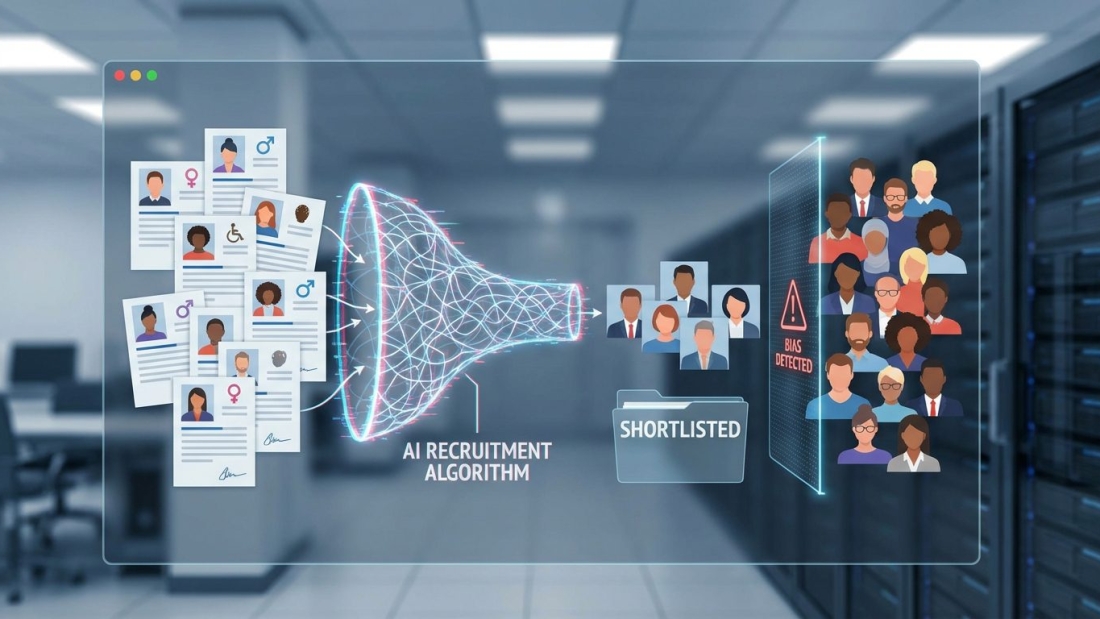
Intersectional Algorithmic Bias in AI Recruitment

Intersectional Algorithmic Bias in AI Recruitment

What is Algorithmic Bias in Hiring?

Understanding AI Decision-Making in Recruitment

Let’s be honest—hiring has never been perfectly fair. Human recruiters bring personal experiences, unconscious preferences, and sometimes even fatigue into their decisions. That is exactly why many organizations turned toward artificial intelligence in recruitment. The promise sounded simple: remove human bias and let machines make objective decisions. But reality has turned out to be far more complicated.

AI systems used in hiring do not think independently. They learn patterns from past data. If historical hiring decisions favored certain demographics, the algorithm picks up on those patterns and treats them as successful benchmarks. As a result, the system does not remove bias; it quietly learns and repeats it. Today, a large percentage of companies rely on AI tools to screen resumes, shortlist candidates, and even conduct initial interviews, which means these automated decisions impact millions of job seekers.

Think of AI like a mirror reflecting past hiring behavior. If the past was unfair, the reflection will be too. The challenge is that AI often appears neutral, making it harder to spot bias. Unlike a human recruiter, it does not openly express preferences. Instead, it embeds them deep within its logic. That makes algorithmic bias more subtle and, in many ways, more dangerous because it operates at scale without obvious warning signs.

How Bias Gets Embedded in Algorithms

Bias in AI systems is not accidental; it is usually the result of multiple hidden factors working together. One of the main sources is training data. If the dataset used to train the algorithm contains biased hiring outcomes, the AI will consider those outcomes as desirable patterns. For example, if a company historically hired more candidates from certain schools or backgrounds, the algorithm may prioritize similar profiles in future decisions.

Another factor is feature selection. Developers decide what data points the AI should consider, such as education, work experience, or even gaps in employment. These choices may unintentionally disadvantage certain groups. For instance, career breaks might negatively impact candidates who took time off for caregiving responsibilities, which often affects women more than men.

There is also the issue of proxy variables. Even when sensitive attributes like race or gender are removed, the algorithm may still infer them indirectly through other data points such as names, locations, or language patterns. This creates a situation where bias persists even when organizations believe they have eliminated it. Over time, these subtle biases compound, shaping hiring decisions in ways that are difficult to detect but deeply impactful.


What Does “Intersectional Bias” Really Mean?

The Concept of Intersectionality

To fully understand bias in AI recruitment, it is important to go beyond single categories like gender or race. Real people are defined by multiple identities that interact with each other. Intersectionality refers to the way these identities overlap and create unique experiences of advantage or disadvantage.

For example, the experience of a woman in the workplace is not identical to that of a man. But the experience of a woman from a minority ethnic background is also not identical to that of a woman from a majority group. These overlapping identities create complex layers of bias that cannot be understood by looking at one factor in isolation.

AI systems often struggle with this complexity because they are designed to identify patterns in structured data. When multiple variables interact in nuanced ways, the system may fail to capture those interactions accurately. As a result, certain groups may be disproportionately disadvantaged, even if the algorithm appears fair when evaluated on individual dimensions.

Why Single-Dimension Bias Analysis Falls Short

Many organizations attempt to address bias by analyzing outcomes across single dimensions. They might compare hiring rates between men and women or between different racial groups. While this approach provides useful insights, it does not capture the full picture.

Intersectional bias hides within combinations of identities. A system might show equal outcomes for men and women overall, but still disadvantage women from specific racial or socioeconomic backgrounds. These disparities remain invisible when analysis is limited to one variable at a time.

This limitation creates a false sense of fairness. Companies may believe their systems are unbiased because they pass basic checks, while deeper inequalities continue to exist. Addressing intersectional bias requires more advanced analysis that considers multiple variables simultaneously. Without this level of scrutiny, even well-intentioned AI systems can perpetuate hidden forms of discrimination.


The Rise of AI in Recruitment

The adoption of AI in recruitment has grown rapidly over the past decade. Organizations are increasingly relying on automated systems to handle tasks that were once performed by human recruiters. These tasks include resume screening, candidate ranking, and even initial interviews.

One of the main reasons for this shift is efficiency. AI can process thousands of applications in a fraction of the time it would take a human recruiter. This speed allows companies to reduce hiring costs and accelerate decision-making. In highly competitive job markets, this advantage can be significant.

However, the widespread use of AI also raises important concerns. As more organizations adopt these tools, the potential impact of bias increases. A single flawed algorithm can influence hiring decisions across multiple roles, departments, and even geographic regions. This scale amplifies both the benefits and the risks of AI in recruitment.

Key AI Tools Used in Hiring

AI recruitment tools come in various forms, each designed to optimize a specific part of the hiring process. Resume screening tools analyze keywords and qualifications to shortlist candidates. Video interview platforms use machine learning to evaluate facial expressions, tone of voice, and communication style. Predictive analytics tools assess the likelihood of a candidate’s success based on historical data.

While these tools offer significant advantages, they also introduce new challenges. For example, video analysis systems may struggle with cultural differences in communication styles. Candidates who do not conform to expected norms may be unfairly evaluated. Similarly, resume screening tools may favor candidates who use specific keywords, regardless of their actual skills or potential.

These limitations highlight the importance of understanding how AI tools work and what assumptions they make. Without careful oversight, organizations risk relying on systems that prioritize efficiency over fairness.


Real-World Evidence of Bias in AI Hiring

Gender and Racial Bias in Resume Screening

Research has consistently shown that AI recruitment systems can exhibit measurable bias. In some cases, algorithms have been found to favor candidates from certain demographic groups while disadvantaging others with similar qualifications. These patterns often reflect historical hiring practices embedded in the training data.

Gender bias is one of the most commonly observed issues. Some systems have shown a tendency to favor male candidates for technical roles, while others may favor female candidates in different contexts. These inconsistencies suggest that AI does not eliminate bias but rather redistributes it based on learned patterns.

Racial bias is another significant concern. Algorithms may associate certain names, locations, or educational backgrounds with higher or lower suitability for a role. These associations can lead to unequal opportunities for candidates from different racial or ethnic groups, even when their qualifications are identical.

Intersectional Disadvantages Across Groups

When multiple forms of bias intersect, the impact becomes even more pronounced. Candidates who belong to more than one marginalized group often face greater challenges in AI-driven hiring processes. For example, a candidate who is both a woman and from a minority background may experience disadvantages that are not captured by analyzing gender or race alone.

These intersectional disadvantages are particularly concerning because they are often overlooked. Standard evaluation methods may fail to detect them, allowing biased systems to operate unchecked. As a result, certain groups may be consistently excluded from opportunities without any clear explanation.

Addressing these issues requires a deeper understanding of how different forms of bias interact. It also requires a commitment to designing AI systems that account for this complexity rather than ignoring it.


Hidden Bias: The Problem of “Unknown” Data

Missing Demographics and Silent Exclusion

One of the less obvious challenges in AI recruitment is the presence of incomplete or missing data. Not all candidates provide the same level of information, and some data points may be unavailable or difficult to classify. This creates gaps in the dataset that can affect how the algorithm makes decisions.

When demographic information is missing, it becomes harder to evaluate fairness. Organizations may not be able to determine whether certain groups are being disadvantaged because they lack the necessary data. This creates a situation where bias can exist without being detected.

In some cases, candidates with incomplete data may be excluded from consideration altogether. This disproportionately affects individuals with non-traditional career paths, gaps in employment, or unconventional educational backgrounds. As a result, the system may favor candidates who fit a more standardized profile, reinforcing existing inequalities.


Why Intersectional Bias is More Dangerous

Compounding Disadvantages

Intersectional bias is particularly harmful because it compounds disadvantages across multiple dimensions. Instead of facing a single barrier, affected individuals encounter multiple overlapping obstacles. These barriers can reinforce each other, making it significantly harder to achieve fair outcomes.

For example, a candidate who faces both gender and racial bias may experience a level of disadvantage that is greater than the sum of its parts. This compounding effect makes it more difficult to identify and address the underlying issues.

Amplification at Scale

AI systems operate at a scale that magnifies their impact. A small bias in the data can lead to significant disparities when applied across thousands or millions of decisions. Over time, these disparities can shape entire industries and labor markets.

This amplification effect makes it essential to address bias at its source. Once an algorithm is deployed, its influence can spread بسرعة and become deeply embedded in organizational processes. Correcting these issues after the fact can be challenging and costly.


Causes of Intersectional Algorithmic Bias

Biased Training Data

The quality of training data plays a critical role in determining the fairness of an AI system. If the data reflects historical inequalities, the algorithm will likely reproduce those patterns. Ensuring diverse and representative datasets is essential for reducing bias.

Flawed Model Design

The design of the algorithm also matters. Decisions about which variables to include, how to weight them, and how to evaluate outcomes can all influence the system’s behavior. Poor design choices can introduce bias even when the data itself is relatively balanced.

Lack of Diverse Development Teams

Diversity within development teams is another important factor. Teams that lack diverse perspectives may overlook potential sources of bias. Including individuals from different backgrounds can help identify and address these issues during the design process.


Regulations and Compliance

Governments and regulatory bodies are beginning to address the challenges posed by AI in recruitment. New laws and guidelines aim to ensure transparency, accountability, and fairness in automated decision-making. These regulations often require organizations to conduct bias audits and provide explanations for their decisions.

Ethical Concerns in AI Hiring

Beyond legal requirements, there are broader ethical considerations. Organizations must consider whether it is appropriate to rely on algorithms for decisions that have a significant impact on people’s lives. Ensuring fairness, transparency, and accountability is not just a legal obligation but a moral one.


Can AI Reduce Bias Instead of Increasing It?

When AI Works Fairly

Despite the challenges, AI has the potential to reduce bias when designed and implemented correctly. By standardizing evaluation criteria and removing subjective judgments, AI can create more consistent hiring processes. In some cases, organizations have reported improvements in diversity and fairness after adopting well-designed AI systems.

Best Practices for Ethical AI Recruitment

To achieve these benefits, organizations must follow best practices such as using diverse datasets, conducting regular audits, and maintaining human oversight. Transparency is also key. Candidates should understand how decisions are made and have the opportunity to challenge them if necessary.


The Future of Fair AI Hiring

Emerging Solutions and Technologies

New approaches to AI development are focusing on fairness and accountability. Techniques such as explainable AI and fairness-aware algorithms aim to make decision-making processes more transparent and equitable. These innovations offer promising pathways for reducing bias in recruitment.

What Organizations Must Do Next

Organizations must take a proactive approach to addressing intersectional bias. This includes investing in better data, improving model design, and fostering diverse teams. It also requires a commitment to continuous improvement, as new challenges and opportunities emerge.


Conclusion

Intersectional algorithmic bias in AI recruitment is a complex and evolving challenge. It reflects deeper issues within both technology and society. As organizations continue to adopt AI-driven hiring tools, the importance of fairness and accountability cannot be overstated. Addressing these issues requires a combination of technical expertise, ethical awareness, and ongoing vigilance.

AI-Powered Talent Acquisition & Skills-Based Hiring

AI-Powered Talent Acquisition & Skills-Based Hiring

The Evolution of Hiring in the AI Era

Traditional Hiring vs Modern Hiring

Traditional hiring used to revolve around resumes, degrees, and job titles. Recruiters would scan documents, looking for familiar institutions, recognizable companies, and a certain number of years of experience. While this method worked to some extent, it often overlooked real capability. A candidate might have an impressive academic background but lack practical skills, while someone highly capable could be ignored simply because they did not follow the traditional path.

Modern hiring flips this approach. With the rise of AI-powered talent acquisition, companies now rely on data and technology to identify the best candidates. Instead of making assumptions based on surface-level information, organizations analyze deeper insights such as skills, performance patterns, and potential for growth. This shift allows businesses to make more informed decisions and reduce costly hiring mistakes.

The difference between the two approaches is significant. Traditional hiring is like judging a book by its cover, while modern hiring is about understanding the full story. In today’s competitive market, companies can no longer afford to rely on outdated practices. They need faster, smarter, and more accurate methods to stay ahead.

Why Change Was Inevitable

The shift toward AI-driven hiring did not happen overnight. It was driven by several factors, including rapid technological advancement, changing job requirements, and a growing gap between available skills and employer needs. As industries evolved, the demand for specialized skills increased, making it harder for traditional hiring methods to keep up.

Another major factor is the global nature of today’s workforce. Remote work has opened opportunities for companies to hire talent from anywhere in the world. This expansion requires systems that can efficiently process large volumes of applications and identify the most suitable candidates quickly. Manual processes simply cannot handle this scale.

At the same time, businesses began to realize that degrees and past job titles are not always reliable indicators of success. Real-world performance depends on practical skills, adaptability, and problem-solving ability. This realization paved the way for a new approach that focuses on what candidates can actually do rather than where they come from.


What is AI-Powered Talent Acquisition?

Definition and Core Concepts

AI-powered talent acquisition refers to the use of artificial intelligence technologies to enhance and automate various stages of the hiring process. From sourcing candidates to screening resumes and conducting initial interviews, AI plays a critical role in improving efficiency and accuracy.

Think of AI as a highly intelligent assistant that can process vast amounts of data in seconds. It can analyze resumes, match candidates to job requirements, and even predict future performance based on historical data. This capability allows recruiters to focus on strategic tasks such as building relationships and making final decisions.

One of the key advantages of AI is its ability to reduce time-to-hire. By automating repetitive tasks, organizations can move candidates through the hiring process more quickly. This not only saves time but also improves the candidate experience, as applicants receive faster responses and clearer communication.

Key Technologies Behind AI Hiring

Several technologies power AI-driven hiring systems, each playing a unique role in the process. Natural Language Processing enables machines to understand and interpret human language, allowing them to analyze resumes and job descriptions effectively. Machine learning algorithms learn from past hiring decisions and continuously improve their accuracy over time.

Another important component is predictive analytics, which uses data to forecast outcomes such as candidate success and retention. This helps organizations make more informed decisions and reduce the risk of hiring mismatches. Additionally, chatbots and automation tools handle communication tasks, such as answering candidate questions and scheduling interviews.

These technologies work together to create a seamless hiring experience. They not only improve efficiency but also provide valuable insights that were previously unavailable. As a result, companies can make better decisions and build stronger teams.


Understanding Skills-Based Hiring

What It Means

Skills-based hiring focuses on evaluating candidates based on their abilities rather than their educational background or work history. This approach prioritizes practical skills, problem-solving capabilities, and real-world performance.

In a skills-based model, candidates are often required to complete assessments, simulations, or practical tasks that demonstrate their expertise. This allows employers to see how individuals perform in real situations rather than relying on theoretical knowledge or past credentials.

This approach is particularly valuable in industries where skills evolve rapidly. For example, in technology and digital marketing, new tools and techniques emerge frequently, making it essential for employees to continuously update their knowledge. Skills-based hiring ensures that companies select candidates who can adapt and thrive in such environments.

Why Degrees Are Losing Importance

While degrees still hold value, they are no longer the primary factor in hiring decisions. Many employers have realized that formal education does not always reflect a candidate’s ability to perform a job effectively. In some cases, individuals without traditional qualifications may possess exceptional skills gained through self-learning or practical experience.

The rise of alternative learning methods has further contributed to this shift. People can now acquire valuable skills outside of traditional academic institutions, making it easier for them to compete in the job market.

By focusing on skills rather than credentials, companies can access a broader and more diverse talent pool. This not only increases the chances of finding the right candidate but also promotes inclusivity and equal opportunity.


Why AI and Skills-Based Hiring Work Together

The Perfect Match Explained

AI and skills-based hiring complement each other perfectly. AI provides the speed and scalability needed to process large volumes of applications, while skills-based hiring ensures that candidates are evaluated accurately based on their abilities.

For example, AI can quickly identify candidates who meet specific skill requirements and rank them accordingly. These candidates can then undergo assessments or practical tests to validate their skills. This two-step process improves the accuracy of hiring decisions and reduces the likelihood of errors.

The combination of these approaches creates a more efficient and effective hiring system. It allows companies to identify top talent quickly while ensuring that candidates are evaluated fairly and objectively.

Real-World Application Examples

Many organizations are already using AI and skills-based hiring in their recruitment processes. AI tools are used to source candidates, screen applications, and shortlist individuals based on skill compatibility. Candidates then complete assessments or participate in simulations to demonstrate their abilities.

This approach not only improves hiring accuracy but also enhances the candidate experience. Applicants are evaluated based on their skills rather than arbitrary criteria, making the process more transparent and fair. As a result, companies can build stronger teams and achieve better outcomes.


Key Benefits of AI in Talent Acquisition

Faster Hiring

Speed is a critical factor in recruitment. Delays in the hiring process can result in losing top talent to competitors. AI helps accelerate every stage of hiring, from sourcing candidates to conducting initial screenings.

By automating repetitive tasks, AI allows recruiters to focus on more strategic activities. This leads to faster decision-making and shorter hiring cycles. Candidates also benefit from quicker responses, which improves their overall experience.

Reduced Bias

Bias has long been a challenge in hiring. Human decisions can be influenced by unconscious preferences, leading to unfair outcomes. AI can help address this issue by focusing on data and objective criteria.

When designed and implemented correctly, AI systems evaluate candidates based on their skills and qualifications rather than subjective factors. This promotes fairness and inclusivity, helping organizations build diverse teams.


Benefits of Skills-Based Hiring

Better Talent Pool

Skills-based hiring expands the talent pool by removing unnecessary barriers. Candidates who may have been overlooked due to lack of formal education or traditional experience now have the opportunity to showcase their abilities.

This approach allows companies to discover hidden talent and tap into a wider range of candidates. It also encourages diversity, as individuals from different backgrounds can compete on an equal footing.

Improved Performance and Retention

Hiring based on skills leads to better job performance. Employees who possess the required abilities are more likely to succeed in their roles and contribute to the organization’s goals.

Additionally, skills-based hiring improves employee satisfaction and retention. When individuals are placed in roles that match their capabilities, they are more engaged and motivated. This reduces turnover and creates a more stable workforce.


Challenges and Risks

AI Bias and Ethical Concerns

Despite its advantages, AI is not without challenges. One of the main concerns is the potential for bias. If AI systems are trained on biased data, they may produce biased outcomes. This can undermine fairness and lead to unintended consequences.

To address this issue, organizations must regularly audit their AI systems and ensure that they are designed to promote fairness and transparency. Human oversight is also essential to identify and correct any biases that may arise.

Implementation Barriers

Implementing AI in hiring requires investment, training, and organizational change. Some companies may face challenges in integrating new technologies with existing systems. Others may struggle with resistance from employees who are unfamiliar with AI tools.

Overcoming these barriers requires a strategic approach. Organizations must invest in training and development to ensure that their teams can effectively use AI technologies. They must also create a culture that embraces innovation and continuous improvement.


Tools and Technologies Used

AI Recruitment Software

AI recruitment software combines multiple functionalities into a single platform. These tools can automate tasks such as resume screening, candidate sourcing, and interview scheduling. They also provide insights and analytics to support decision-making.

Skills Assessment Platforms

Skills assessment platforms play a crucial role in evaluating candidate abilities. These tools offer various types of assessments, including coding tests, simulations, and case studies. They provide objective data that helps employers make informed hiring decisions.


Agentic AI and Automation

The future of hiring is moving toward more advanced forms of AI. Agentic AI systems can handle entire workflows independently, from sourcing candidates to making recommendations. This level of automation has the potential to transform recruitment processes even further.

Rise of Hybrid Hiring Models

The future is not about replacing humans with machines. Instead, it is about combining the strengths of both. Hybrid hiring models integrate AI technology with human judgment, creating a balanced approach that maximizes efficiency and effectiveness.


How Companies Can Adapt

Building a Skills-First Strategy

To stay competitive, companies must adopt a skills-first approach. This involves redefining job requirements, focusing on capabilities rather than credentials, and implementing assessment-based evaluations.

Training Recruiters for AI Integration

Recruiters need to develop new skills to work effectively with AI tools. This includes understanding data analytics, learning how to interpret AI-generated insights, and adapting to new technologies. Training and development programs can help organizations prepare their teams for this transition.


Conclusion

AI-powered talent acquisition and skills-based hiring are reshaping the future of recruitment. Together, they offer a more efficient, accurate, and fair approach to hiring. Organizations that embrace these strategies can improve their hiring outcomes, build stronger teams, and stay ahead in a competitive market. The shift is already underway, and those who adapt quickly will be better positioned for long-term success.

What Is Claude Cowork? The Complete Beginner's Guide (2026)

What Is Claude Cowork? The Complete Beginner’s Guide (2026)

Introduction to Claude Cowork

Why Everyone Is Talking About AI Coworkers

Let’s be real for a second—most AI tools today still feel like interns. You ask something, they respond, and then… you still have to do the work yourself. That’s exactly the frustration that led to the rise of AI coworkers—tools that don’t just think, but actually do.

In 2026, the conversation around artificial intelligence has shifted dramatically. Instead of asking, “Can AI help me?” people are now asking, “Can AI do this for me entirely?” And that’s where Claude Cowork enters the picture.

This isn’t just another chatbot upgrade. It’s a fundamental leap. Instead of replying with suggestions, Claude Cowork executes tasks—organizing files, creating reports, analyzing data—like a real teammate working behind the scenes.

The Shift from Chatbots to AI Agents

Here’s the big idea: traditional AI = conversation.
Claude Cowork = execution.

Think of it like this:

  • Chatbots are like Google.
  • Cowork is like hiring an assistant.

AI is evolving from passive tools into active agents—systems that can plan, act, and deliver results without constant supervision. This shift is often called agentic AI, and Claude Cowork is one of the clearest examples of it in action.


What Exactly Is Claude Cowork?

Definition and Core Concept

Claude Cowork is an AI agent built into the Claude desktop app that can complete multi-step tasks on your behalf.

Instead of just answering questions, it:

  • Understands your goal
  • Breaks it into steps
  • Executes those steps
  • Delivers a finished output

It’s often described as “Claude Code for non-coding work”, meaning it brings powerful automation to everyday tasks like writing, organizing, and analyzing.

How It Differs from Regular AI Chat

Here’s where things get interesting.

FeatureRegular AI ChatClaude Cowork
InteractionBack-and-forth promptsGoal-based execution
File AccessNoneDirect file access
OutputSuggestionsCompleted work
WorkflowManualAutomated
ContextUser-providedSelf-discovered

In simple words: chatbots assist, Cowork delivers.


How Claude Cowork Works

Folder Access and Permissions

Claude Cowork operates inside a secure sandbox. You give it access to a specific folder on your computer, and that’s its workspace.

Inside that folder, it can:

  • Read files
  • Edit documents
  • Create new files
  • Organize folders

This controlled access ensures your data stays safe while still allowing the AI to work efficiently.

Multi-Step Task Execution

Unlike a normal AI response that happens instantly, Cowork works in stages.

You give it a task like:

“Turn these 50 screenshots into a structured expense report.”

And it will:

  1. Analyze each image
  2. Extract data
  3. Organize it into categories
  4. Generate a spreadsheet

All automatically.

This multi-step execution is what makes it feel less like software and more like a human assistant.

Autonomous Workflow System

One of the most powerful aspects is asynchronous execution.

You don’t have to sit and wait. You can:

  • Assign a task
  • Approve the plan
  • Walk away

Cowork handles the rest and delivers the result when it’s done.


Key Features of Claude Cowork

File Management and Automation

Messy desktop? Thousands of downloads? No problem.

Claude Cowork can:

  • Rename files
  • Sort documents into folders
  • Extract data from images
  • Convert notes into reports

It’s like having a digital organizer who never gets tired.

Parallel Task Handling

For complex tasks, Cowork can split the work into parallel sub-agents.

That means:

  • Multiple processes run at once
  • Results are merged at the end
  • Work gets done faster

This is especially useful for research, data analysis, or large document processing.

Plugins and Integrations

In 2026, Cowork isn’t working alone anymore.

It connects with tools like:

  • Excel
  • Google Workspace
  • WordPress
  • CRM systems

It can even move data between apps while maintaining context.

That’s where things start to feel really powerful.


Real-Life Use Cases

Content Creation

Imagine dumping random notes, ideas, and drafts into a folder.

Now imagine saying:

“Turn this into a polished blog post.”

Done.

Cowork can:

  • Write articles
  • Create presentations
  • Summarize documents
  • Generate reports

Business Operations

For teams, this is a game changer.

It can:

  • Automate weekly reports
  • Analyze business data
  • Prepare presentations
  • Handle repetitive admin tasks

Some companies are already using it to replace hours of manual work every week.

Personal Productivity

Even for personal use, it’s insanely helpful.

Think:

  • Organizing photos
  • Managing files
  • Planning trips
  • Creating budgets

It’s like having a personal assistant built into your computer.


Claude Cowork vs Traditional AI Tools

Comparison Table

FeatureChatGPT-style AIClaude Cowork
TypeConversational AIAgentic AI
Task HandlingSingle-stepMulti-step
File InteractionManualDirect
AutomationLimitedHigh
OutputTextFiles, reports, actions

Benefits of Using Claude Cowork

Let’s break it down simply.

1. Saves massive time
Tasks that take hours can be done in minutes.

2. Reduces manual work
No more copy-pasting between tools.

3. Works like a real teammate
You assign tasks—it delivers results.

4. Scales your productivity
You can handle more work without burnout.

5. Learns your workflow
With custom instructions, it adapts to how you work.


Limitations and Risks

No tool is perfect—and Cowork is no exception.

1. Requires clear instructions
Vague tasks can lead to wrong outputs.

2. File access risks
You must be careful about what folders you allow.

3. Still in research preview
It’s evolving, so bugs and limitations exist.

4. Dependency on system state
Some features require your computer to stay active.


Claude Cowork Pricing and Availability (2026)

As of 2026:

  • Available on Pro, Max, Team, and Enterprise plans
  • Pricing ranges roughly from $20 to $100/month depending on plan
  • Works on macOS and Windows

It’s still labeled as a research preview, meaning rapid updates are happening.


How to Get Started with Claude Cowork

Installation and Setup

Getting started is surprisingly simple:

  1. Download the Claude desktop app
  2. Install it on your system
  3. Log in with your account
  4. Open the “Cowork” tab
  5. Grant folder access

That’s it—you’re ready to go.

First Task Walkthrough

Try something simple:

“Organize my downloads folder into categories.”

Watch how it:

  • Scans files
  • Creates folders
  • Moves everything into place

It’s honestly kind of mind-blowing the first time.


The Future of AI Coworkers

Here’s the exciting part: we’re just getting started.

Claude Cowork represents a bigger trend:

👉 AI is becoming your digital workforce

Soon, you won’t just have one AI—you’ll have multiple:

  • One for writing
  • One for research
  • One for operations

And they’ll all collaborate.

Some experts already believe this shift will redefine how companies operate, replacing repetitive roles while enhancing creative ones.


Conclusion

Claude Cowork isn’t just another AI feature—it’s a paradigm shift.

It moves AI from being a passive assistant to an active worker. Instead of helping you do tasks, it actually does them for you. That alone changes everything.

If you’re still using AI like a chatbot, you’re missing the bigger picture. The future isn’t about asking better questions—it’s about assigning better tasks.

And Claude Cowork is leading that transformation.

PhishReaper Investigation: Airwallex Phishing Operation Exposed by Agentic AI

PhishReaper Investigation: Airwallex Phishing Operation Exposed by Agentic AI

PhishReaper Investigation: Airwallex Phishing Operation Exposed by Agentic AI

Introduction

In today’s rapidly evolving digital threat landscape, phishing campaigns have become one of the most persistent and sophisticated cyber risks facing organizations worldwide. As the Exclusive OEM Partner of PhishReaper in Pakistan, LogIQ Curve is proud to present the latest threat intelligence findings from the PhishReaper research team to our global audience. Through this strategic collaboration, LogIQ Curve represents the advanced phishing-detection capabilities of the PhishReaper platform to enterprises, financial institutions, telecom operators, and government organizations.

Organizations interested in strengthening their cybersecurity posture and proactively identifying phishing infrastructure are invited to explore this technology further by contacting our cybersecurity team at security@logiqcurve.com.

A recent investigation conducted by PhishReaper uncovered a phishing operation impersonating Airwallex, a global financial technology company providing cross-border payment solutions. What makes this discovery particularly significant is the duration and stealth of the malicious infrastructure. According to the investigation, the phishing campaign had been operating quietly for multiple years, remaining largely unnoticed by conventional detection mechanisms until it was illuminated through PhishReaper’s advanced AI-driven threat hunting capabilities.

The Discovery: A Long-Running Phishing Campaign

PhishReaper’s investigation revealed an extensive phishing infrastructure targeting users of Airwallex’s digital financial platform. The malicious campaign involved carefully crafted phishing domains and web interfaces designed to mimic legitimate Airwallex services.

These phishing environments were constructed to deceive users into believing they were interacting with the authentic Airwallex platform. Once victims entered credentials or sensitive account information, attackers could capture and exploit that data for fraudulent activities.

What made the campaign particularly concerning was the longevity of the infrastructure. Instead of appearing briefly like many phishing attacks, this campaign maintained operational presence for an extended period, suggesting a well-organized and persistent threat actor strategy.

The ability of the campaign to remain hidden for such a long time highlights the limitations of traditional detection approaches that rely primarily on known malicious indicators or user reports.

Understanding the Infrastructure Behind the Attack

During the investigation, PhishReaper analyzed the structure of the malicious infrastructure supporting the phishing operation. The campaign demonstrated several characteristics commonly associated with advanced phishing operations:

• Domain registrations designed to closely resemble legitimate brand assets
• Infrastructure clusters capable of hosting multiple phishing environments
• Carefully replicated login portals intended to capture user credentials
• Operational infrastructure designed for persistence over long periods

These components allowed attackers to maintain the campaign without immediately triggering detection systems. By distributing phishing assets across multiple infrastructure points, attackers increased their ability to remain operational even if individual domains were eventually discovered.

PhishReaper’s analysis focused not only on individual malicious domains but also on the relationships between infrastructure elements, enabling a broader understanding of the campaign ecosystem.

Why Traditional Security Systems Often Miss These Campaigns

Many traditional cybersecurity tools rely heavily on reactive detection mechanisms. These tools typically identify phishing websites only after they have already been reported or after users have encountered them.

Such models depend on:

• Known indicators of compromise
• Previously identified malicious domains
• User-reported phishing incidents

While these methods can eventually detect threats, they often do so after significant exposure has already occurred.

In the case of the Airwallex phishing campaign, the infrastructure remained operational for an extended period because the attackers designed their operations to avoid triggering traditional detection systems.

This scenario demonstrates a fundamental challenge in cybersecurity: reactive detection alone is not sufficient against modern phishing campaigns.

PhishReaper’s Agentic AI Threat Hunting Approach

PhishReaper approaches phishing detection differently by focusing on intent-based infrastructure discovery rather than relying solely on known malicious indicators.

Using agentic AI-driven analysis, PhishReaper can identify suspicious infrastructure patterns that suggest phishing intent even before attacks become widely distributed.

This methodology enables detection through:

• analysis of domain behavior and relationships
• infrastructure pattern recognition
• automated intelligence gathering across phishing ecosystems
• identification of attacker operational patterns

Through these capabilities, the platform was able to illuminate the Airwallex phishing infrastructure that had remained hidden for years.

Rather than identifying only isolated phishing pages, PhishReaper maps the broader infrastructure supporting the campaign, allowing security teams to disrupt phishing operations more effectively.

Strategic Implications for Organizations

The Airwallex phishing operation highlights the growing sophistication of threat actors targeting financial technology platforms.

Organizations operating digital financial services face particularly high risks because phishing campaigns targeting financial systems can lead to:

• Credential theft
• Unauthorized financial transactions
• Customer data compromise
• Reputational damage

The longer such campaigns remain active, the greater the potential damage to both organizations and their users.

Early detection of phishing infrastructure is therefore essential for protecting customer trust and maintaining operational security.

Platforms like PhishReaper allow organizations to move from reactive incident response to proactive threat prevention.

Moving Toward Proactive Cyber Defense

The investigation demonstrates a clear need for cybersecurity strategies that focus on early detection of attacker infrastructure.

As phishing campaigns become more automated and scalable, defenders must adopt technologies capable of identifying threats before they reach victims.

Proactive threat hunting platforms provide organizations with:

• Earlier visibility into emerging phishing campaigns
• Improved ability to protect brand identity
• Reduced exposure to credential harvesting attacks
• Enhanced situational awareness for security teams

By identifying malicious infrastructure before it becomes widely distributed, organizations can significantly reduce the impact of phishing campaigns.

Conclusion

The multi-year Airwallex phishing campaign uncovered by PhishReaper illustrates how sophisticated phishing infrastructure can remain hidden within the broader internet ecosystem for extended periods.

Through its agentic AI-driven threat hunting capabilities, PhishReaper was able to illuminate infrastructure that had previously gone unnoticed.

This discovery reinforces the importance of proactive cybersecurity approaches that detect phishing ecosystems at their earliest stages.

Through its collaboration with PhishReaper, LogIQ Curve is committed to bringing this advanced phishing detection capability to organizations seeking stronger protection against evolving cyber threats.

Learn More About PhishReaper

Organizations interested in evaluating the PhishReaper phishing detection platform can contact LogIQ Curve to learn how this technology can strengthen enterprise security operations.
📧 security@logiqcurve.com

LogIQ Curve works with:

• Banks
• Telecom operators
• Government organizations
• Enterprises
• SOC teams

to identify phishing infrastructure before attacks, reach users.

Research Attribution

This analysis is based on the original threat intelligence research conducted by PhishReaper. LogIQ Curve republishes these findings for its global audience as the Exclusive OEM Partner of PhishReaper in Pakistan, helping organizations gain early visibility into emerging phishing threats.

Description

PhishReaper exposes a long-running phishing campaign impersonating Airwallex. Learn how AI-driven threat hunting uncovered infrastructure that remained hidden for years and why proactive phishing detection is critical for modern enterprises.

Tags

#PhishReaper #LogIQCurve #CyberSecurity #PhishingDetection #ThreatIntelligence #ThreatHunting #CyberDefense #EnterpriseSecurity #SOC #AIinCybersecurity #DigitalSecurity #CyberResilience #FinancialSecurity #InfoSec #SecurityOperations #CyberThreats #PakistanCyberSecurity #CyberInnovation #SafwanKhan #HaiderAbbas #NajeebUlHussan #MumtazKhan #CISO #CTO #SecurityLeadership

Automating Pull Requests in GitHub Skills Using Claude Code

Automating Pull Requests in GitHub Skills Using Claude Code

Understanding Pull Request Automation

What Is a Pull Request in GitHub

If you have ever worked on a collaborative software project, you already know how important pull requests are. A pull request (PR) is essentially a request to merge code changes from one branch into another branch, usually from a feature branch into the main project branch. It creates a place where developers can review the code, suggest improvements, run automated checks, and decide whether the changes should be merged into the codebase.

Think of a pull request as a checkpoint in the development process. Instead of pushing code directly into the main branch, developers propose their changes and allow teammates to review them. This process protects the project from bugs, keeps the codebase stable, and encourages collaboration between developers.

However, creating pull requests manually can quickly become repetitive. Developers often have to write long descriptions, explain what changes were made, add testing instructions, and organize commits. These tasks do not directly improve the code itself, yet they consume a significant amount of time during development.

This is where automation becomes extremely useful. By using AI tools such as Claude Code, developers can automate many of these repetitive steps. The AI can analyze commit history, summarize changes, generate structured descriptions, and even open the pull request automatically. Instead of spending time on documentation tasks, developers can focus on writing better code and building new features.

Why Automation Matters in Modern Development

Software development has evolved significantly over the last decade. Continuous integration pipelines, microservices architectures, and distributed teams have increased the volume of commits and pull requests generated every day. In large projects, dozens or even hundreds of pull requests may be created in a single week.

Managing these manually can slow down development workflows. When developers spend too much time writing pull request descriptions or formatting documentation, it reduces the time they can spend solving actual technical problems. Automation helps eliminate these repetitive tasks and keeps development pipelines moving efficiently.

Automated pull requests also improve consistency across teams. When every developer writes descriptions differently, pull requests become harder to read and review. AI automation standardizes this process by generating structured summaries that follow a predefined format.

Another major benefit is improved productivity. Instead of manually preparing pull requests, developers can rely on automation to generate titles, summaries, and checklists instantly. The AI analyzes the code changes and produces a clear explanation of what was modified and why it matters.

This shift allows development teams to focus on creativity, architecture, and problem solving rather than routine documentation tasks.


Introduction to Claude Code

What Claude Code Actually Does

Claude Code is an AI-powered development assistant designed to help programmers manage code, automate tasks, and accelerate development workflows. Unlike traditional code completion tools that only suggest single lines of code, Claude operates more like an intelligent collaborator.

It can read project files, understand repository structure, and perform complex development tasks. Developers can ask it to implement new features, fix bugs, generate documentation, or refactor existing code. Claude then analyzes the codebase and produces solutions based on the project context.

One of the most powerful capabilities of Claude Code is its ability to automate workflows. Instead of simply suggesting code snippets, it can execute entire development tasks from start to finish. For example, if a developer describes a feature request, Claude can generate the necessary code changes, create commits, and prepare a pull request ready for review.

This makes Claude more than just an assistant. It functions as an AI development partner that helps teams move faster while maintaining high code quality.

How Claude Integrates With GitHub

Claude Code integrates seamlessly with GitHub through tools such as GitHub Actions, the GitHub command line interface, and repository integrations. This connection allows Claude to interact directly with repositories and perform tasks automatically.

With proper configuration, Claude can create branches, commit code changes, generate pull requests, and update existing issues. Developers can even trigger Claude through simple commands inside GitHub comments.

For example, a developer can mention Claude in an issue or pull request comment and ask it to implement a change. Claude then analyzes the request, generates the necessary code modifications, and opens a pull request for review.

This integration removes the need to switch between multiple development tools. Everything happens inside the GitHub workflow that developers already use every day.


GitHub Skills and AI Automation

What Are GitHub Skills

Within the Claude ecosystem, skills are reusable instruction sets that define how the AI should perform specific tasks. Skills allow developers to customize automation workflows according to their project requirements.

You can think of skills as structured playbooks that guide the AI through complex processes. For example, a skill might instruct Claude to automatically generate pull request descriptions, format commit messages, run tests before creating a PR, or ensure that documentation is included.

Skills are usually stored inside a repository directory and can be reused across multiple projects. Once a skill is defined, Claude can execute it whenever the workflow is triggered.

This system provides consistency across teams. Instead of relying on each developer to follow the same guidelines manually, the AI enforces the rules automatically.

How AI Skills Enhance DevOps Workflows

AI skills significantly improve DevOps workflows by combining automation with contextual understanding. Traditional automation scripts follow rigid instructions and cannot adapt to different situations. AI-powered skills, on the other hand, can analyze the context of code changes and respond intelligently.

For instance, when a developer commits several changes to a feature branch, Claude can review the commit history and determine the purpose of the update. It then generates a pull request description that explains the feature, lists modified files, and provides instructions for testing.

This automated documentation makes pull requests easier to understand and review. Team members can quickly grasp the purpose of the changes without reading every commit individually.

Skills also help enforce development standards. If a project requires specific formatting or testing procedures before creating pull requests, the AI can automatically ensure those rules are followed.

Over time, these skills become an integral part of the development pipeline, improving both efficiency and collaboration.


How Claude Code Automates Pull Requests

AI-Based Code Analysis

Before creating a pull request, Claude performs a deep analysis of the code changes within the branch. It examines modified files, commit messages, and the overall project structure to determine the purpose of the update.

This analysis allows the AI to generate accurate summaries and meaningful pull request descriptions. Instead of generic messages such as “updated files,” the AI produces clear explanations that help reviewers understand the context of the changes.

For example, if a developer introduces caching to improve API performance, Claude might generate a title such as “Add Redis caching to reduce API response latency.” This kind of clarity improves the efficiency of the review process.

AI-based analysis also helps identify potential issues before the pull request is created. The system can flag missing tests, inconsistent formatting, or incomplete documentation.

Automated PR Creation and Documentation

After analyzing the code changes, Claude automatically prepares the pull request. This includes generating a title, writing a detailed description, and organizing the information into a structured format.

Most automated pull requests include several sections such as a summary of the change, a list of modifications, testing instructions, and any relevant notes for reviewers. This structure ensures that every pull request follows a consistent format.

Claude can also create the pull request directly using the GitHub command line interface. This means the entire process can occur within a development script or automation workflow.

By eliminating manual documentation work, developers can submit pull requests more quickly and focus on improving the quality of their code.


Setting Up Claude Code for PR Automation

Installing the GitHub App and API Keys

The first step in enabling pull request automation is installing the Claude GitHub integration. This application connects Claude with the repository and allows it to interact with project files, issues, and pull requests.

During the installation process, developers grant the application permission to access repository contents and manage pull requests. These permissions allow the AI to read code changes, create branches, and submit pull requests automatically.

Developers also need to configure an API key so the GitHub automation workflow can communicate with the Claude service. This key is usually stored as a repository secret to ensure security.

Once the integration is configured, Claude becomes capable of responding to repository events and performing automated development tasks.

Configuring GitHub CLI and Permissions

Automation workflows often rely on the GitHub command line interface. This tool allows scripts and automation pipelines to interact with repositories directly from the terminal.

Developers authenticate with GitHub using a simple login command. After authentication, the CLI can perform actions such as creating pull requests, viewing repository information, and editing existing pull requests.

By combining Claude with the GitHub CLI, developers can create powerful automation workflows that run entirely within their development environment.


Creating an Automated Pull Request Workflow

Using GitHub Actions With Claude

GitHub Actions plays a critical role in automating pull requests. It allows developers to create workflows that run automatically whenever certain events occur within a repository.

For example, a workflow might trigger Claude when a new issue is created, when a label is applied to a task, or when a developer mentions the AI in a comment.

The workflow runs inside GitHub’s infrastructure and executes the automation tasks defined in the configuration file. This makes it possible to create intelligent pipelines without running additional servers.

With GitHub Actions, teams can automate everything from code analysis to pull request generation.

Triggering Automation With Issues or Comments

One of the most convenient features of Claude automation is the ability to trigger workflows using simple comments. Developers can request tasks directly within GitHub discussions or issue threads.

For instance, a developer might ask Claude to fix failing tests or implement a small feature. Claude reads the request, analyzes the repository, generates the required changes, and opens a pull request automatically.

This conversational workflow feels similar to collaborating with another developer. Instead of manually writing scripts, teams interact with the AI using natural language.


Building a Claude Skill for PR Automation

Example Skill Structure

A pull request automation skill usually contains clear instructions that define how Claude should perform the workflow. These instructions may include steps for analyzing commits, generating pull request titles, writing descriptions, and creating the PR through the command line interface.

The skill acts as a reusable template. Whenever Claude executes the skill, it follows the same instructions and produces consistent results.

Because skills are modular, developers can modify them over time to match their project requirements.

Best Practices for Skill Templates

Effective skill templates focus on clarity and structure. They typically include sections for pull request summaries, lists of changes, testing instructions, and review checklists.

Including these elements ensures that every pull request contains enough information for reviewers to understand the update quickly.

Teams often refine their skill templates based on experience. Over time, these templates evolve into highly optimized workflows that support faster and more reliable development.


Benefits of Automating Pull Requests

Speed, Consistency, and Reduced Manual Work

The most obvious advantage of automating pull requests is speed. Tasks that once took several minutes can now be completed in seconds. Developers no longer need to manually format descriptions or organize documentation.

Automation also improves consistency. Every pull request follows the same structure, making it easier for reviewers to navigate and understand the changes.

Another major benefit is reduced cognitive load. Developers can focus on solving complex problems rather than worrying about formatting and documentation tasks.

Improved Code Review Quality

Automated pull request descriptions make the review process much easier. Reviewers receive a clear explanation of the purpose of the change, which files were modified, and how the update should be tested.

This structured information allows reviewers to focus on the technical quality of the code rather than trying to interpret incomplete documentation.

As a result, teams can complete reviews faster while maintaining high code quality.


Challenges and Limitations

Security Considerations

While automation offers many advantages, it also introduces potential security concerns. Granting AI tools access to repositories requires careful permission management.

Developers should ensure that access tokens and API keys are stored securely and that automation workflows only have the permissions they truly need.

Security reviews should remain part of the development process to prevent unauthorized changes or vulnerabilities.

Human Oversight Still Matters

Even though AI-generated pull requests are highly effective, they should not replace human judgment entirely. Developers must still review the generated code to ensure it aligns with architectural decisions and project requirements.

AI automation works best as a supporting tool rather than a replacement for human developers.

The ideal workflow combines AI efficiency with human expertise.


Future of AI-Driven GitHub Workflows

AI coding assistants are becoming increasingly common in modern development environments. As these tools continue to improve, they will likely handle more aspects of the software development lifecycle.

Future AI systems may automatically implement features, generate documentation, run tests, and submit pull requests with minimal human intervention. Developers will focus more on system design, strategy, and innovation.

Automation will not eliminate developers, but it will transform how they work. Instead of performing repetitive tasks, developers will guide intelligent systems that handle much of the operational workload.

Teams that adopt AI-assisted workflows early are likely to gain significant productivity advantages.


Conclusion

Automating pull requests using Claude Code and GitHub skills represents a significant step forward in modern software development. By combining AI-powered analysis with automated workflows, teams can streamline the process of creating pull requests and reduce the manual effort involved.

Claude Code analyzes code changes, generates structured documentation, and opens pull requests automatically. When integrated with GitHub Actions and the GitHub CLI, it becomes a powerful tool for building intelligent development pipelines.

The result is faster development cycles, clearer collaboration, and more consistent pull request quality. Developers remain in control of the review process while benefiting from automation that handles repetitive tasks.

As AI technology continues to evolve, tools like Claude Code will play an increasingly important role in shaping the future of software development.

DevSecOps with Claude Code: Security in CI/CD Pipelines

DevSecOps with Claude Code: Automating Security in CI/CD Pipelines

Understanding DevSecOps in Modern Software Development

What DevSecOps Really Means

Modern software teams release code at lightning speed. Agile workflows, microservices, and cloud deployments have transformed development cycles from months into days—or sometimes hours. While this speed fuels innovation, it also introduces a new problem: security vulnerabilities can slip through the cracks. This is exactly where DevSecOps enters the picture. DevSecOps is the practice of integrating security directly into the software development lifecycle rather than treating it as an afterthought. Instead of waiting until the final stage to perform security checks, DevSecOps embeds automated testing, vulnerability scanning, and policy enforcement into every step of development.

Think of DevSecOps like installing guardrails on a highway. Without them, drivers might move faster, but accidents become far more likely. Security guardrails in DevSecOps ensure developers can move quickly without crashing into security risks. Automated security scans, dependency checks, and secure configuration validation all operate inside the CI/CD pipeline. By shifting security left—meaning earlier in development—organizations reduce the cost and complexity of fixing vulnerabilities later. In traditional environments, security teams often worked separately from development teams. DevSecOps breaks down these silos, creating a collaborative culture where developers, security engineers, and operations teams share responsibility for protecting the application.

Why Security Must Be Integrated into CI/CD

Continuous Integration and Continuous Deployment (CI/CD) pipelines have become the backbone of modern software delivery. Every code commit triggers automated processes such as building, testing, and deploying applications. While these pipelines accelerate delivery, they also create opportunities for vulnerabilities to propagate quickly if security checks are missing. A single insecure code commit can travel from development to production in minutes. Embedding security directly into CI/CD pipelines ensures that every change is verified before it reaches users.

Automated security scanning tools now detect issues such as dependency vulnerabilities, insecure configurations, or malicious code patterns during the pipeline itself. With DevSecOps, these checks run alongside unit tests and performance benchmarks. As a result, security becomes a natural part of development rather than an external checkpoint. When developers receive immediate feedback about vulnerabilities in their code, they can fix issues instantly instead of waiting weeks for a security review. The outcome is a development culture where speed and safety coexist rather than compete.

The Rise of AI-Assisted DevOps

How AI Is Changing Software Delivery

Artificial intelligence is reshaping how software is built, tested, and deployed. Tools powered by large language models can analyze massive codebases, detect anomalies, and generate fixes faster than manual inspection. In DevOps environments, AI assistants are now helping developers write code, generate tests, review pull requests, and identify security issues. The shift is similar to the introduction of automated compilers decades ago—once revolutionary, now indispensable.

AI systems bring something unique to DevSecOps: contextual understanding. Traditional static analysis tools rely on rule-based detection patterns. AI-driven tools can examine code context, architecture patterns, and dependencies to detect subtle vulnerabilities that might otherwise remain hidden. Instead of scanning only for predefined patterns, AI can reason about how code behaves. This allows teams to identify security issues earlier and more accurately, which significantly reduces remediation costs.

The Role of AI Coding Agents in Security Automation

AI coding agents take automation even further by acting as collaborators within development workflows. They can run automated code reviews, suggest improvements, and even generate patches. When integrated into CI/CD pipelines, these agents function like tireless security reviewers who never miss a commit. Developers gain immediate feedback about potential vulnerabilities, code smells, or architectural weaknesses.

AI agents also excel at scaling security reviews across large codebases. Large enterprises often manage millions of lines of code across multiple repositories. Manual security reviews for every commit are practically impossible. AI assistants can analyze pull requests automatically, highlight potential risks, and prioritize issues based on severity. This capability transforms security operations from reactive to proactive. Instead of responding to incidents after deployment, teams prevent vulnerabilities before they ever reach production.

Introduction to Claude Code

What Claude Code Is and How It Works

Claude Code is an AI-powered coding assistant designed to integrate directly into developer workflows. It can operate from the command line, within development environments, or inside automated pipelines. Instead of simply generating code snippets, Claude Code can analyze entire repositories, run automated reviews, and propose improvements based on contextual understanding of the project. Developers interact with it through natural language prompts, allowing them to ask questions about code, architecture, or security concerns.

One of the key strengths of Claude Code lies in its ability to operate autonomously inside automation pipelines. In CI/CD environments, it can run in a headless mode, meaning it performs tasks without requiring interactive input. This allows organizations to integrate AI-powered analysis directly into their deployment pipelines. Claude Code can perform automated code reviews, generate tests, update documentation, and run security scans as part of CI/CD workflows.

Key Capabilities for DevOps and Security

Claude Code brings a wide range of capabilities that make it suitable for DevSecOps environments. It can analyze pull requests, generate unit tests based on code changes, and even refactor code to improve maintainability. Security scanning is one of its most powerful features. The system can detect vulnerabilities such as SQL injection, cross-site scripting (XSS), authentication flaws, and insecure data handling patterns before code reaches production.

Another important feature is its integration with cloud-based CI/CD platforms such as GitHub Actions and GitLab CI. When developers submit a pull request, the pipeline can automatically trigger Claude Code to analyze the changes. The assistant reviews the code, identifies potential risks, and generates feedback directly within the pull request discussion. This seamless integration ensures that security feedback appears exactly where developers expect it—inside their existing workflow. Instead of switching tools or waiting for external audits, developers receive instant recommendations while they are still working on the code.

Integrating Claude Code into CI/CD Pipelines

Automating Code Reviews

Code reviews are one of the most important quality gates in software development. They help ensure that new changes follow best practices, maintain code quality, and avoid introducing vulnerabilities. However, manual code reviews often become bottlenecks in fast-moving development teams. AI-assisted reviews powered by Claude Code can significantly reduce this friction. When integrated into a CI/CD pipeline, Claude automatically analyzes pull requests and highlights potential issues.

This process works by connecting Claude Code with repository events. Whenever a pull request is created or updated, the pipeline triggers a job that passes the changed code to the AI system. Claude evaluates the code structure, dependencies, and potential security risks. It then generates comments suggesting improvements or identifying vulnerabilities. Because the analysis happens automatically, developers receive feedback almost instantly. Instead of waiting hours or days for a human reviewer, they can resolve issues within minutes.

Running Claude in Headless Mode for Pipelines

Automation requires tools that can operate without manual interaction. Claude Code supports this through its headless execution mode, which allows it to run tasks directly inside CI/CD pipelines. Developers provide prompts through command-line parameters, and the AI returns structured results that can be processed automatically. For example, a pipeline job might instruct Claude to review a pull request for security vulnerabilities and output the findings in JSON format.

This headless approach makes Claude Code highly adaptable to different environments. Organizations can integrate it with GitHub Actions, GitLab CI, Jenkins, or other automation platforms. Each pipeline stage can trigger specific AI tasks, such as security analysis or documentation updates. The ability to control allowed tools and permissions also helps maintain security boundaries within the pipeline. By restricting access to read-only operations or specific directories, teams prevent the AI from making unauthorized modifications.

Security Automation with Claude Code

Automated Vulnerability Detection

One of the most powerful applications of Claude Code in DevSecOps is automated vulnerability detection. Traditional security scans rely on predefined rules to identify common threats. While effective, these systems sometimes miss vulnerabilities that require contextual understanding. AI-powered analysis can detect patterns that traditional scanners might overlook. Claude Code examines code logic, data flow, and configuration settings to identify potential weaknesses.

When the /security-review command is executed, Claude scans the codebase and provides explanations for any detected vulnerabilities. These explanations help developers understand why the issue exists and how it could be exploited. Instead of simply reporting a problem, the system often suggests fixes or mitigation strategies. This educational feedback improves developer awareness and gradually strengthens the overall security posture of the organization.

Detecting Injection Attacks and Authentication Issues

Injection attacks remain among the most common security threats in web applications. SQL injection, cross-site scripting, and command injection vulnerabilities continue to appear in production systems despite decades of security awareness. Claude Code helps identify these issues during development by analyzing how user input flows through the application. If untrusted input reaches a database query or system command without proper sanitization, the system flags the vulnerability immediately.

Authentication and authorization flaws are another major risk area. These vulnerabilities can allow unauthorized users to access restricted resources or escalate privileges within an application. Claude Code analyzes authentication logic to detect weaknesses such as missing access controls or insecure session management. By catching these issues early, teams prevent potential breaches before the application ever reaches production.

Real-World DevSecOps Workflow with Claude Code

Example Pipeline Architecture

A typical DevSecOps pipeline powered by Claude Code involves several automated stages. When a developer commits code to a repository, the CI system triggers the pipeline. The first stage performs standard tasks such as linting, compiling, and running unit tests. If these checks pass, the pipeline moves to the security stage where Claude Code performs automated analysis. The AI scans the code changes, identifies vulnerabilities, and generates a report.

If serious vulnerabilities are detected, the pipeline can automatically block the merge request. Developers receive detailed feedback explaining the issue and possible fixes. Once the developer resolves the problem, the pipeline runs again to verify the solution. This feedback loop ensures that security checks remain continuous throughout development rather than occurring only during release cycles.

GitHub Actions Integration

Integrating Claude Code into GitHub Actions is relatively straightforward. Developers configure a workflow file that triggers when pull requests are opened or updated. The workflow job installs Claude Code, authenticates using a secure API key stored in repository secrets, and runs the analysis command. The results appear directly in the pull request as comments or status checks.

This integration brings several advantages. Developers do not need to learn a new interface or tool. All security feedback appears inside GitHub, where developers already collaborate and review code. The automation ensures that every pull request undergoes consistent security checks regardless of team size or workload. Over time, this automated review process becomes a natural part of the development workflow.

Benefits of Using Claude Code for DevSecOps

Faster Vulnerability Detection

Speed is one of the biggest advantages of AI-assisted DevSecOps. Manual security reviews often happen late in the development cycle, which increases remediation costs. With Claude Code integrated into CI/CD pipelines, vulnerabilities can be detected seconds after code is committed. Developers receive feedback while the code context is still fresh in their minds, making it easier to fix issues quickly.

Faster detection also reduces the risk of vulnerabilities reaching production environments. When security checks run automatically for every commit, risky code rarely progresses through the pipeline unnoticed. This continuous verification process dramatically improves the reliability and safety of software releases.

Improved Developer Productivity

Security processes sometimes frustrate developers because they slow down delivery. DevSecOps tools must strike a balance between strong security controls and developer productivity. Claude Code helps achieve this balance by acting as an intelligent assistant rather than a rigid gatekeeper. Instead of simply blocking deployments, it explains security issues and suggests practical solutions.

Developers benefit from immediate, contextual feedback that helps them improve their coding practices. Over time, this feedback loop builds stronger security awareness across development teams. Developers learn to recognize risky patterns and adopt safer practices naturally. The result is a more secure codebase without sacrificing development velocity.

Best Practices for Secure AI-Driven Pipelines

Isolation, Permissions, and Secrets Management

AI-powered automation introduces new security considerations. Pipelines must be designed carefully to prevent unauthorized access to sensitive data. Running Claude Code inside isolated containers helps protect the environment from unintended interactions. Limiting the AI’s permissions ensures that it cannot modify critical infrastructure or access confidential information unnecessarily.

Secrets management is another critical aspect of secure pipelines. API keys, authentication tokens, and database credentials should never be stored directly in code repositories. Instead, they should be injected securely through environment variables or dedicated secrets management systems. These practices protect sensitive information even when automation tools interact with the pipeline.

Continuous Monitoring and Audit Logs

Automation does not eliminate the need for oversight. Organizations should maintain detailed logs of every automated action performed by AI tools within the pipeline. Audit logs help security teams track changes, investigate incidents, and ensure compliance with security policies. Continuous monitoring systems can also detect anomalies in pipeline activity.

For example, if a pipeline suddenly begins executing unusual commands or accessing unexpected resources, monitoring systems can trigger alerts. This visibility ensures that automation remains transparent and accountable. With proper monitoring, organizations can safely leverage AI-driven DevSecOps while maintaining full control over their infrastructure.

Challenges and Limitations

Despite its benefits, AI-assisted DevSecOps is not without challenges. AI models can sometimes generate false positives or overlook subtle vulnerabilities. Security teams must treat AI feedback as guidance rather than absolute truth. Human expertise remains essential for validating findings and making final security decisions.

Another challenge involves the security of the AI tools themselves. Researchers have identified vulnerabilities in AI-powered development tools that could allow malicious repositories to execute hidden commands or expose API keys. These issues highlight the importance of implementing strict security controls and updating tools regularly to patch vulnerabilities. Security teams must carefully evaluate AI tools before integrating them into production pipelines.

Future of DevSecOps with AI Agents

The future of DevSecOps is likely to be heavily influenced by intelligent automation. AI coding assistants will continue evolving into full development collaborators capable of writing code, reviewing architecture, and enforcing security policies. Instead of simply detecting vulnerabilities, future systems may automatically generate secure patches and update affected services.

Organizations are also exploring self-healing security systems that respond to threats in real time. Research into automated security frameworks shows that AI-driven approaches can improve threat detection accuracy and reduce incident recovery times significantly. As these technologies mature, DevSecOps pipelines will become increasingly autonomous while maintaining strong security guarantees.

The integration of AI tools like Claude Code represents an important step toward this future. By embedding intelligent security analysis directly into CI/CD pipelines, organizations can deliver software faster while maintaining high security standards. The combination of automation, AI reasoning, and continuous monitoring is reshaping how modern applications are built and protected.

Conclusion

DevSecOps has transformed how organizations approach application security by embedding protection mechanisms directly into the software development lifecycle. Instead of treating security as a final checkpoint, modern teams integrate automated checks into every stage of development. Tools like Claude Code take this concept even further by introducing AI-powered analysis that operates continuously inside CI/CD pipelines.

By automating code reviews, vulnerability detection, and security feedback, Claude Code enables developers to identify risks early and fix them quickly. The result is a faster, safer development process where security becomes a shared responsibility across teams. When implemented with proper safeguards—such as isolation, permission controls, and monitoring—AI-driven DevSecOps pipelines can dramatically improve both productivity and security.

As software systems continue to grow in complexity, automation will become essential for maintaining secure development workflows. AI assistants are not replacing human security experts, but they are becoming powerful partners that help teams manage the increasing demands of modern software delivery.

PhishReaper Investigation: HBL Phishing Campaign, 18 Days of Global Oblivion, Day-1 Detection by PhishReaper

PhishReaper Investigation: HBL Phishing Campaign, 18 Days of Global Oblivion, Day-1 Detection by PhishReaper

Introduction

In today’s rapidly evolving digital threat landscape, phishing campaigns have become one of the most persistent and sophisticated cyber risks facing organizations worldwide. As the Exclusive OEM Partner of PhishReaper in Pakistan, LogIQ Curve is proud to present the latest threat intelligence findings from the PhishReaper research team to our global audience. Through this strategic collaboration, LogIQ Curve represents the advanced phishing detection capabilities of the PhishReaper platform to enterprises, financial institutions, telecom operators, and government organizations.

Organizations interested in strengthening their cybersecurity posture and proactively identifying phishing infrastructure are invited to explore this technology further by contacting our cybersecurity team at security@logiqcurve.com.

In a recent investigation, PhishReaper uncovered a phishing campaign impersonating Habib Bank Limited (HBL). What makes this discovery particularly significant is the timing: while the phishing infrastructure remained unnoticed by much of the global detection ecosystem for 18 days, PhishReaper identified the campaign on Day-1 of its activity, demonstrating the effectiveness of proactive threat-hunting technologies. (LinkedIn)

The Discovery: Early Detection of an HBL Phishing Operation

PhishReaper’s threat-hunting platform detected a fraudulent website designed to imitate the online presence of HBL, one of Pakistan’s largest financial institutions.

The phishing environment was constructed to deceive users into interacting with what appeared to be a legitimate banking interface. Victims encountering such pages may unknowingly submit sensitive information such as login credentials, banking details, or personal data.

According to the investigation, this malicious infrastructure remained operational for 18 days without being flagged by major scanning and threat-intelligence systems, illustrating the limitations of traditional detection models that rely on reactive indicators. (LinkedIn)

PhishReaper’s detection on the first day of the campaign highlights the importance of identifying phishing infrastructure at its earliest stages.

Understanding the Infrastructure Behind the Attack

Phishing campaigns targeting banking institutions often rely on carefully engineered infrastructure designed to replicate trusted financial services.

The HBL phishing campaign exhibited several characteristics commonly associated with organized phishing operations:
• Look-alike domain registrations designed to resemble legitimate banking portals
• Cloned web interfaces replicating brand assets and login systems
• Infrastructure designed to capture sensitive credentials
• Hosting environments structured to sustain campaign longevity

By analyzing relationships between these infrastructure elements, PhishReaper was able to identify the broader ecosystem supporting the phishing campaign.

This infrastructure-level visibility enables security teams to detect phishing operations before they reach widespread distribution.

Why Traditional Detection Systems Miss These Campaigns

Most traditional cybersecurity tools rely on reactive threat-intelligence models.
These systems typically detect phishing websites only after:
• Victims report suspicious activity
• Domains appear in threat-intelligence feeds
• Security researchers manually identify malicious pages

While these approaches eventually expose threats, they often do so after a phishing campaign has already begun harvesting victims.

The HBL phishing campaign illustrates this challenge clearly. Despite operating for over two weeks, the malicious infrastructure remained largely unnoticed by the broader detection ecosystem.

This detection delay creates a dangerous window during which attackers can distribute phishing links and collect sensitive information.

PhishReaper’s Proactive Threat Hunting Approach

PhishReaper addresses these detection gaps by focusing on intent-driven infrastructure discovery.
Rather than relying solely on previously known indicators of compromise, the platform analyzes behavioral and structural patterns associated with phishing campaigns.

These capabilities include:
• Infrastructure relationship mapping
• Domain behavior analysis
• Attacker pattern recognition
• Intent-based phishing detection

By focusing on these signals, PhishReaper can detect phishing campaigns before they become widely visible through traditional threat-intelligence channels.

In the HBL phishing case, this approach enabled detection on Day-1, long before the global detection ecosystem recognized the threat.

Strategic Implications for Financial Institutions

Financial institutions remain among the most frequently targeted sectors for phishing attacks.

Brand impersonation campaigns targeting banks can lead to:
• Credential harvesting
• Financial fraud
• Identity theft
• Erosion of customer trust

For banking institutions, the ability to identify phishing infrastructure early is critical to protecting customers and preserving institutional reputation.

Proactive threat-hunting platforms like PhishReaper provide financial organizations with the ability to detect malicious infrastructure before phishing campaigns reach large numbers of victims.

Moving Toward Proactive Cyber Defense

The HBL phishing campaign highlights a broader shift occurring within the cybersecurity landscape.

Attackers are increasingly deploying phishing infrastructure at scale, using automated systems to create convincing brand impersonation campaigns.

To counter this threat, organizations must move beyond reactive detection and adopt proactive defense strategies that focus on identifying malicious infrastructure early.

Technologies capable of infrastructure-level analysis enable organizations to:
• detect phishing campaigns earlier in their lifecycle
• disrupt malicious infrastructure before attacks spread
• improve protection for customers and digital assets
• strengthen enterprise threat-intelligence capabilities

This proactive approach represents the future of phishing defense.

Conclusion

The HBL phishing campaign uncovered by PhishReaper demonstrates how phishing operations can remain active for extended periods when detection systems rely solely on reactive intelligence.

Despite operating for 18 days under the radar of the global security ecosystem, the malicious infrastructure was identified by PhishReaper on the very first day of the campaign.

This investigation highlights the importance of proactive threat hunting and infrastructure-level analysis in detecting modern phishing operations.

Through its collaboration with PhishReaper, LogIQ Curve is committed to bringing these advanced cybersecurity capabilities to organizations seeking stronger protection against evolving phishing threats.

Learn More About PhishReaper

Organizations interested in evaluating the PhishReaper phishing detection platform can contact LogIQ Curve to learn how this technology can strengthen enterprise security operations.
📧 security@logiqcurve.com

LogIQ Curve works with:
• Banks
• Telecom operators
• Government organizations
• Enterprises
• SOC teams

to identify phishing infrastructure before attacks, reach users.

Research Attribution

This analysis is based on the original threat-intelligence research conducted by PhishReaper. LogIQ Curve republishes these findings for its global audience as the Exclusive OEM Partner of PhishReaper in Pakistan, helping organizations gain early visibility into emerging phishing threats.

Description

PhishReaper detects an HBL phishing campaign on Day-1 while the global detection ecosystem remained unaware for 18 days. Discover how proactive AI-driven threat hunting reveals hidden phishing infrastructure.

#PhishReaper #LogIQCurve #CyberSecurity #PhishingDetection #ThreatIntelligence #ThreatHunting #CyberDefense #EnterpriseSecurity #SOC #AIinCybersecurity #DigitalSecurity #CyberResilience #BankingSecurity #FinancialSecurity #InfoSec #SecurityOperations #CyberThreats #PakistanCyberSecurity #CyberInnovation #SafwanKhan #HaiderAbbas #NajeebUlHussan #MumtazKhan #CISO #CTO #SecurityLeadership