

AI Agent Projects: Beneath the Surface of the Hype
Understanding AI Agents
AI agents are not just automated scripts—they’re self-operating digital entities capable of interpreting data, making calculated decisions, and executing actions with minimal human interference. Picture them as tireless operators working behind the scenes, constantly learning and refining their behavior. Businesses are increasingly embedding these systems into their operations to streamline workflows, elevate user experiences, and improve efficiency. From conversational bots to intelligent decision engines, AI agents are becoming foundational to modern business ecosystems. Yet, despite the excitement surrounding them, their real-world execution often proves far more complex than anticipated.
The Surge of AI Adoption
Organizations are investing heavily in AI, drawn by the promise of faster processes, sharper insights, and reduced costs. Most begin with pilot programs—controlled experiments designed to validate potential. These pilots often deliver impressive outcomes, creating confidence and momentum. However, this early success can be misleading. Scaling from a controlled setting to a live production environment introduces layers of complexity that many teams fail to anticipate.
The 40% Failure Warning
What It Really Signals
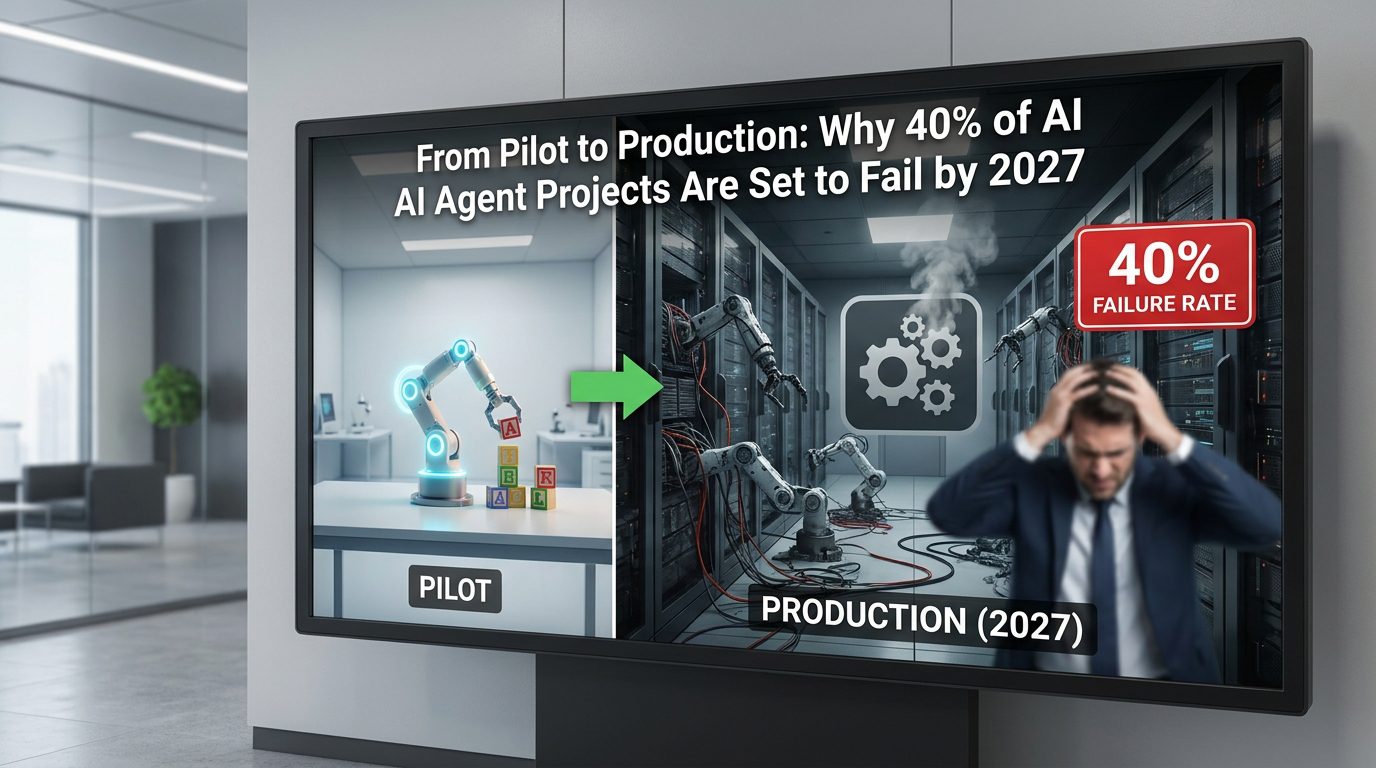
The prediction that 40% of AI agent projects may fail by 2027 does not reflect a flaw in AI itself. Instead, it highlights the growing gap between ambition and execution. Many organizations assume that success in a pilot phase guarantees scalability. In reality, moving to production requires a completely different level of planning, infrastructure, and strategic clarity.
Why Failure Risks Are Rising
As AI adoption accelerates, companies are rushing to implement solutions without fully understanding long-term requirements. This urgency often results in fragile systems that cannot scale effectively. At the same time, weaknesses in data management, governance, and system integration are becoming more visible, increasing the likelihood of failure.
The Gap Between Pilot and Production
The Comfort of Pilot Environments
Pilot phases operate in controlled conditions where data is clean, variables are limited, and the focus is on proving feasibility. Under these circumstances, AI systems tend to perform well, building confidence among stakeholders. However, this success is often artificial, shaped by an environment that does not reflect real-world challenges.
The Reality of Production
Production environments are unpredictable and demanding. Systems must handle large-scale data, integrate with existing infrastructure, and operate reliably under pressure. Issues such as latency, inconsistency, and system failures become more apparent. Without proper preparation, the transition exposes weaknesses that were hidden during the pilot phase.
Why AI Agent Projects Fail
Unclear Use Cases
A major reason for failure is the absence of a clearly defined objective. Many organizations adopt AI because it is trending rather than because it addresses a specific problem. This leads to solutions that lack direction and fail to deliver meaningful value.
Weak Data Foundations
AI systems rely heavily on data quality. Incomplete, inconsistent, or biased data leads to unreliable outputs. As projects scale, these issues become more pronounced, affecting performance and trust.
Integration Barriers
Integrating AI with existing systems is often more complex than expected. Legacy infrastructure may not support modern AI frameworks, creating compatibility challenges that delay progress and increase costs.
Governance Limitations
Without strong governance, AI projects face risks related to compliance, security, and accountability. Clear policies and oversight are essential to ensure responsible and effective deployment.
Organizational and Technical Barriers
Talent Shortages
AI requires specialized expertise, and many organizations lack the necessary skills. This gap leads to poor implementation and limits the potential of AI initiatives.
Misaligned Expectations
Leadership often expects rapid results, placing pressure on teams to deliver without adequate resources. This misalignment can lead to rushed decisions and compromised outcomes.
Scalability and Security Challenges
Scaling AI systems requires careful planning and robust infrastructure. At the same time, handling sensitive data demands strong security and compliance measures. Neglecting these areas increases the risk of failure.
Scaling AI the Right Way
Think Beyond the Pilot
Successful AI initiatives are designed with production in mind from the start. This means focusing on scalability, reliability, and integration early in the process.
Keep Humans Involved
AI should not operate in isolation. Human oversight ensures better decision-making, reduces risks, and allows for continuous improvement.
Final Perspective
AI success is not determined by technology alone—it is driven by strategy, discipline, and execution. The transition from pilot to production is where most projects falter, not because AI lacks potential, but because organizations underestimate the complexity of scaling it. Those who approach AI with clarity, preparation, and long-term thinking will not only avoid failure but turn it into a competitive advantage.