
Understanding the Cybersecurity Reality for SMEs
Let’s be real—hackers don’t care how big your company is. In fact, small and medium businesses are often their favorite targets. Why? Because they’re easier to break into. Limited budgets, smaller IT teams, and less strict security setups make SMEs low-hanging fruit.
Think of your business like a shop. If your front door (your website or app) is weak, that’s where attackers will try first. And today, most businesses rely heavily on web apps—login portals, dashboards, payment systems—so that’s exactly where the risk lives.
This is where penetration testing comes in. It’s like hiring someone to break into your system (ethically) before a real hacker does. But the big question is: should you go for WAPT or traditional penetration testing?
What Is WAPT (Web Application Penetration Testing)?
WAPT focuses only on your web applications—your website, APIs, and anything customers interact with online. It’s like putting all your attention on the front door of your business.
Security experts test things like:
- Login systems
- Forms and inputs
- User sessions
- API security
They try to find real ways attackers could break in, not just theoretical issues.
Why SMEs Like WAPT
WAPT is simple, focused, and cost-effective. It targets the most exposed part of your business, which often gives the biggest security impact for the least cost.
If your business runs online (which most do), this is where you’ll get quick wins.
What Is Traditional Penetration Testing?
Traditional penetration testing takes a wider view. Instead of just the “front door,” it checks the whole building—networks, servers, systems, and even internal access.
It simulates a full attack, showing how a hacker could move through your systems if they got in.
Why It Still Matters
This approach is great if your setup is complex. It helps uncover deeper issues that WAPT might miss, especially inside your network.
But yes—it’s usually more expensive and takes more time.
WAPT vs. Traditional Testing: The Key Differences
| Factor | WAPT | Traditional Pen Testing |
|---|---|---|
| Focus | Web apps only | Entire IT system |
| Cost | Lower | Higher |
| Speed | Faster | Slower |
| Frequency | Can be frequent | Usually periodic |
| Depth | Deep in apps | Broad across systems |
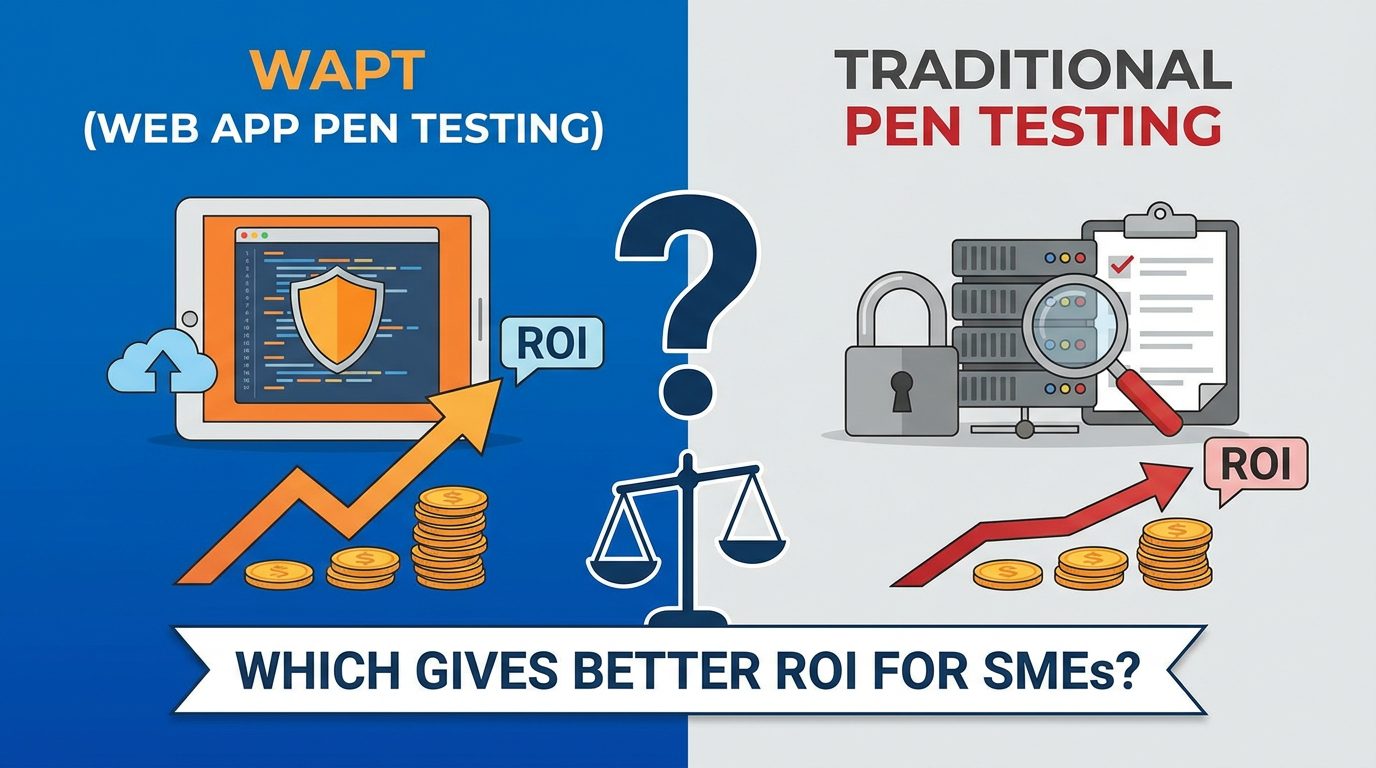
In short, WAPT goes deep in one area, while traditional testing goes wide across everything.
Which One Gives Better ROI?
Let’s talk about what really matters—return on investment.
For SMEs, ROI isn’t just about saving money. It’s about avoiding disasters. A single breach can cost way more than any testing service.
WAPT ROI
- Lower cost
- Faster results
- Focus on high-risk areas
- Ideal for web-based businesses
Traditional Testing ROI
- Full visibility
- Strong for complex setups
- Better for compliance-heavy industries
If your business lives online, WAPT usually gives better short-term ROI. You fix the most critical risks quickly without overspending.
The Smart Move: A Hybrid Approach
Here’s the truth—you don’t always have to choose one.
Smart SMEs combine both:
- Use WAPT regularly (monthly or after updates)
- Use traditional testing occasionally (once or twice a year)
This way, you stay secure day-to-day while also getting a full security check when needed.
Final Verdict
If you’re an SME with limited budget and a strong online presence, WAPT gives you better ROI right away. It’s focused, affordable, and practical.
But if your systems are more complex, don’t ignore traditional testing. The best strategy is usually a mix of both.
Conclusion
Cybersecurity isn’t about spending the most money—it’s about spending smart. WAPT helps you protect what matters most right now, while traditional penetration testing gives you a bigger picture over time.
If you think of your business like a house, WAPT locks your front door tight, while traditional testing checks every window, wall, and hidden corner. The real win comes when you do both—just at the right time.