
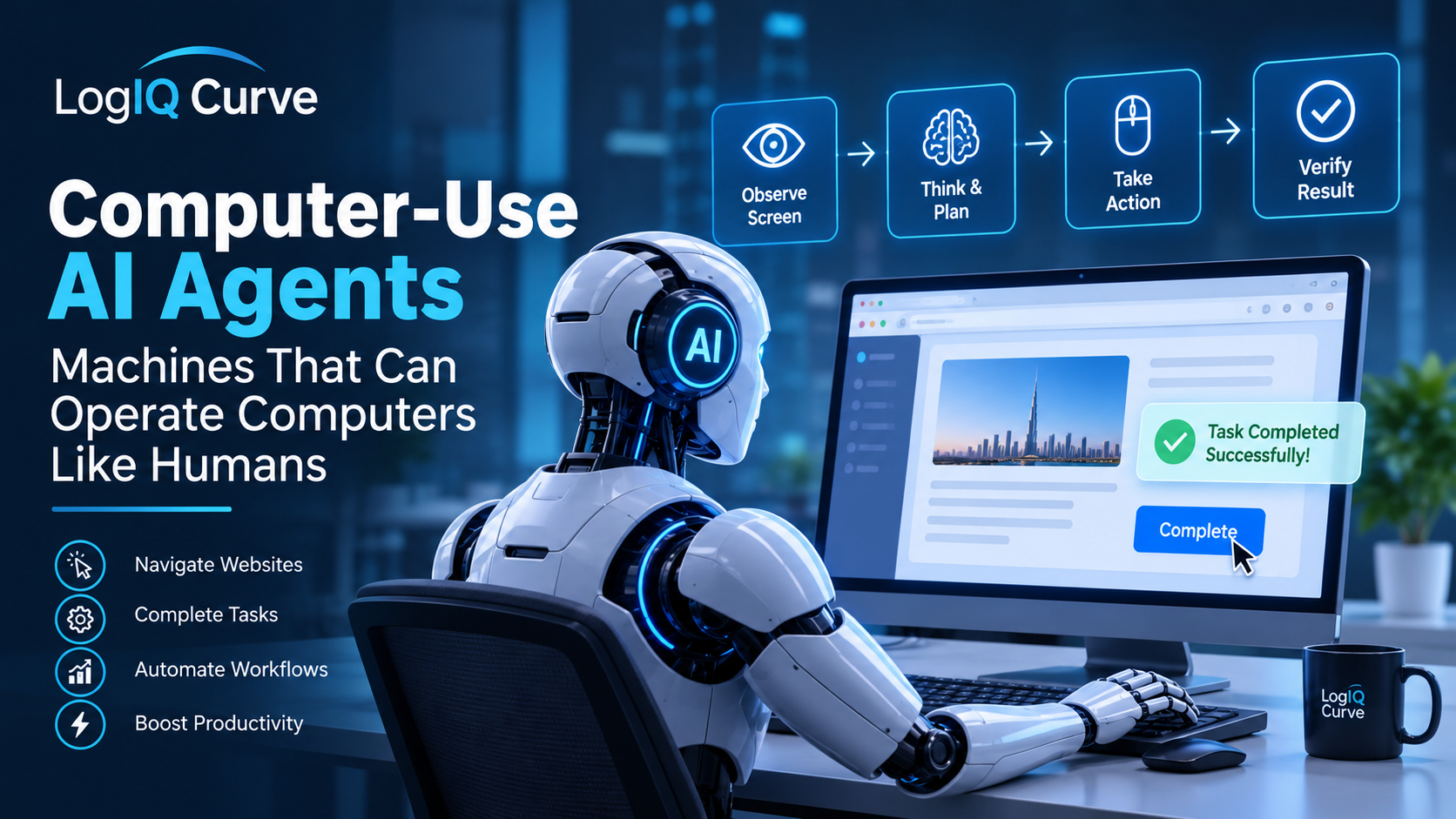
Artificial intelligence is moving beyond answering questions, generating content, and writing code. The next major evolution is Computer-Use AI Agents, intelligent systems capable of operating computers, navigating websites, interacting with applications, and completing digital tasks just like humans.
Instead of simply telling users what to do, these AI agents can actually perform tasks on their behalf. From managing business operations to handling repetitive administrative work, computer-use AI is opening a new chapter in workplace automation.
What Are Computer-Use AI Agents?
Computer-use AI agents are AI-powered systems designed to interact directly with graphical user interfaces (GUIs). They can observe a computer screen, understand what is displayed, and take actions using a mouse, keyboard, and other interface controls.
For example, a traditional AI chatbot might explain how to create an account on a website. A computer-use AI agent can open the website, navigate the registration process, complete the required fields, and submit the form with appropriate authorization.
These agents combine large language models (LLMs), computer vision, reasoning capabilities, and automated interaction technologies to understand and execute multi-step instructions.
How Do Computer-Use AI Agents Work?
Computer-use AI agents typically follow a continuous cycle of observation, reasoning, action, and verification.
Here is how the process works:
- Screen Observation: The agent captures and interprets the computer screen to understand the current interface.
- Decision Making: Its AI model analyzes the available information and determines the next appropriate action.
- Computer Interaction: It uses mouse clicks, keyboard inputs, scrolling, and other controls to interact with applications.
- Task Verification: The agent checks whether the action was successful and adjusts its approach if something goes wrong.
This process allows AI agents to handle complex workflows without requiring users to manually perform every step.
Real-World Applications of Computer-Use AI
Computer-use AI agents have the potential to transform almost every industry that depends on digital workflows.
Some important applications include:
- Business Operations: Automating data entry, invoice processing, reporting, and administrative tasks.
- Digital Marketing: Managing advertising dashboards, analyzing campaign performance, and organizing marketing activities.
- Customer Support: Navigating CRM platforms, updating customer records, and processing support requests.
- Software Development: Interacting with development environments, testing applications, and assisting with debugging workflows.
- E-commerce: Managing product listings, processing orders, and updating inventory information.
- Research and Data Analysis: Collecting information from multiple websites and organizing findings into structured reports.
These capabilities can help businesses reduce repetitive manual work while allowing employees to focus on strategic and creative responsibilities.
Challenges and Security Considerations
Despite their potential, computer-use AI agents still face several challenges.
AI models can misunderstand interfaces, click incorrect elements, or struggle with unexpected pop-ups and changing website layouts. Complex workflows may also require human supervision.
Security is another major concern. Giving an AI agent access to business applications, financial platforms, or confidential information introduces potential risks.
Organizations must implement appropriate permissions, activity monitoring, authentication controls, and human approval mechanisms for sensitive operations.
The goal should not simply be to automate everything, but to build reliable and secure systems that operate within clearly defined boundaries.
The Future of Computer-Use AI Agents
Computer-use AI represents a significant shift in how humans interact with technology.
In the coming years, businesses may move from managing dozens of separate applications manually to delegating complete workflows to intelligent AI agents.
Imagine instructing an AI agent to research potential customers, update your CRM, prepare marketing reports, and organize follow-up activities. Instead of performing each action individually, you simply provide the objective and let the agent execute the workflow.
Companies investing in AI-powered automation today could gain a significant competitive advantage as these technologies mature.
At LogIQ Curve, we believe computer-use AI agents are an important step toward the future of intelligent business automation. By combining AI engineering, software development, and workflow automation, businesses can move beyond traditional automation and build smarter digital operations.
The future of AI is not just about machines that can think or answer questions. It is about machines that can take action, execute tasks, and get real work done.