
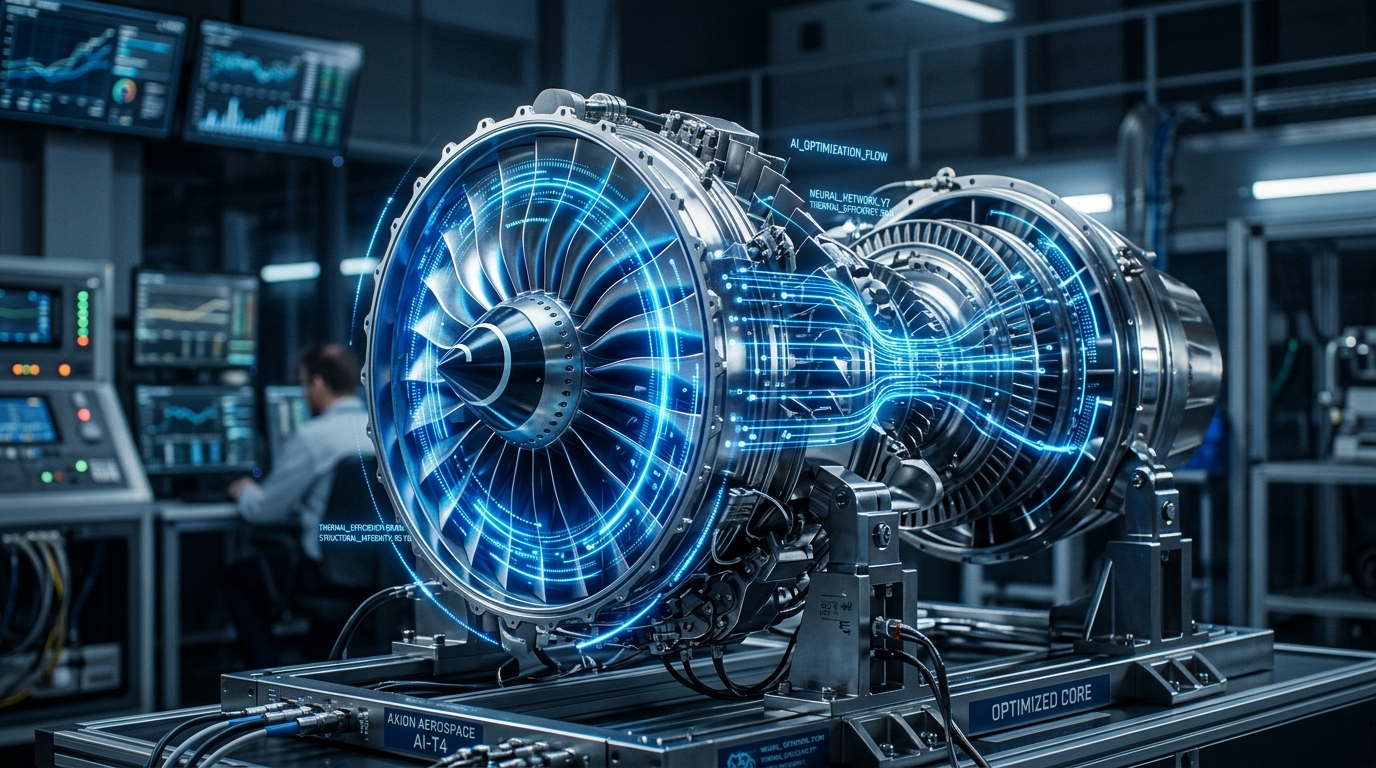
The aerospace industry has always pushed the boundaries of engineering. Designing components for jet engines requires exceptional precision, because even small improvements in weight, strength, airflow, or thermal performance can have a significant impact on an aircraft’s efficiency and reliability. Today, artificial intelligence is beginning to transform this process by exploring design possibilities that human engineers may never consider.
One of the most exciting developments is the use of AI and generative design to create jet engine components. Instead of starting with a conventional design and making gradual improvements, AI systems can be given a set of engineering requirements and allowed to explore thousands or even millions of possible solutions. The result can be highly complex structures optimized for specific performance goals.
In some specialized design challenges, AI-generated components have demonstrated performance advantages over traditional human-designed solutions. These advantages can include reduced weight, improved strength-to-weight ratios, better thermal performance, and more efficient use of materials.
The reason AI can be so effective is its ability to evaluate enormous numbers of possibilities in a relatively short period of time. A human engineer may develop a limited number of concepts based on experience, established principles, and practical constraints. AI, however, can analyze a much larger design space and identify patterns that may not be immediately obvious to humans.
This does not mean that human engineers are becoming unnecessary.
Jet engine design is an extremely complex discipline involving aerodynamics, thermodynamics, materials science, manufacturing, safety, and strict regulatory requirements. An AI-generated design still needs to be evaluated, tested, manufactured, and validated by experts. Human judgment remains essential when determining whether a theoretically optimized component can actually be produced reliably and safely.
The real opportunity lies in combining the strengths of both.
AI can handle massive amounts of data, perform repetitive simulations, and rapidly explore unconventional designs. Engineers can provide creativity, domain knowledge, practical judgment, and an understanding of real-world manufacturing and operational challenges.
This partnership could significantly reduce the time required to move from an initial concept to a functional component. Instead of spending months evaluating a small number of design alternatives, engineering teams could use AI to identify the most promising solutions and focus their expertise on testing and refining them.
There is also a broader lesson here. AI is changing the definition of what is possible in engineering. Some AI-generated designs may look unusual or even counterintuitive because they are optimized according to mathematical and physical requirements rather than traditional human design conventions.
The future of aerospace engineering may therefore not be about AI replacing engineers. It may be about engineers working with AI to explore possibilities that were previously too complex, expensive, or time-consuming to investigate.
AI may not replace human engineering expertise, but it can dramatically expand what engineers are capable of designing.
As AI continues to improve, the question is no longer simply whether machines can design better components. The more important question is how humans and AI can work together to build the next generation of aircraft, engines, and aerospace technologies.