
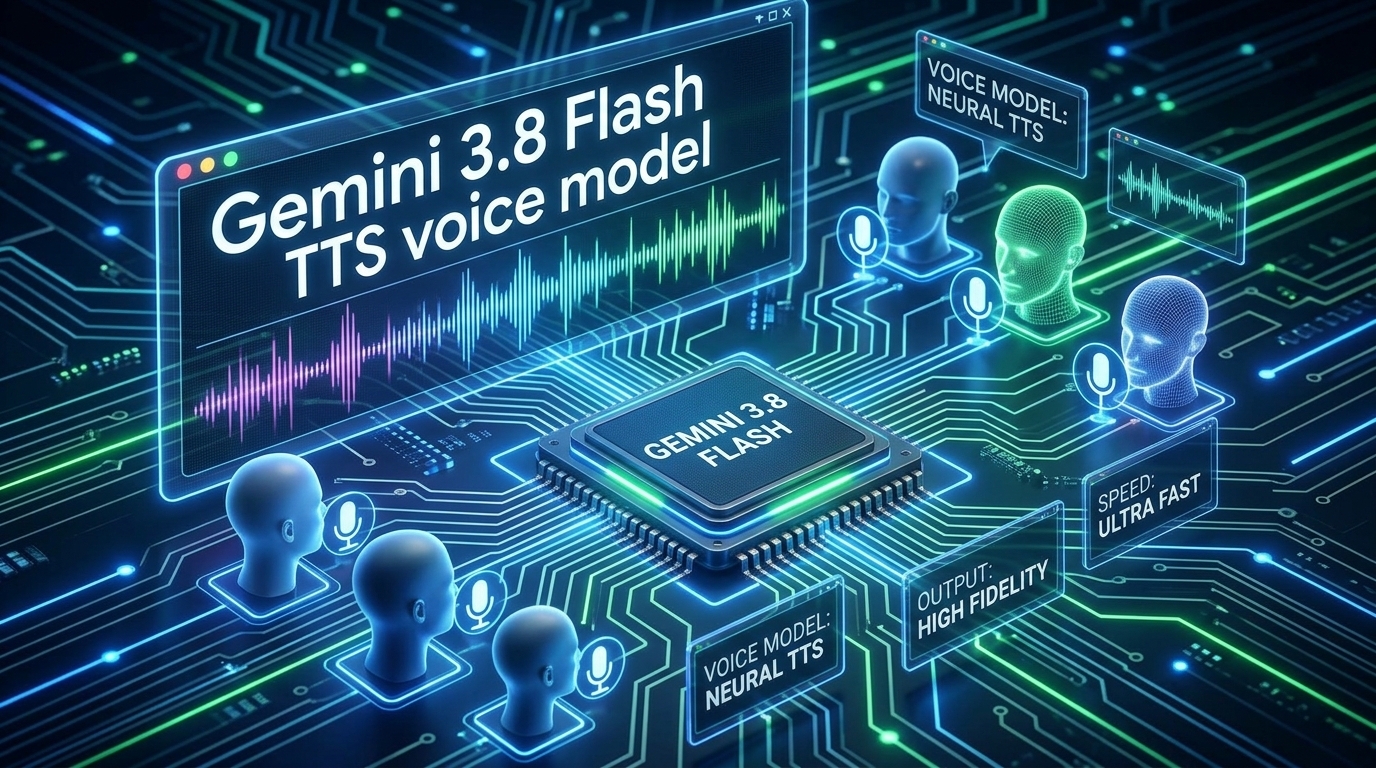
Google has expanded its Gemini AI ecosystem with the launch of Gemini 3.8 Flash TTS and Gemini 3.8 Flash-Lite TTS, two new text-to-speech models designed to make AI-generated voices more expressive, customizable and scalable. Announced in September 2026, the models move beyond traditional text-to-speech systems by giving developers and creators greater control over how an AI voice sounds and performs.
From Text-to-Speech to Voice Creation
Traditional text-to-speech technology generally converts written text into speech using a predefined collection of voices. Gemini 3.8 Flash TTS takes a more flexible approach, allowing users to create custom vocal personas from natural-language descriptions.
Developers can specify characteristics such as accent, role, personality and vocal style. Google says the flagship model supports 130 languages, while Flash-Lite supports 101 languages, providing broad opportunities for multilingual content creation and localization.
Google also says its extended voice ecosystem includes more than 2,000 production-ready voices, giving creators a wide range of options for different applications and audiences.
More Control Over How AI Voices Perform
One of the major features of Gemini 3.8 Flash TTS is its ability to follow detailed performance instructions. Instead of simply reading a script, the model can respond to directions concerning emotion, pacing, accents, pauses and conversational behavior.
Creators can also add vocal events such as laughter, sighs, breaths and short pauses. The technology supports two-speaker dialogue, allowing a single script to produce conversations with distinct voices and natural turn-taking.
This could make AI-generated audio more useful for audiobooks, podcasts, games, educational content, advertising and interactive storytelling, where delivery and emotion can be just as important as the words themselves.
Two Models for Different Workloads
Google is positioning the two models for different production needs.
Gemini 3.8 Flash TTS is the flagship creative model, focusing on high voice fidelity, expressive acting, regional accents, difficult pronunciations and long-form audio stability. It is designed for applications where quality and detailed creative control are priorities.
Gemini 3.8 Flash-Lite TTS, meanwhile, is optimized for speed, efficiency and high-volume production. Google describes it as a workhorse for bulk audio generation, read-aloud applications and voice-agent workflows.
Both models use the same API schema and prompting structure, making it easier for developers to switch between them depending on the requirements of a project.
Voice Replication With Safety Measures
Another significant capability is voice replication. Google says users can recreate a vocal profile from a short audio sample when they have the necessary rights to use that voice.
The company has added safeguards around this capability, including consent verification. Google also says generated audio is protected with SynthID watermarking, while voice-related systems can use C2PA credentials to improve transparency around AI-generated content.
These measures are particularly important as increasingly realistic synthetic voices create new opportunities while also raising concerns around impersonation, identity and misinformation.
Applications Across Industries
The new models could have a broad impact on digital media and software development.
Content creators can use them to produce narrated videos, podcasts and audiobooks. Game developers can create distinct character voices and interactive dialogue. Businesses can develop multilingual voice agents, while media companies can use expressive speech generation for dubbing and localization.
Google has also highlighted integrations and partnerships involving companies such as Figma, HeyGen, Wondercraft and Ollang, demonstrating potential applications in creative production, localization and conversational interfaces.
A New Direction for AI Audio
Gemini 3.8 Flash TTS reflects a broader shift in generative AI: speech generation is increasingly becoming a form of creative direction rather than simple text conversion.
By combining custom voice creation, detailed performance control, multilingual support, long-form consistency and voice replication, Google is positioning Gemini TTS as a platform for building complete audio experiences.
The models are rolling out through the Gemini API and Google AI Studio, with Gemini 3.8 Flash TTS also available in Gemini Notebook and Flash-Lite available in Google Vids. Enterprise availability is planned through Gemini Enterprise.
As AI-generated voices become more natural and controllable, the competition in synthetic audio is likely to shift from simply producing speech to creating voices that can communicate personality, emotion, context and character at scale.