
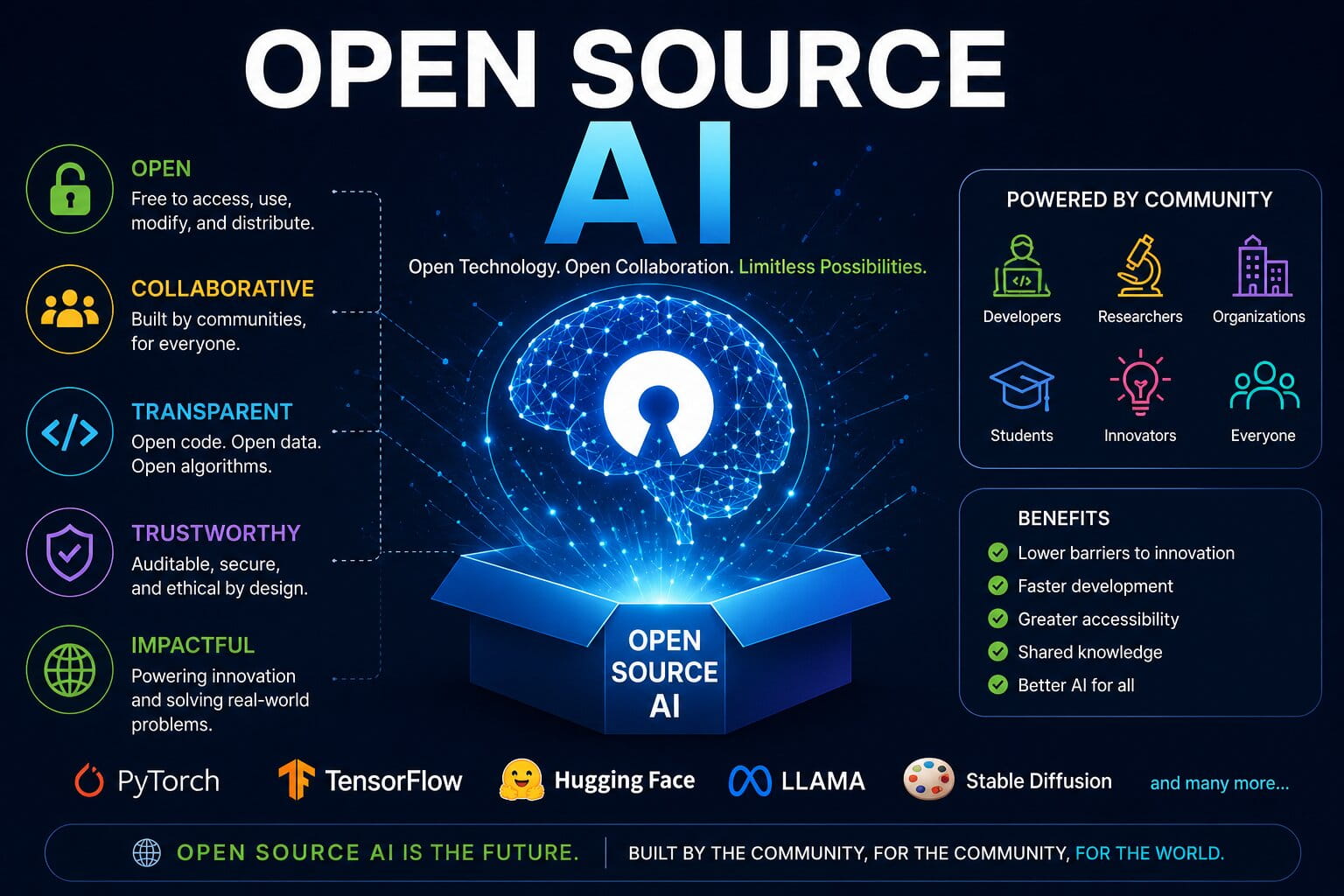
Artificial intelligence was once dominated by a small number of technology companies with enormous computing resources, proprietary models, and closed ecosystems. Today, that balance is changing rapidly.
The rise of open-source and open-weight AI models has transformed the global AI landscape by making advanced capabilities more accessible to developers, startups, researchers, governments, and businesses around the world.
In 2026, the open-model ecosystem is no longer simply an alternative to proprietary AI—it has become one of the major forces shaping the future of the industry.
From Closed AI to Open Innovation
Traditional AI development required enormous investments in infrastructure, specialized hardware, data, and research teams. Companies wanting powerful AI often had little choice but to depend on commercial APIs and closed platforms.
Open models have disrupted this structure.
Models released with accessible weights can be downloaded, fine-tuned, customized, and deployed on private infrastructure, giving organizations greater control over how AI is used.
This is particularly important for companies handling sensitive information. Instead of sending every request to an external AI provider, organizations can increasingly deploy models within their own environments.
The Rise of Global Competition
One of the biggest disruptions has been the emergence of powerful open models from outside the traditional U.S. technology giants.
Alibaba’s Qwen ecosystem, for example, has become a major foundation for developers. According to Hugging Face’s 2026 analysis, Qwen-based models accounted for more than 151,000 derivatives on the platform, demonstrating how quickly developers are building on top of open model families.
Chinese AI companies have also pushed the frontier aggressively, with several organizations releasing very large open models during 2026. This has challenged the assumption that the most capable AI systems must come exclusively from a handful of Western technology companies.
The result is a much more competitive global AI ecosystem.
Lower Costs and Greater Accessibility
Open AI models are also putting pressure on the economics of artificial intelligence.
Businesses can take an existing model, fine-tune it for a specific industry, optimize it for their hardware, and deploy it without building an entire foundation model from scratch.
This creates opportunities for:
- Startups with smaller AI budgets
- Universities and independent researchers
- Developers building specialized applications
- Governments pursuing sovereign AI capabilities
- Enterprises that want greater control over their data
- Emerging markets that cannot afford massive proprietary AI infrastructure
The impact is significant: AI innovation is becoming less dependent on access to a handful of centralized platforms.
A New Developer Ecosystem
Open-source AI is not only about releasing model weights.
A broader ecosystem has developed around models, datasets, inference tools, fine-tuning frameworks, quantization, evaluation systems, and AI applications.
Hugging Face reported that public model repositories increased from 2.43 million to 2.96 million between January and August 2026, while datasets grew from approximately 711,000 to 1 million.
This creates a powerful feedback loop:
Open model → Developers → Fine-tuning → New applications → New models → More developers
Innovation can therefore happen across thousands of organizations simultaneously rather than inside a single laboratory.
Open Source vs. Open Weight
However, there is an important distinction.
Not every model described as “open source” is genuinely open source.
Some companies release model weights while keeping training data, training code, or other components private. That makes these systems better described as open-weight models rather than fully open-source AI.
This distinction matters because true openness can provide greater transparency, reproducibility, and community participation.
The future of open AI will therefore depend not only on how many models are released, but how much of the technology is actually accessible and modifiable.
The Geopolitical Impact
Open AI is also changing the geopolitical balance.
Countries and organizations increasingly want AI sovereignty—the ability to develop and operate AI systems without becoming completely dependent on foreign technology companies or cloud providers.
The growth of open models makes this more achievable.
A country can potentially build local AI infrastructure, adapt open models to its own language and industries, and maintain greater control over sensitive data.
This makes open AI more than a technical movement. It is becoming an important part of the global technology and economic competition.
What Comes Next?
The open-source AI revolution is still developing.
The biggest challenge will be finding the right balance between openness, security, responsible development, and commercial sustainability.
There are also growing concerns around model misuse, cybersecurity, licensing, data transparency, and the concentration of influence around major AI platforms.
The Nvidia acquisition of Hugging Face for approximately $12.9 billion in September 2026 illustrates just how strategically important the open AI ecosystem has become. Nvidia says Hugging Face will remain open and interoperable, but the deal also raises questions about whether increasingly powerful open ecosystems can remain truly neutral as they become strategically valuable.
Conclusion
The disruption caused by open-source AI is bigger than simply making AI models freely available.
It is changing who can build AI, who controls AI, how much AI costs, and where AI innovation happens.
The next generation of AI may not be controlled entirely by a few technology giants. Instead, it could emerge from a global network of developers, researchers, startups, universities, and companies building on one another’s work.